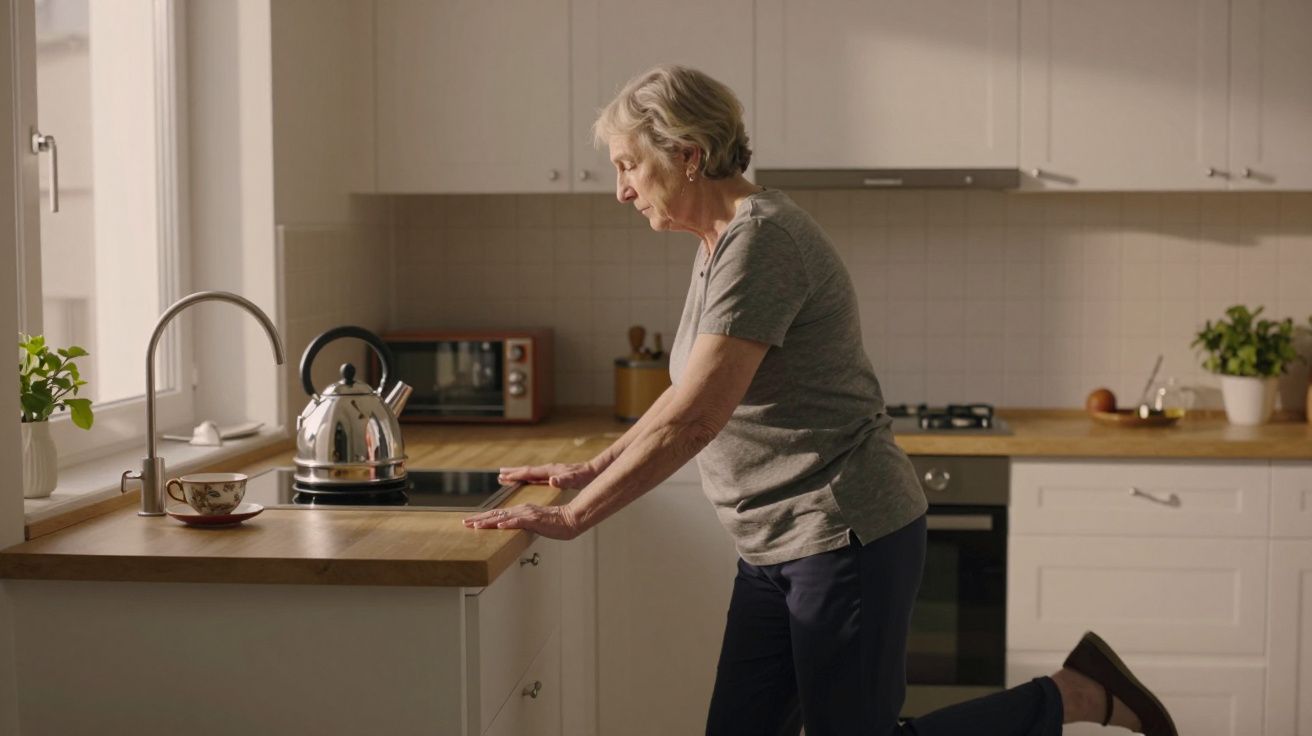
Most people over 65 remember the first time a small stumble did not feel entirely harmless. It might be a trip on the rug, a sideways lurch getting out of the chair, or that heart‑in‑mouth moment when you catch yourself on the kitchen worktop and then pretend nothing happened. The fear creeps in quietly: “If I go down, will I get back up? Will I be able to stay at home?”
In physiotherapy clinics, those questions come every week. Behind the medical terms, the reality is simple: confidence shrinks first, then activity, then strength. But there is also a quietly powerful truth that physiotherapists repeat to anyone who will listen: well‑chosen balance exercises, done consistently, can cut your risk of falling in a way pills cannot. One of the easiest starts right where most slips happen – at the kitchen worktop.
The one exercise physiotherapists wish everyone over 65 would do
Physiotherapists have many tools, but when asked for “one thing to do daily at home”, a version of the same drill keeps coming up. It is a supported balance exercise that uses the worktop, takes less than five minutes, and can be adapted whether you are fairly steady or very nervous.
They often call it supported tandem stance with weight shift. You might call it the “worktop balance hold”.
You stand facing the kitchen counter, hold it lightly, place one foot in front of the other as if on a tightrope, and gently move your weight from side to side. It looks almost too simple. Yet this modest move quietly retrains the systems that keep you upright: feet, ankles, hips, eyes and inner ear all talking to each other again.
Research on balance‑training programmes shows falls can be reduced by around a quarter when people practise regularly. This single drill is not a magic shield, but as physiotherapists like to say, it is a very practical hinge: a small daily habit that nudges the odds back in your favour.
“You do not need a gym or fancy kit,” says Rachel M., a London physiotherapist specialising in older adults. “A firm worktop, flat shoes and three minutes of focus can start rewiring your balance more than most people realise.”
How to set up safely at the worktop
Before you move your feet at all, the safety set‑up matters. A good rule: if it feels rushed or fiddly, reset and start over.
- Choose the right worktop. It should be solid, fixed and about waist height – a kitchen counter is ideal. Avoid anything on wheels or that can slide, such as a table or chair back.
- Clear the area. Move mats, spills, pets and bags. You want flat, dry flooring and enough space to step sideways if needed.
- Wear sensible shoes. Flat, closed‑heel shoes with non‑slip soles are best. Bare feet can work on non‑slip flooring; avoid socks on smooth surfaces.
- Have a ‘spotter’ at first if you are unsure. A partner, friend or relative can stand nearby for the first few sessions, especially if you have fallen recently.
- Keep any mobility aids within reach. If you normally use a stick or frame, park it close by so you can grab it easily once you finish.
Only when you feel reasonably secure should you move to the actual drill.
Step‑by‑step: the supported tandem stance
Think of this as three levels of the same exercise. Most people start at Level 1 and move up gradually over weeks.
Level 1 – Feet apart (finding your base)
- Stand facing the worktop, about a forearm’s length away.
- Place both hands flat on the surface, shoulder‑width apart.
- Put your feet hip‑width apart, toes pointing forwards.
- Gently lean your weight a little towards your toes, then back towards your heels, without lifting your feet.
- Repeat this forward‑back weight shift 10 times, breathing steadily.
When that feels easy, add side‑to‑side movement:
- Still holding on, slowly let more weight go into your right leg, then into your left, as if you are swaying in slow motion.
- Repeat 10 times each side.
This level wakes up your ankles and hips and reminds your brain that your feet are the base of the operation.
Level 2 – One foot slightly in front (narrowing the base)
- Keep your hands on the worktop.
- Step your right foot half a shoe‑length in front of your left (not yet heel‑to‑toe). Both feet remain flat.
- Hold this stance for up to 10 seconds, looking straight ahead, not at your feet.
- Gently sway your weight side to side five times, staying in control.
- Step back to feet‑apart position, rest, then swap legs.
Aim for 2–3 holds on each side. You are teaching your balance system to cope with a narrower support, similar to walking in a crowded shop or on a narrow path.
Level 3 – Heel‑to‑toe (the ‘tightrope’ version)
Only try this once Level 2 feels steady and you are not gripping the worktop for dear life.
- Stand side‑on to the worktop so that one hand can slide along it.
- Place one foot directly in front of the other, heel touching the toes of the back foot – like standing on a painted line.
- Lightly rest one or two fingers on the worktop; imagine you are borrowing balance, not hanging on to it.
- Hold for up to 10 seconds, breathing normally.
- If that feels secure, add a tiny weight shift forwards and backwards, as if you were about to take a step but then changed your mind.
- Step out, shake your legs, and swap which foot is in front.
Start with just 1–2 attempts each side. Over time, the goal is to need less hand support and hold the stance for longer, never losing the feeling of control.
A simple progression plan
- Week 1–2: Level 1 most days, plus a taste of Level 2.
- Week 3–4: Mainly Level 2, with short holds of Level 3 if safe.
- Beyond: Level 3 as your main drill, returning to easier levels on “wobbly” days or when tired.
The mantra physiotherapists use is clear: challenging but safe. If you feel panicky or your feet start shuffling wildly, you have gone a step too far – go back a level.
Why this exercise works so well after 65
Balance is not one thing; it is several systems working together. After 65, some of those systems naturally dull unless they are used on purpose. The worktop drill targets them all at once.
- Feet and ankles: tiny muscles and joint sensors learn to react again to small sways instead of letting you topple.
- Hips and core: as your stance narrows, your trunk has to work to keep you aligned over your feet.
- Vision and inner ear: focusing on a still point while your body moves trains your brain to resolve mixed signals better.
- Confidence: perhaps the most important. Knowing you can regain control during a wobble makes you less likely to freeze or grab at unsafe objects in real life.
Physiotherapists like this exercise because it fits into real life. You can do it:
- while waiting for the kettle to boil,
- between stirring pans,
- or during a phone call, with the speaker on the side.
It does not demand special clothing, a mat on the floor or a trip anywhere. The fewer obstacles between you and practice, the more likely it is to happen.
Turn it into a tiny daily ritual
Balance improves with little and often, not with huge heroic sessions every few weeks. A sustainable target for most people is:
- Frequency: 5 days per week.
- Duration: 3–5 minutes each time.
- Timing: pair it with something you already do in the kitchen.
For example:
- after you switch on the kettle in the morning,
- while dinner is in the oven,
- or every time you wait for the microwave.
You can also layer it with other simple moves once you are comfortable:
- Heel raises: holding the worktop, lift both heels off the ground, pause, and lower slowly, 8–10 times.
- Mini knee bends: small, comfortable bends of both knees, as if starting to sit down, then returning to stand.
A short balance ritual, plus regular walking and some strength exercises for legs and hips, forms a powerful trio against falls.
“We see the biggest change when people make balance work as routine as brushing their teeth,” says Rachel M. “It stops being therapy and becomes hygiene for your nervous system.”
Who should modify or avoid this drill?
Most people over 65 can do some version of the worktop balance exercise safely, but there are exceptions. Take extra care, and speak to your GP or physiotherapist first, if you:
- have had blackouts or unexplained fainting,
- experience spinning vertigo, especially when turning your head,
- have severe osteoporosis with recent spinal or hip fractures,
- are recovering from major surgery,
- or already need hands‑on support from another person to stand.
If you have diabetes with reduced feeling in your feet, a history of stroke, Parkinson’s or other neurological conditions, you may still benefit greatly – but guided progression from a professional is strongly advised.
Warning signs to stop immediately
- Sudden chest pain or pressure.
- New or severe shortness of breath.
- Sharp pain in the hip, back or leg.
- Vision going dark or “curtain‑like”.
- Feeling as if you are about to faint.
Sit down somewhere safe and seek medical help if any of these appear.
A quick guide to choosing your starting level
| Starting point | Best level to begin | Typical next step |
|---|---|---|
| I walk independently and rarely feel unsteady | Level 2, short holds | Progress to Level 3 within a few weeks |
| I use a stick or feel wobbly in crowds | Level 1, side‑to‑side shifts | Add short Level 2 holds when confident |
| I have fallen in the last year | Level 1 only, with someone nearby | Ask a physiotherapist before going to Level 2 |
The aim is not to “race” to Level 3. The aim is to make your level feel gradually easier and more natural.
What this small kitchen habit says about ageing well
Falls are often framed as bad luck, but physiotherapists see them differently. They see patterns: slightly weaker legs, slightly slower reactions, slightly less practice standing on a narrow base – built up quietly over years. The good news is that the same principle works in reverse. Small, repeated challenges nudge your body to adapt at any age.
The worktop balance drill is not glamorous. No one will applaud you for doing it while the kettle hums. Yet it signals something important: you are choosing to train the part of you that catches yourself when life nudges unexpectedly.
Ageing well is rarely about grand gestures. It is about tiny acts of maintenance – three minutes here, five minutes there – that keep you steady enough to enjoy the life you have built.
FAQ:
- How long before I notice a difference in my balance? Many people feel slightly more secure within 2–4 weeks if they practise most days. Clearer improvements in confidence and steadiness often appear after 8–12 weeks.
- Can I just do this and skip other exercises? It is a strong start, but it works best alongside leg‑strength exercises (like sit‑to‑stand from a chair) and regular walking. Think of balance, strength and stamina as three legs of the same stool.
- Is it normal to wobble during the exercise? A gentle, controlled wobble is expected and even helpful. Wild, jerky movements, gripping the worktop hard, or feeling frightened mean you should step back to an easier level.
- Should I look down at my feet? Glancing down briefly to place your feet is fine, but for the holds and weight shifts, look at a steady point ahead. Your balance system relies heavily on what your eyes are doing.
- What if I already use a frame or two sticks? You can usually still do a simple version of Level 1, with someone beside you. However, it is safer to ask a physiotherapist to show you how and to check the exercise fits your current ability.



Comments (0)
No comments yet. Be the first to comment!
Leave a Comment