You do not start with a gym. You start with a chair.
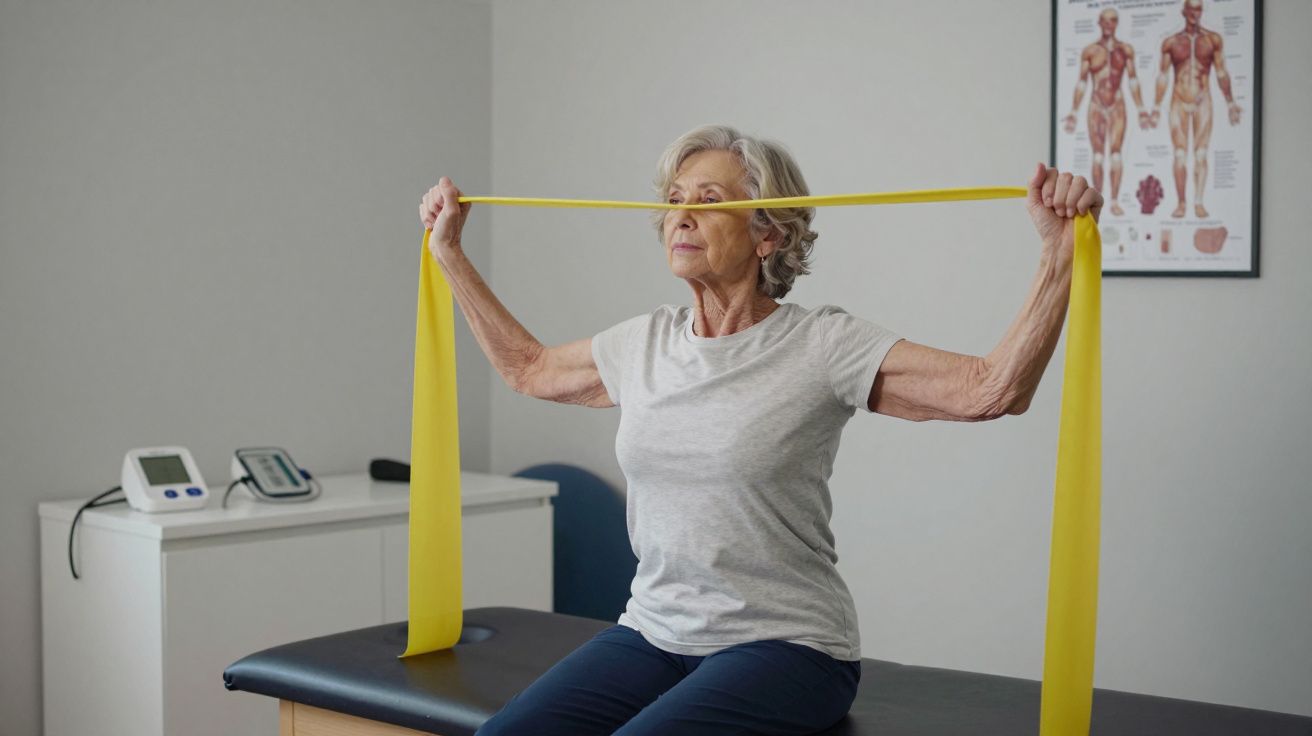
On a Tuesday morning in a quiet outpatient clinic in Leeds, 78‑year‑old Margaret sits on the edge of a physiotherapy plinth, a yellow loop of rubber in her hands. Two years ago she tried to copy her grandson’s weight‑room routine and came away with a swollen knee, three sleepless nights and a lingering fear of “proper exercise”. Today her consultant geriatrician hands her the band and asks her to pull, gently.
Her shoulders draw back, her chest lifts, her spine lengthens almost without her noticing. No clanking plates, no pounding treadmill. Just a slow, deliberate movement that makes her work and keeps her joints calm.
Across the UK, geriatricians are quietly steering people in Margaret’s age bracket away from heavy barbells and hard jogging, and towards something that looks deceptively simple: resistance bands.
“Past 70, the game is not punishment, it’s preservation - muscle, balance and joints,” as one London‑based geriatrician puts it. “Bands hit that sweet spot.”
What changes after 70 – and why it matters for your joints
By your seventies, the rules of the body have shifted. Muscle fibres shrink, joint cartilage thins, and the small stabilising muscles around your hips, knees and shoulders are often weaker than you think. The result is a system that still needs load to stay strong, but has less tolerance for sudden impact or awkward twisting.
On top of that, many people accumulate what doctors politely call “co‑morbidities”: osteoarthritis here, a bit of heart disease there, maybe a replaced knee or a spinal stenosis diagnosis. None of these are automatic reasons to avoid exercise. They are reasons to choose the right kind.
Heavy weights and long runs ask your joints to act as shock absorbers over and over again. If your cartilage and ligaments are already under strain, each repetition can be the straw that eventually tips things into pain. Geriatricians see those straws walk into clinic every week.
The aim after 70 is not to escape load, but to dose it: enough to build, not enough to break.
Why geriatricians are wary of heavy weights and hard jogging
You will still find very fit 75‑year‑olds happily squatting in weight rooms and jogging in the park. They tend to be people who have done it for years, know their bodies well and have slowly built up to that level. The picture is different if you are starting (or re‑starting) in later life.
Geriatricians tend to flag three problems with “go hard or go home” approaches once you are into your eighth decade:
Joint compression and impact
Heavy external weights load knees, hips and spinal discs. Hard jogging adds repeated impact on ankles and knees, especially on concrete.Poor movement control under load
If your balance and coordination have faded, throwing big weights or fast running on top of that increases the risk of falls and sudden twists.Recovery time
Older muscles and tendons take longer to repair. What feels like a “good sore” in your forties can turn into a nagging tendon problem in your seventies.
None of this means strength or aerobic work are off the table. It means the tools need to match the body in front of you. This is where bands come in.
The case for resistance bands: gentle, but not “lightweight”
Resistance bands look unassuming: a strip or loop of elastic tucked in a drawer. They are, in effect, portable, joint‑friendly weights with a built‑in safety feature: the resistance rises as you stretch them, not as a sudden jolt at the start of a movement.
From a geriatrician’s point of view, they tick several boxes at once:
Low joint stress
No heavy compressive load through arthritic joints, and no impact. The force is spread smoothly through the range of motion.Control and feedback
You feel the band’s pull immediately. If something twinges, you simply ease the tension or switch to a lighter band.Access and adherence
They are cheap, light, and live happily in a handbag, glovebox or bedside drawer. That makes you more likely to actually use them.Functional carry‑over
Properly chosen band exercises copy real‑life tasks – standing up, lifting, reaching, stepping sideways. This is exactly what geriatric medicine wants you to protect: the movements of daily living.
“If I can get a patient doing bands three times a week, I am often buying them extra years of independent walking,” says one consultant from Manchester. “That is not an exaggeration.”
Five band moves geriatricians keep returning to
You do not need dozens of variations. You need a small set of reliable, repeatable moves that build strength where it matters most: legs, hips, back, shoulders and ankles. Here are five that crop up again and again in geriatric clinics and falls‑prevention classes.
1. Seated band row – waking up the upper back
This one counters the rounded shoulders and stooped posture that creep in with age.
- Sit tall on a firm chair, feet flat.
- Loop the band around your feet and hold an end in each hand.
- Start with your arms straight, band lightly taut.
- Pull your elbows back, keeping them close to your sides, as if you are trying to tuck your shoulder blades into your back pockets.
- Pause, then slowly release.
You should feel work between your shoulder blades, not strain in your neck. Think “gentle proud chest”, not “military parade”. If your back protests, shorten the range and build up.
2. Sit‑to‑stand with band – protecting knees and hips
Every time you get off the loo or out of a chair, you perform a squat. This exercises that movement directly.
- Place the band in a loop around your thighs, just above the knees.
- Sit on a dining‑chair height seat, feet hip‑width apart.
- Gently press your thighs outwards against the band – not to move your knees far, just to feel engagement in your hip muscles.
- Lean slightly forwards and stand up, keeping the gentle outward pressure.
- Sit back down slowly with control, without crashing.
The band encourages your glute muscles to fire, taking some strain off the front of the knees. If standing fully is tough, use your hands on the chair arms at first, then gradually do more of the work with your legs.
3. Standing hip abduction – side‑to‑side strength for balance
Falls rarely happen straight forwards like a textbook diagram. They happen when you slip sideways or turn. Strong side‑hip muscles help you catch yourself.
- Stand side‑on to a counter or sturdy chair, holding lightly for balance.
- Loop a band around both ankles.
- Stand tall, weight on the leg nearest the support.
- Slowly move the outer leg out to the side against the band, keeping toes pointing forwards.
- Bring it back with control. Repeat, then swap sides.
You should feel work in the outside of your hip, not in your lower back. Keep the movement small and deliberate, like a slow swing door.
4. Wall band press – shoulder and chest without push‑ups
Traditional press‑ups can stress wrists and shoulders. A wall press with a band offers strength work in a safer range.
- Stand facing a wall, band around your back at chest level, one end in each hand.
- Place your hands on the wall at shoulder height, slightly wider than shoulders. Step back a little so your body is on a mild diagonal.
- Bend your elbows and lean towards the wall, letting the band stretch.
- Push the wall away, straightening your arms against the band’s resistance.
You are effectively doing a standing push‑up. Adjust your distance from the wall to make it easier (closer) or harder (further).
5. Ankle dorsiflexion – saving your “foot clearance”
A surprisingly common cause of trips is poor ankle lift: the foot does not clear the ground and catches on a rug, step or kerb. This simple move targets that lift.
- Sit on a chair with one leg straight out in front, heel on the floor.
- Loop the band over the front of your foot and hold the ends in your hands, creating a gentle pull towards you.
- Pull your toes and forefoot up towards your shin against the band, keeping your heel down.
- Slowly allow the foot to point away again.
You should feel the front of your shin working. This is not glamorous muscle, but it is crucial for safe walking.
How to turn these into a 15‑minute routine
Geriatricians usually care less about perfection and more about consistency. Two or three modest sessions a week trump a heroic workout you do once and abandon.
A simple starter pattern might look like this:
Warm‑up (2–3 minutes)
March on the spot beside a chair, roll your shoulders, make gentle ankle circles.Main set (10–12 minutes)
- Seated row: 2 sets of 8–12 pulls
- Sit‑to‑stand with band: 2 sets of 6–10 stands
- Standing hip abduction: 2 sets of 8–10 each leg
- Wall band press: 2 sets of 8–12 presses
- Ankle dorsiflexion: 2 sets of 8–12 each foot
- Seated row: 2 sets of 8–12 pulls
Rest 30–60 seconds between sets. Breathe normally; you should be working, but still able to talk.
- Cool‑down (2–3 minutes)
Gentle stretching of calves, thighs and chest. Slow, relaxed breathing.
On two other days of the week, add easy walking: ten to twenty minutes at a pace where you feel mildly out of breath but can still hold a conversation. The bands build strength; the walking keeps your heart and lungs honest.
Safety checklist before you start
Geriatricians tend to repeat the same few safety lines, because they matter more than any specific exercise plan.
- Talk to your doctor first if you have: unstable heart disease, recent chest pain, uncontrolled blood pressure, a recent fracture, or major surgery in the last three months.
- Start with the lightest band and only move up when the last few repetitions feel comfortably challenging, not like a strain.
- Avoid holding your breath. Exhale on the effort (as you pull or stand), inhale as you return.
- Use stable furniture. Chairs without wheels, tables that do not wobble, kitchen counters anchored to the wall.
- Pain is information, not a test. Mild muscle effort or a bit of “work burn” is fine. Sharp, joint‑line pain is your cue to stop or adjust.
A good rule from clinic: you should feel better, looser and more confident within half an hour of finishing – not as if you have been in a boxing match.
When bands are enough – and when to progress
For many people over 70, a band‑based routine plus regular walking is a complete, medically respectable exercise programme. It covers strength, mobility and a chunk of cardiovascular work in a joint‑friendly way.
You might consider gently progressing if:
- standing from chairs becomes noticeably easier
- you can complete all sets without real effort
- your balance has improved and your consultant or physiotherapist is happy
Progress does not have to mean barbells. It can mean:
- moving to a slightly firmer band
- doing one extra set of a movement
- adding very short stair climbs or gentle hill walking
- incorporating simple balance drills (heel‑to‑toe walks along the kitchen counter, for example)
The point is not to chase numbers, but to keep giving your muscles and bones a reason to stay alive and attentive.
Making it part of daily life, not a project
The people who do best with bands after 70 rarely talk about “workouts”. They talk about “my breakfast exercises”, “my kettle‑boil routine”, “the moves I do before the six o’clock news”. They hook the bands over the door handle they pass ten times a day, not in a box under the bed.
If you are helping a parent or grandparent start, keep the tone light. Show them one or two moves, not ten. Celebrate the small wins: an easier climb up the bus steps, less effort getting out of the car, a bit more confidence in the garden.
Because that, ultimately, is the measure geriatricians use. Not how much you can lift in a gym, or how far you can jog. It is whether you can get out of a chair, carry your shopping, step off a kerb and walk down the road to see a friend – without your joints complaining for days afterwards.
Gentle does not mean pointless. With a simple strip of elastic and fifteen minutes, three times a week, you can stack the odds in favour of the one thing that matters most after 70: staying on your feet, in your own life, for as long as possible.
FAQ:
- Do I need a special type of resistance band for my age? No. Flat bands or loop bands are both fine; what matters is starting with a light resistance and a non‑slippery surface. Many hospital physio departments use basic colour‑coded bands – those are a good benchmark.
- Will bands really improve bone strength, or do I need heavy weights? Heavier loads do stimulate bone most strongly, but consistent band work that challenges your muscles still sends a useful signal to bone, especially if you are starting from a low activity base. For fragile or osteoporotic bones, bands are often a safer first step.
- Is it too late to start if I am already 80 or 90? No. Studies show meaningful gains in strength, balance and function well into the ninth decade. The key is to begin gently, possibly under the guidance of a physiotherapist, and to prioritise safety and confidence.
- What if I have arthritis and some moves hurt? Mild joint discomfort that eases as you move is common with arthritis and often improves with regular band work. Sharp or worsening pain is a sign to stop, reduce the range, or choose a different exercise. A physiotherapist can help you tailor the routine.
- How quickly should I expect to feel a difference? Many people notice small changes – slightly easier stands or better posture – within three to four weeks if they practise two to three times a week. More substantial gains in strength and confidence usually build over two to three months.




Comments (0)
No comments yet. Be the first to comment!
Leave a Comment