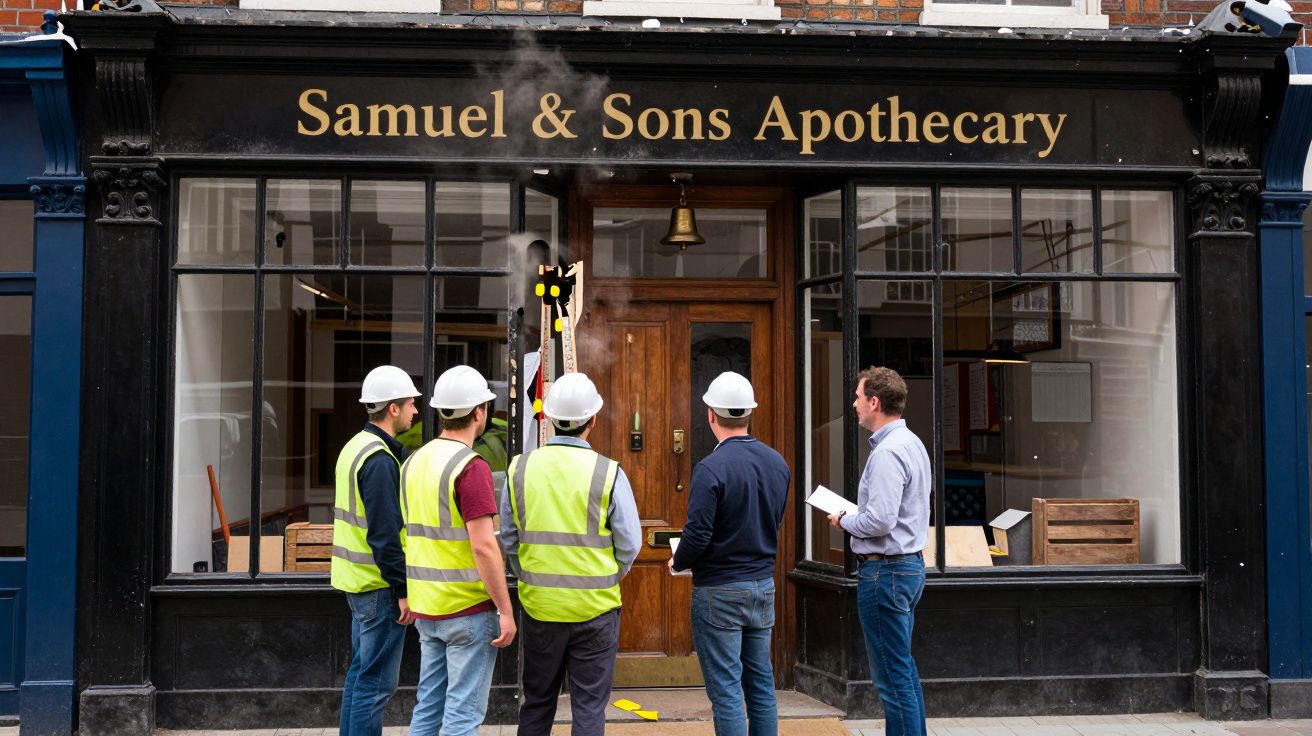
The chisel slipped under the plasterboard with a dry rasp, and a strip of modern shop wall peeled away like card. Behind it, in the gap of dust and dim light, something curved and pale emerged: moulded timber, a sliver of old glass, the ghost of hand-painted gold lettering. The demolition crew stopped talking. Someone killed the radio. For a moment, the only sound on the high street was the traffic outside and the soft crumble of 21st‑century plaster falling off an 18th‑century façade.
The archaeologist on site remembers the first clear view of it: a complete Georgian shop front, bow windows, fanlight, fascia board and doorcase, standing exactly where a till and sunglasses rack had sat the week before. Not an outline, not a fragment. The whole thing, from fluted pilasters to the little brass bell above the door, sealed in darkness behind flat, forgettable cladding.
“It felt like walking into a painting that had been put away and forgotten,” she said later. “The last customer had just stepped out - two centuries ago.”
Outside, shoppers hurried past a hoarding advertising “Exciting New Retail Coming Soon”. Inside, a team with dust masks and torches stared at a shop that had never seen a barcode, perfectly preserved because, at some point, someone found it cheaper to hide history than to remove it.
A Georgian shop frozen in the moment of closing time
Stand in front of the uncovered façade and the period textbooks suddenly gain weight. The shop front curves gently into the pavement line, twin bow windows framing a central door recessed on stone flags worn into shallow bowls. Each pane in the delicate glazing bars is slightly wavy, the imperfect glass catching the light in ripples rather than reflections.
Above the door, a semicircular fanlight spreads wooden spokes like a sunburst, still holding its original leaded glass. The fascia board below the cornice bears the faint but legible remains of hand-lettered signage - the name of a long-vanished proprietor and the trade, picked out in once-bright gold leaf now dulled to smoke.
On the inside of the window frames, scraps of painted price lists cling on: “Best Bohea Tea”, “Fine Muslins”, “Patent Stays”. Between them, someone had once pasted a notice about a performance at the local assembly rooms. The paper is brittle but intact, the ink browned but readable.
It is the ordinariness that hits hardest. No grand townhouse, no aristocratic folly. Just the place where people came to buy cloth, buttons, gossip and credit, frozen at the instant before someone boxed it in behind a sheet of new walling.
How a modern refit accidentally built a time capsule
To understand why this shop front survived so well, you have to think like a cost‑cutting builder. At some point in the mid‑ to late‑20th century, the building was refitted. The Georgian frontage was out of fashion, awkward to adapt for plate glass, and expensive to dismantle. The answer was blunt and pragmatic: leave it in place, build a new wall just in front, and hide the old under smooth plaster and fresh branding.
That decision created almost perfect conservation conditions by accident. The gap between old and new walls buffered temperature swings, kept out direct sunlight and limited airflow. No UV, no rain, no hands. Just darkness and stillness.
In conservation terms, this is “protective encapsulation” - usually a deliberate choice in museums, rarely a side effect of a shopfit.
Layers tell the story:
- Georgian timber and paint, still keyed into the original masonry.
- Victorian gas pipes threaded past the cornice and then forgotten.
- A run of 1960s wiring clipped to the new stud wall, painfully close but never quite touching the old façade.
- 1990s alarm cables and CCTV brackets drilled into plasterboard that never reached the original wood.
Let’s be honest: nobody on those later jobs was thinking about heritage. They were chasing deadlines and floor plans. Yet every time someone chose the quicker fix and worked around rather than through the old front, they left it more intact.
“It’s a textbook case of how everyday shortcuts can accidentally become acts of preservation,” one building historian noted. “Neglect is rarely this kind.”
What this storefront reveals about 18th‑century shopping
Written records tell us what Georgian traders stocked and how they were taxed. A surviving shop front shows how it felt to stand on the threshold with a coin in hand.
Several details jump out:
- Visual hierarchy: expensive goods advertised at eye level in the centre panes; cheaper items and notices pushed to the edges.
- Light management: small panes and deep window bays softened glare, keeping fabrics from fading but still drawing the eye.
- Security: internal shutters on discreet hinges, still able to fold and lock behind the glass - a reminder that shopkeepers worried about theft then as now.
Inside the window recess, conservators have found:
- Chalk tally marks where an assistant tracked stock moves or credit on the frame itself.
- A child’s roughly carved initials, perhaps bored during long hours watching the street.
- Tiny iron hooks along the mullions where ribbons, gloves or trimmings once dangled.
This one façade also plugs gaps in the record:
| Feature | What survived | Why it matters |
|---|---|---|
| Original paint scheme | Multiple layers from pale stone to later darker greens | Shows shifting tastes and regulations on signage |
| Glazing and putty | Intact crown glass and linseed putty | Rare evidence of everyday glazing techniques |
| Hardware | Bell, lock, hinges and shutter bolts in place | Reveals how shops balanced welcome with security |
For social historians, this is data. For people standing in front of it, it is something else: a sudden, physical sense that the Georgian period was not sepia‑toned distance but colour, light and the everyday business of making a living on a street that still carries the same footfall.
Preserving it without turning it into a stage set
Once the shock fades, the practical questions arrive quickly. How do you preserve a timber and glass façade that has not seen daylight in half a century without letting it fall apart in front of you?
The team on site has taken the same steps you might see with a painting or sculpture, only squeezed into a shop unit:
- Stabilise first: temporary props under the cornice, gentle cleaning with soft brushes to remove loose dust but not original paint.
- Document everything: 3D laser scanning, high‑resolution photography and measured drawings before anything is altered.
- Test the layers: paint samples the size of pinheads lifted for analysis, giving a timeline of colour schemes and any past restorations.
Crucially, they are resisting the urge to “make it pretty” too quickly. Strip too much, and you lose the story of use and adaptation. Over‑restore, and the shop begins to look like a themed restaurant.
There are three broad options now under discussion:
- Leave it in situ and visible, integrating it into the new shop as a feature behind glass or within a controlled microclimate.
- Create a public viewing window from the street, allowing passers‑by to see the façade while it remains structurally part of the building.
- Carefully dismantle and re‑erect it in a museum or heritage centre, where environment and access can be tightly controlled.
Each comes with trade‑offs in cost, authenticity and everyday disruption. The current mood leans towards keeping it where it has always stood and letting the modern shop work around it, rather than stripping it out for display elsewhere.
“The power of the piece is that it’s still on the high street,” says the local conservation officer. “Take it away, and you lose half the meaning.”
What high streets forget - and what they remember
Discoveries like this can feel like lightning strikes, but in reality they are the slow harvest of centuries of building over, boxing in and forgetting. British high streets, especially in older towns and cities, are layered:
- Medieval property lines buried under modern paving.
- Georgian fronts behind 1970s tiles.
- Victorian ironwork hidden in suspended ceilings.
Most of the time, renovations move too fast to pause and look. Surveyors check for rot and subsidence, not for faint gold leaf under distemper. Shopfitters are paid to deliver opening dates, not dendrochronology samples.
Yet this find has already started to shift habits locally. Contractors have begun flagging “odd” construction details earlier. Owners are asking what lies behind their plaster, not just what colour to paint it. Planning officers are inserting conditions into consents that allow for archaeological recording when walls come down.
For the wider public, the message is simpler but no less important: the places where we buy coffee, queue for deliveries and scroll our phones sit on top of dense, textured histories. The past is not cordoned off in stately homes; it is literally next door, waiting behind a stud wall no thicker than your arm.
| Key point | Detail | Why it matters |
|---|---|---|
| Hidden survival | Whole shop front intact behind modern cladding | Shows how ordinary buildings can conceal major artefacts |
| Everyday history | Evidence of pricing, display and security | Brings Georgian retail to life beyond archives |
| Living context | Still part of an active high street | Connects heritage with daily routines, not just tourism |
When the new tenant eventually opens their doors, they will not simply be launching another retail unit. They will be stepping through a threshold that has already welcomed customers for more than two hundred years - some in wigs and stays, some in denim and trainers, all walking the same stretch of flagstone.
FAQ:
- Can the public see the Georgian shop front yet? Access will depend on conservation work and safety assessments. In many such cases, local authorities arrange limited open days or viewing windows while long‑term plans are agreed.
- How do archaeologists know the frontage is Georgian? Dating comes from a mix of stylistic features (such as bow windows and fanlights), construction methods, paint analysis, and sometimes documentary records tying a shopkeeper’s name on the fascia to 18th‑century trade directories.
- Why didn’t earlier builders simply remove it? Stripping out a well‑made timber front is labour‑intensive and costly. For mid‑20th‑century refits, boxing it in with a new flat wall was quicker, cheaper and matched contemporary tastes for plate glass and clean lines.
- Will the shop front be restored to its “original colours”? Conservators are cautious here. Analysis can identify early colour schemes, but full repainting risks erasing later layers of history. The likely approach is gentle stabilisation, with minimal retouching to keep what survives readable.
- Are discoveries like this common? Entire intact façades are rare, but partial survivals - cornices, pilasters, window frames - appear fairly often during refurbishments in older streets. Most pass unnoticed unless someone on site knows what to look for and is given time to investigate.





Comments (0)
No comments yet. Be the first to comment!
Leave a Comment