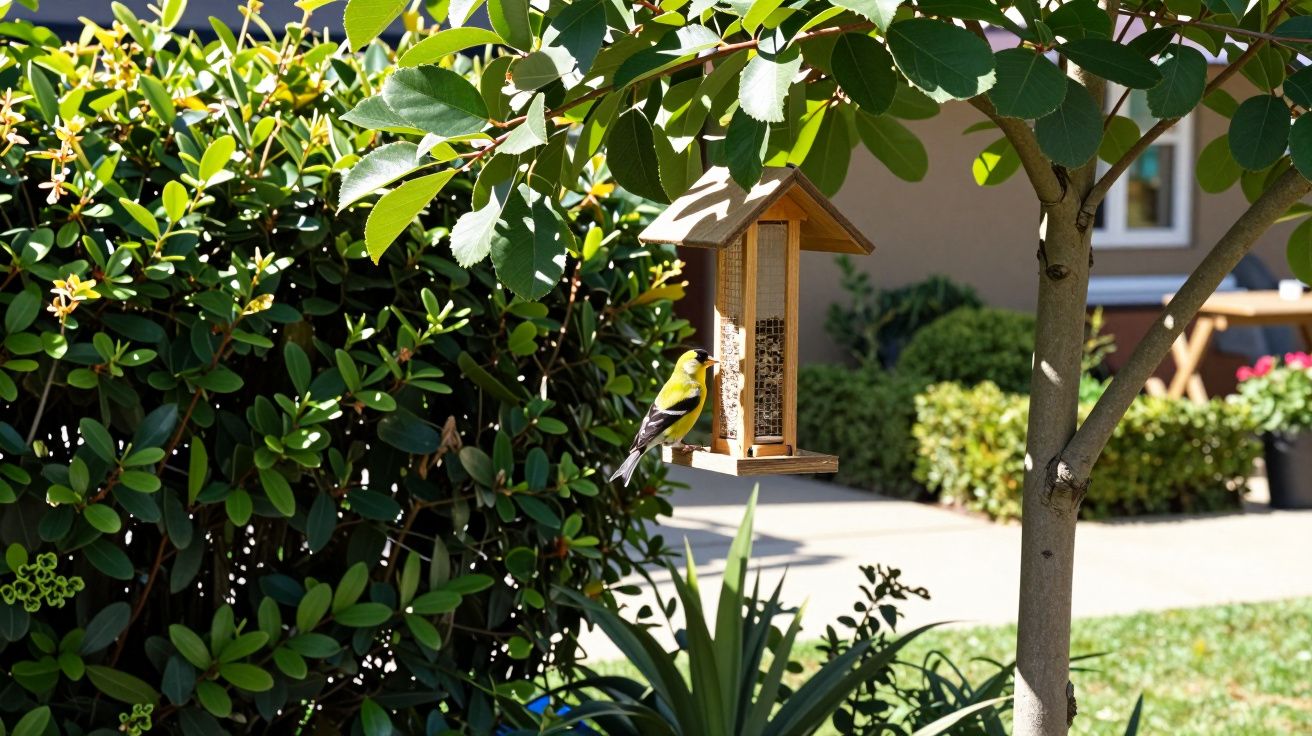
A blur of yellow and black lands on the washing line for half a second, thinks better of it, and vanishes over the neighbour’s hedge. The seed feeder you bought “for the goldfinches” sways gently in the middle of a perfect, empty lawn. Week after week, the peanuts go down, the starlings squabble, the pigeons waddle in for the crumbs. The bird you actually wanted never stays.
Ask around in bird groups or at local reserves and you hear the same puzzled refrain: “They’re all over the park, but they never touch my feeders at home.” People tweak seed mixes, buy fancier tubes, even add plastic nyjer trays. Sometimes it works. Often, it doesn’t.
According to ringers and garden bird survey volunteers, the problem in many British gardens isn’t the food at all. It’s where we hang it.
The one feeder mistake that reliably scares goldfinches off?
Sticking the feeder out on its own, in the most exposed spot in the garden.
Why “lonely” feeders put goldfinches on edge
From a human perspective, the middle of the lawn looks ideal. Open views, no branches to tangle in, perfect line of sight from the kitchen window. You see everything.
Goldfinches see everything too – especially predators.
These small, agile finches spend much of their wild feeding time on seedheads in weedy patches, hedgerows and the tops of thistles. Those plants might look scruffy to us, but they offer exactly what a nervous little bird wants: food within a short, explosive flight of cover.
In open, suburban gardens, an isolated feeder can feel like a dinner bell for sparrowhawks. No hedge to dive into, no dense shrub to vanish inside, nowhere to sit and check that the coast is clear. Many goldfinches simply avoid those “flagpole” feeders altogether, no matter how good the seed is.
One experienced ringer put it bluntly during a winter count:
“We see goldfinches queue calmly in trees near a feeder, but avoid ones dangling like a bauble in empty space. They’re not fussy, they’re cautious.”
What goldfinches are actually looking for
Goldfinches have boomed as a garden species in the UK partly because we unknowingly cater to their tastes: seed-bearing plants, quiet corners and more year-round food. Feeders are just one piece of that puzzle.
When they assess a garden, they’re making a fast calculation:
- Can I escape quickly if something dives at me?
- Is there cover to hide in while I check the area?
- Is the feeder stable enough for me to grip and feed?
- Is there company? (A few other finches usually signal safety.)
More than the brand of seed, three elements matter:
Proximity to cover
A small tree, tall shrub, dense hedge or even a mixed border gives goldfinches a launch point. They prefer to perch, survey the feeder and then drop down briefly to feed, rather than sit exposed for long stretches.Shelter from sudden noise and movement
Feeders right by a banging gate, a busy path, or under a football goalpost are often abandoned. Sudden movement reads as danger, even if it’s just the recycling bin.Stability and height
Thin, whippy branches or strings that make the feeder swing wildly are off-putting. A solid hook on a bracket, a stout branch or a well-anchored pole around head height feels much safer.
In short: they want to feel like they’re still in a hedge, not on a spotlighted stage.
How to move a feeder from “hawk magnet” to “goldfinch lane”
The good news is you rarely need to buy a new feeder. You often just need to shift what you already have by a few metres and adjust the surroundings.
1. Let cover do the confidence-building
Walk into the garden and look for:
- A shrub, small tree or tall mixed border that birds already use.
- A hedge line where you see sparrows diving in and out.
- A branch or wall bracket that sits close to leaves or twigs.
Aim to place your finch feeder:
- Roughly 1–3 metres from dense cover – close enough for a fast dash, far enough that cats can’t leap straight from the hedge onto the feeder.
- At about 1.5–2 metres high, so birds are above head height and eye-level with low branches.
A common expert trick is to create a “stepping stone” arrangement: cover → nearby perch (tree, tall stake, arch) → feeder slightly in front. Birds gather in the cover first, then take turns dropping to the feeder.
2. Calm the swing, soften the surroundings
A wildly swinging tube makes feeding harder and feels riskier. You can:
- Use a short, rigid hanger rather than a long wire.
- Fix feeders to a sturdy pole with an arm, driven deep into the ground.
- Avoid the very tip of thin branches; move inwards to thicker wood.
Around the feeder, think about what you can soften:
- Add a climber or trellis behind a wall-mounted feeder.
- Let part of the lawn grow a little longer under the feeder, so fallen seed sprouts into a small patch of natural food.
- Avoid shiny metal right at eye level; a simple, dark bracket or wooden post blends in better.
Birds interpret cluttered, varied backgrounds as safer than bright, bare fences.
3. Match the food to the new, safer spot
Once the location feels right, you can make the most of it with food they actually want to linger over. Goldfinches are particularly drawn to:
- Sunflower hearts (husks removed) in a standard seed feeder.
- Nyjer (niger) seed in a special fine-port nyjer feeder.
- Natural seedheads left on teasel, knapweed, dandelions and verbena.
You don’t need all three. Many garden birdwatchers report that simply switching to sunflower hearts in a properly placed feeder doubles their finch traffic within a few weeks.
What matters more than variety is freshness and consistency. A well-sited feeder that always offers the same, reliable food becomes part of the goldfinches’ mental map. They’ll bring their relatives.
Simple layout tweaks that make a big difference
Here’s how small changes in where you hang things can transform how safe your garden feels to a goldfinch.
| Feeder tweak | What to do | Why it helps |
|---|---|---|
| Move from lawn centre | Shift feeder 2 m out from a shrub or hedge instead of centre-stage | Gives birds a fast escape route and a place to queue safely |
| Add a “waiting room” perch | Put a small tree stake, arch or bracket near cover | Lets goldfinches land and watch before committing to the feeder |
| Separate noisy spots | Keep feeders away from trampolines, doors and bins | Reduces sudden scares that teach birds to avoid your garden |
These are the sort of micro-adjustments ringers see every winter: the house that moves its feeder a few metres and, suddenly, gains a charm of goldfinches that were already in the area but refusing to risk the old, exposed set-up.
Other quiet mistakes that keep goldfinches away
The exposed-feeder problem is the big one, but two other habits quietly undo people’s efforts.
Dirty tubes and clumped seed
Finches, including goldfinches, are prone to diseases such as trichomonosis. Experts now strongly recommend:
- Cleaning feeders weekly with hot water and a safe disinfectant.
- Discarding clumped, damp seed after rain rather than topping up on top.
- Raking up fallen, mouldy seed from the ground beneath.
A filthy feeder not only risks illness; birds often sense something is wrong and avoid it altogether.
Constant chopping and tidying
Goldfinches love “untidy” gardens. Cut down every seedhead the moment it browns and you remove one of their most important natural food sources.
If you can bear it, leave:
- Teasel and verbena stems through winter.
- A patch of dandelions and knapweed to set seed.
- One corner of the garden to grow a little wild.
The combination of natural food plus a safe feeder is what convinces them your garden is a good long-term bet, not a risky snack bar.
How long until they notice the change?
Bird experts often remind impatient gardeners that birds work on their own timetable. Even a perfectly placed, freshly cleaned feeder can take a few weeks to gain regular visitors, especially if there’s abundant wild food in nearby fields or parks.
Patterns they see in garden surveys:
- Goldfinches investigate within days if they’re already in the neighbourhood.
- Regular, daily visits often build over 2–4 weeks once a few birds decide it’s safe.
- Numbers can spike in late summer and winter, when natural seed is scarcer.
What tips the balance is consistency. If the feeder keeps disappearing, moving location every few days, or running empty, birds treat it as unreliable and focus their efforts elsewhere.
The real shift: thinking like a nervous finch, not a human spectator
Underneath the talk of nyjer bags and specialist tubes, bird experts keep circling back to one simple idea: goldfinches are prey. They live with that knowledge every second.
When you stop designing your feeder set-up purely around the view from your patio chairs, and start imagining the world from a 15-gram bird’s eye level – hawks overhead, cats under hedges, loud bangs from every direction – the logic of where to hang things changes.
You don’t have to turn your garden into a jungle or buy an entire new range of feeders. You just need to avoid that one, deeply human instinct: putting the bird table in the dead centre and hoping the show will come to you.
Shift the stage closer to the wings, add a bit of shelter, keep the food clean and predictable, and you give goldfinches exactly what they’ve been looking for all along: the feeling that they can eat and still get away.
FAQ:
- Do goldfinches only come for nyjer seed? No. Nyjer is excellent, but many British goldfinches happily take sunflower hearts from a standard seed feeder, especially in gardens where nyjer has never been offered.
- How close to a hedge is too close? Around 1–3 metres is a good rule of thumb. Any closer and you risk giving cats a direct launch point; any further and birds lose that reassuring dash to cover.
- Should I move all my feeders out of the open? Not necessarily. Some species, like pigeons and corvids, tolerate more exposed spots. Focus on providing at least one “goldfinch-friendly” feeder near cover and keep the more open ones for other birds.
- What time of year is best to attract them? Late summer through winter is often easiest, when natural seedheads are fading and garden feeders become more important in their diet.
- If I move the feeder and still see no goldfinches, what next? Check that goldfinches are present locally (in nearby parks or on bird apps), keep feeders clean, be consistent with food, and consider adding a few seed-rich plants. Sometimes it simply takes one bold bird to discover your garden before the rest follow.




Comments (0)
No comments yet. Be the first to comment!
Leave a Comment