The first sound was the crack, then the quiet swear. Six eggs in a pan for Sunday brunch, two fizzing out white ribbons into the water like tiny ghosts, the timings blown before the toast even popped. You skim the froth, you turn down the gas, you tell yourself it’s just eggs. Still, there’s that small sting when half of what you bought ends up jagged and leaking.
In professional kitchens this almost never happens, even when they’re boiling trays of eggs at a time. They don’t have harder shells or magical hens; they have a routine. A pin‑prick before the water and a disciplined cool‑down afterwards. It’s so simple you’d miss it if you weren’t looking.
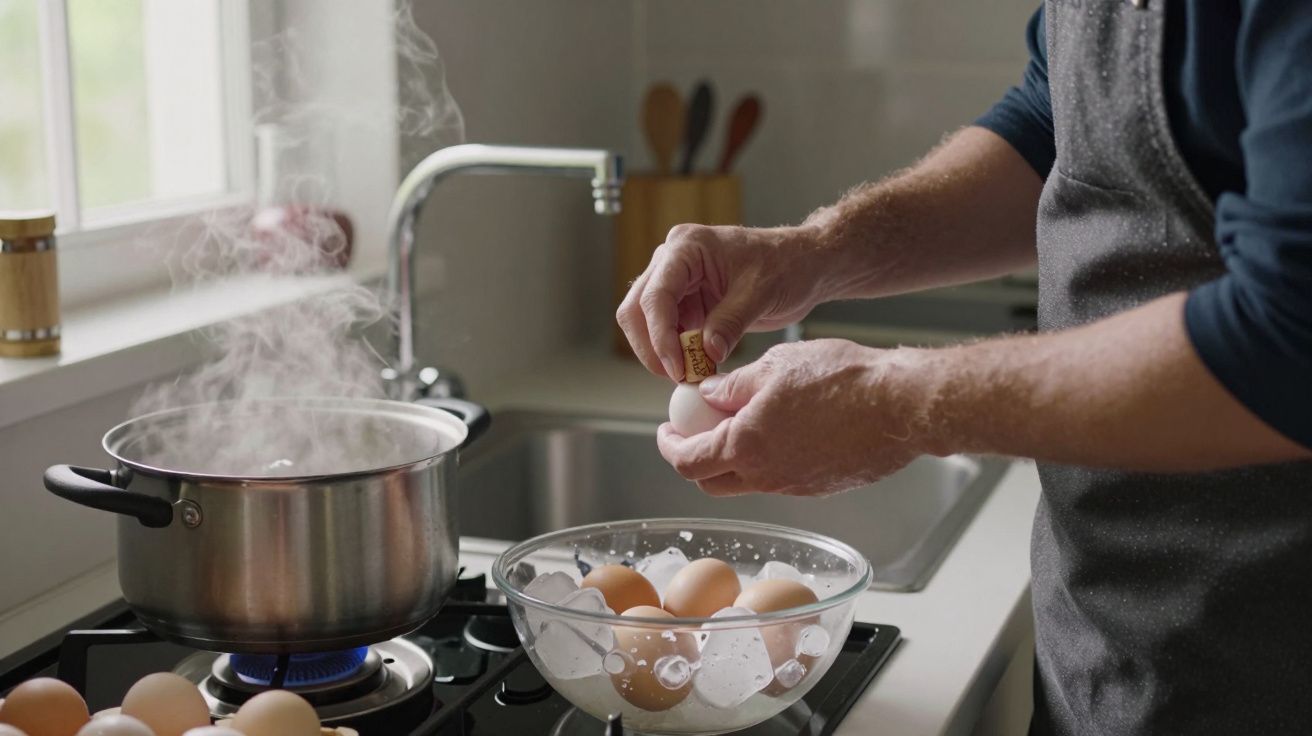
Walk behind the pass in a hotel kitchen at breakfast and you’ll often see it: a pot of boiling water rolling quietly, a small drawing pin stuck into a wine cork, a tub of ice water waiting in the sink. One cook sits at the counter pricking the broad end of each egg with the calm of someone who knows they won’t be mopping up egg white in five minutes. The whole thing looks unremarkable, which is why almost no home cook copies it.
The tiny hole that stops eggs exploding
Look closely at an egg and you’ll notice one end is a little rounder. That’s the broad end, where a small air pocket lives just under the shell. As the egg heats, that air expands. If it has nowhere to go, pressure builds until the shell gives way with that familiar starburst crack and a rush of white into the water.
Chefs cheat the physics with a pin. One clean prick through the shell at the broad end gives the air pocket a tiny vent. As the egg warms, the air escapes quietly instead of blowing out a chunk of shell. The membrane under the shell usually stays intact, so the contents don’t leak; you’ve simply given the expanding gas a polite exit.
In a café kitchen in Bristol, the breakfast cook lines up thirty eggs in a gastronorm tray. She pricks each broad end with a thumbtack set into a rubber wine stopper so her fingers never meet the point, then lowers them into already‑boiling water. No cracks, no floating islands of white, no guessing which egg is half‑empty. She doesn’t think of it as a trick; to her, it’s just how you boil eggs.
There’s a second, quieter benefit. That same tiny vent makes it easier for the egg to pull away from the shell as it cools, especially when you pair it with the right cooling routine. The result is not just eggs that don’t crack in the pan, but eggs that peel without the usual muttered commentary.
The step‑by‑step chef routine for crack‑free eggs
Here’s the exact sequence many professionals use, simplified for a home hob. It looks fussy on paper; in practice it’s ten calm minutes and a bit of ice.
Set up your pin.
Push a drawing pin or sewing pin firmly into a wine cork, thick eraser, or bit of wood so only a few millimetres of point show. This gives you control and keeps your fingertips well away.Prick the broad end.
Hold the egg in your hand, broad end up. Place the pin in the centre of that end and press with a small twist until you feel a gentle “give”. You’re going through the shell only, not boring a tunnel; a pin‑head sized hole is enough.Bring water to a full boil first.
Fill a saucepan with enough water to cover the eggs by about 2–3 cm. Add a teaspoon of salt or a pinch of bicarbonate of soda if you like (both help with peeling later). Bring it to a proper rolling boil, not just the first shy bubbles.Lower the eggs in gently.
Turn the heat down a notch so the boil is lively but not volcanic. Using a spoon, lower the pricked eggs in one by one. The pin‑prick means the sudden heat won’t burst them, and starting in hot water gives you precise timing.Start the clock immediately.
Keep the water at a steady simmer‑boil. Use these timings as a reliable guide:- 6 minutes: soft‑boiled, runny yolk, set white.
- 8 minutes: “jammy” yolk, just starting to thicken in the centre.
- 10–11 minutes: firm but tender yolk, classic hard‑boiled.
- 6 minutes: soft‑boiled, runny yolk, set white.
Prepare an ice bath.
While the eggs cook, fill a large bowl halfway with cold water and a generous handful of ice. This waiting bowl is as important as the pin.Stop the cooking fast.
When the timer goes, drain the hot water immediately. Give the pan a gentle rattle to crack the shells very lightly (optional but useful for easy peeling), then slide the eggs straight into the ice bath.Cool completely.
Leave the eggs in the ice water for at least 10 minutes. The cold not only stops the cooking dead, so you don’t creep past your chosen texture, it also shrinks the egg slightly inside the shell. That tiny movement helps separate the membrane, making peeling surprisingly smooth.
Let’s be honest: nobody does this whole dance for a lone emergency egg at 7 a.m. But once you’ve seen a dozen eggs come out identically cooked, none of them blown apart, the routine feels less like a faff and more like muscle memory.
Why the cooling routine matters as much as the pin‑prick
You can prick every egg perfectly and still end up with chalky yolks or shells that cling like wet wallpaper if you skip the cooling step. In professional kitchens, the pan of ice water isn’t there for show; it’s part of the texture.
Eggs keep cooking from their own heat once they’re out of the water. A “just right” eight‑minute egg will nudge towards hard‑boiled if it sits in hot water or on a warm counter. The ice bath halts that carryover cooking in its tracks, which is why chefs can promise the same yolk on plate one and plate twenty.
There’s a peeling advantage too. The rapid temperature change, especially when combined with those slight post‑boil shell cracks, pulls the egg white away from the shell and its inner membrane. That’s what gives you the satisfying peel where the shell comes off in three or four big pieces rather than a hundred tiny shards.
In a small London café, the prep cook boils two dozen eggs at once, chills them hard in ice water, then stores them in the fridge still in their shells. At service, she can peel to order in seconds, without gouging out half the white. The customers never see the routine, only the clean halves on their plates.
How this small change shifts your egg routine at home
Once you combine the pin‑prick with proper cooling, a few things quietly improve in your kitchen. You stop sacrificing an extra egg “in case one cracks”. You can finally promise yourself a 7‑minute egg and get it, rather than “somewhere between runny and rubbery”.
You also gain control over timing. Boil a batch on Sunday using this method, cool them fully, and keep them in the fridge in their shells. They’ll peel easily over the next few days, and the yolks will stay bright, not grey‑ringed. Breakfast, quick salads, and packed lunches get easier, simply because the eggs behave.
Most of all, that small sense of gamble disappears. You know the eggs won’t explode in the pan, and you know they’ll stop cooking when you tell them to. For something as ordinary as a boiled egg, that feels surprisingly luxurious.
| Key point | Detail | Why it matters to you |
|---|---|---|
| Pin‑prick at the broad end | Vent the air pocket with a tiny hole before boiling. | Prevents shells bursting and leaking white into the water. |
| Boiling‑then‑cooling routine | Start in boiling water, finish in an ice bath. | Gives consistent yolks and stops overcooking. |
| Gentle post‑boil cracks | Lightly rattle the pan, then chill. | Makes shells peel off in big pieces instead of fragments. |
FAQ:
- Won’t the egg leak out through the hole?
In practice, no. The membrane under the shell usually stays intact, so only the trapped air escapes as the egg heats. If you pierce gently and only at the broad end, you get the benefit of pressure release without a stream of white in the water.- Do the eggs need to be at room temperature first?
With the pin‑prick, you can use eggs straight from the fridge because the expanding air has somewhere to go. If you’d rather skip pricking, bringing eggs to room temperature for 20–30 minutes reduces, but doesn’t remove, the risk of cracking.- Is the ice bath really necessary?
You can run cold tap water over the eggs, but an ice bath is more reliable. It cools the eggs faster and more evenly, which locks in your chosen yolk texture and makes peeling easier, especially if you’re cooking a big batch.- Can I use this method in an electric pressure cooker?
The pin‑prick isn’t needed under pressure, but the cooling routine still is. Follow your cooker’s egg timing, then transfer the eggs straight into an ice bath to stop overcooking and help with peeling.- How long will boiled eggs keep after using this routine?
Cooled quickly and stored in the fridge in their shells, hard‑boiled eggs are best within 5–7 days. Soft‑boiled eggs are safer eaten within 2–3 days. Always keep them chilled and discard any that smell off when peeled.


Comments (0)
No comments yet. Be the first to comment!
Leave a Comment