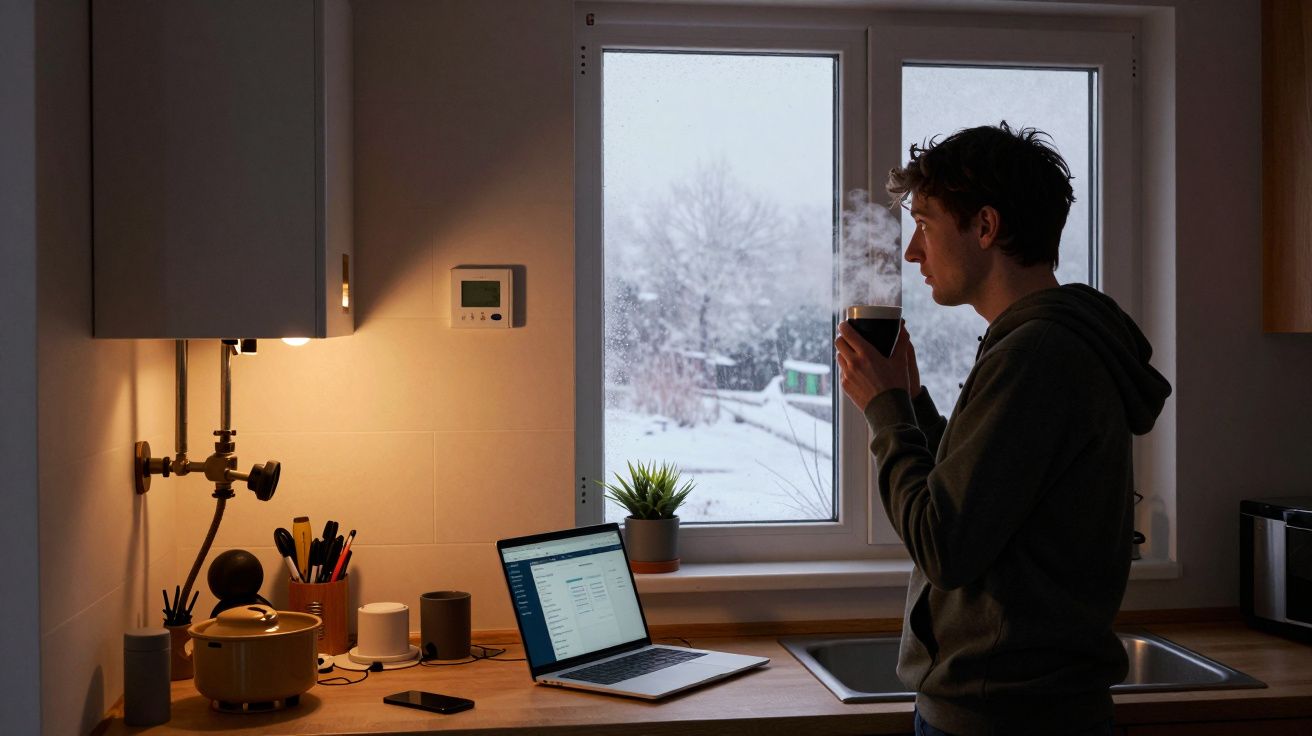
The boiler light glows a quiet orange in the corner of the kitchen. It has been on since before dawn, ticking over on that “just warm enough” setting a friend swore was cheaper. Outside, you can see your breath in the air. Inside, the radiators are only vaguely lukewarm, and the number on the direct debit email keeps creeping up.
Some version of the same advice crops up every winter: “Don’t let the house get cold - it costs more to heat it back up.” Or: “Leave it on low all day, it’s more efficient.” It sounds sensible. It feels grown‑up, almost professional, like something a facilities manager might say in an office block.
Yet when energy auditors walk into real British homes and compare bills with boiler settings, they see another pattern entirely. That “low background heat” habit quietly adds up to dozens of extra hours of heating every week. Over a full season, the cost gap can be brutal - often £200–£300 more than a properly timed system in the exact same house.
The uncomfortable truth is simple: your home doesn’t care where the dial is. It cares how warm it is, and for how long.
Why “low and constant” feels right – but rarely is
On a cold Tuesday night, nobody wants to come home to an icy living room, wait for radiators to catch up, or listen to relatives complain. The myth of “leave it on low” offers a comforting picture: a house that never quite cools down, a boiler that never has to “work harder”, a bill that stays miraculously level.
There is also the fear factor. For years, people were told that “cold walls cause damp” and “letting the house get cold is bad for the fabric of the building”. The leap from that to “so keep the heating on all the time” is understandable, especially in older, draughty homes.
As one auditor in Manchester puts it: “Everyone thinks the danger is turning the boiler on. The real danger is never giving it permission to turn off.”
Add landlord folklore, social media half‑truths and quick tips from colleagues, and the story cements. Leaving it on “a touch under 20” all day becomes shorthand for being sensible, especially if you work from home or have someone in the house most of the time.
The problem is that physics does not care about folk wisdom.
What the physics – and auditors – actually see
At the heart of every heating bill is a dull equation: the hotter your house is, and the longer it stays hot, the more heat it loses to the outside. That loss is roughly proportional to the temperature difference between indoors and outdoors, multiplied by time.
- Keep your home at 20 °C all day when it is 5 °C outside, and you are paying to maintain a 15‑degree gap every hour.
- Let it drop to 15 °C while you are out and warm it up only when you are home, and the average gap over 24 hours is much smaller.
The “it costs more to reheat a cold house” line sounds plausible, but for standard UK homes with gas boilers and radiators, it is largely a myth. Modern condensing boilers are not “straining” when they run harder for an hour; they are simply transferring the energy you ask of them. What matters is the total heat you put in over the day.
Energy auditors see this in the numbers. When they compare two similar households - same build, same insulation level, same occupancy pattern - the one leaving the heating on low all day almost always uses more gas.
A typical pattern looks like this for a three‑bed semi with an elderly combi boiler and average insulation:
House A – “On low all day”
Thermostat at 18–19 °C, 24/7.
Annual gas for space heating: roughly 8,000–9,000 kWh.House B – “Timed and targeted”
20 °C from 6:30–8:30, 17:00–22:30; lower set‑back (15–16 °C) the rest of the time. Spare rooms turned down.
Annual gas for space heating: roughly 5,500–6,500 kWh.
At a gas price of around 7–10p per kWh (recent UK caps have bounced in that range), that difference in consumption - 2,000–3,000 kWh - equates to £140–£300 a year. Same house. Same winter. Different use of the thermostat.
The important point: you are not being charged for how “hard” the boiler works when it is on. You are charged for how much heat it delivers over time.
A simple way to picture the loss
Imagine two radiators on a graph:
- Radiator 1 ticks along gently for 16 hours a day.
- Radiator 2 blasts hot for 8 hours, then is off for 8.
If both deliver the same total heat over 24 hours, the fuel cost is essentially the same. But in real homes, the “always on low” approach almost never ends up delivering the same heat - it delivers more, because the house is held warm when no one needs it.
Heat loss is about area under the curve, not how dramatic the peaks look.
When “always on” might make some sense
There are a few niche cases where a near‑constant low setting is less terrible, though still rarely optimal.
Very poorly insulated, very leaky homes
In a stone cottage with gaping draughts and single glazing, letting rooms plunge to 10 °C can indeed create comfort and condensation issues. A modest set‑back (say 15–16 °C when empty) may be kinder than deep cycling between very cold and very warm, especially for older occupants.Slow‑response systems (e.g. some underfloor heating)
Water‑based underfloor heating buried in thick screed can take hours to respond. In a well‑insulated building, many designers do run this type of system relatively steadily. Even then, they still use thermostats and schedules - they do not simply “leave it on” at the same level all year.Vulnerable occupants with strict health needs
Some medical conditions mean people genuinely cannot tolerate a cool home. In those cases, the priority is stable warmth, and savings come from insulation, draught‑proofing and targeting unused rooms, not aggressive scheduling.
Even across these edge cases, energy auditors almost never recommend completely abandoning timing or zoning. They recommend narrower schedules and shallower set‑backs, not permanent full‑time running.
A smarter daily heating pattern (that still feels comfortable)
You do not have to live in a parka to avoid wasting £300 a year. The aim is to warm the spaces you use, when you use them, and let everything else drift a little cooler without ever becoming icy or damp.
Think of it as three levers you can actually control:
- Time – When the heating runs.
- Temperature – How warm it gets.
- Targeting – Which rooms actually need that heat.
A realistic routine for a typical UK home might look like this:
Use your programmer properly
- Morning: heating on 30–45 minutes before you get up; off or down as you leave.
- Evening: on 30–60 minutes before you come home; off 30–60 minutes before bed (the house will hold the heat for a while).
- Overnight: a set‑back temperature of 15–17 °C, depending on your home and comfort.
- Morning: heating on 30–45 minutes before you get up; off or down as you leave.
Set a clear temperature goal
- Main living area: 19–21 °C for most healthy adults.
- Bedrooms: 16–18 °C is usually fine (and often better for sleep).
- Do not keep nudging the thermostat up. Choose a number and wait; radiators do not heat faster at 26 °C.
- Main living area: 19–21 °C for most healthy adults.
Use thermostatic radiator valves (TRVs) properly
- Turn spare rooms and hallways down one or two numbers, not off completely.
- Keep TRVs clear of curtains and furniture so they actually sense the room air.
- If you work from home, prioritise your study and living room; let less‑used spaces run cooler.
- Turn spare rooms and hallways down one or two numbers, not off completely.
Block the easy leaks
- Draught‑proof obvious gaps around doors, loft hatches and letterboxes.
- Shut doors between heated and unheated rooms.
- Use thick curtains at night over large windows and patio doors.
- Draught‑proof obvious gaps around doors, loft hatches and letterboxes.
These changes do not feel dramatic in daily life. Yet across a season, they cut hours of unnecessary heating while keeping your lived‑in rooms warm when it matters.
What auditors actually recommend, in practice
When auditors leave a home, their notes often boil down to a handful of moves that keep comfort steady and trim waste.
| Move | What it changes | Typical impact |
|---|---|---|
| Timed schedule with night set‑back | Reduces hours at full temperature | Can trim 10–25% off space‑heating use |
| Zoning with TRVs | Stops heating unused rooms to 21 °C | Lower bills without feeling colder |
| Small draught‑proofing fixes | Cuts uncontrolled cold air leaks | Rooms feel warmer at same thermostat setting |
The exact saving depends on your house, boiler, and habits. But for many British homes, simply moving from “always on low” to “timed and targeted” is where that £200–£300 a year difference emerges.
What about damp, mould and “cold walls”?
One of the stickiest arguments for constant low heating is fear of damp: the idea that if you let walls cool down, they will “sweat” and grow mould.
The reality is more nuanced:
Mould loves moisture, not one‑hour dips in temperature.
Persistent damp from poor ventilation, drying clothes indoors, and steamy showers in shut bathrooms is a far bigger driver than a sensible night set‑back.Short temperature drops do not ruin your walls.
In a reasonably insulated home, dropping from 20 °C to 16–17 °C overnight will not suddenly turn plaster into a sponge. What matters is average humidity and the worst cold spots (e.g. behind wardrobes, inside corners).Ventilation beats background heat.
Extractor fans, trickle vents, “shock ventilation” (windows opened wide for a few minutes) and occasionally running a dehumidifier do more for mould control than running radiators at a lukewarm level 24/7.
You can have a house that is warm when you are awake, cooler when you sleep, and still keep mould at bay - provided you let moisture out and do not ignore condensation signals on windows and cold corners.
A quick self‑audit you can do this week
If you suspect the “on low all day” habit is costing you, try a simple two‑week comparison:
Week 1 – Your usual routine
- Take a meter reading at the start and end of the week.
- Note your average thermostat setting and approximate hours of heating.
- Take a meter reading at the start and end of the week.
Week 2 – Timed and targeted
- Programme clear on/off periods, with a night set‑back.
- Turn TRVs down in less‑used rooms.
- Take another meter reading over seven days with similar outside weather, if possible.
- Programme clear on/off periods, with a night set‑back.
Even allowing for weather quirks, many households see a noticeable drop in gas use on the timed week without feeling colder. That is the “ghost” of your always‑on setting made visible.
FAQ:
- Does turning the heating on and off damage the boiler or make it “work harder”? No. Modern boilers are designed to cycle on and off. There is no penalty for reheating a cooled house beyond the fuel you actually burn. What wears a boiler out fastest is lack of servicing, not sensible scheduling.
- Is it ever cheaper to leave heating on low all day? In a typical UK home with radiators and a thermostat, it is almost never cheaper over a full season. The exceptions (very leaky homes, slow underfloor systems, specific health needs) are rare and still benefit from some level of timing and zoning.
- What is a good night‑time temperature set‑back? For many homes, 15–17 °C works well. If your home loses heat very quickly, you may need a smaller set‑back. The aim is “cooler, not freezing” while you are under blankets and not moving around much.
- Will smart thermostats save me money automatically? They can help, especially with features like occupancy sensing and weather compensation, but they are not magic. The real savings come from shorter run‑times, lower temperatures where possible, and not heating empty rooms.
- I’m on electric panels or storage heaters. Does this still apply? The principles are similar - do not heat rooms you do not use, and avoid running expensive direct electric heaters longer than necessary. With storage heaters, timing is even more critical, as you are buying cheaper night‑rate electricity to release during the day.






Comments (0)
No comments yet. Be the first to comment!
Leave a Comment