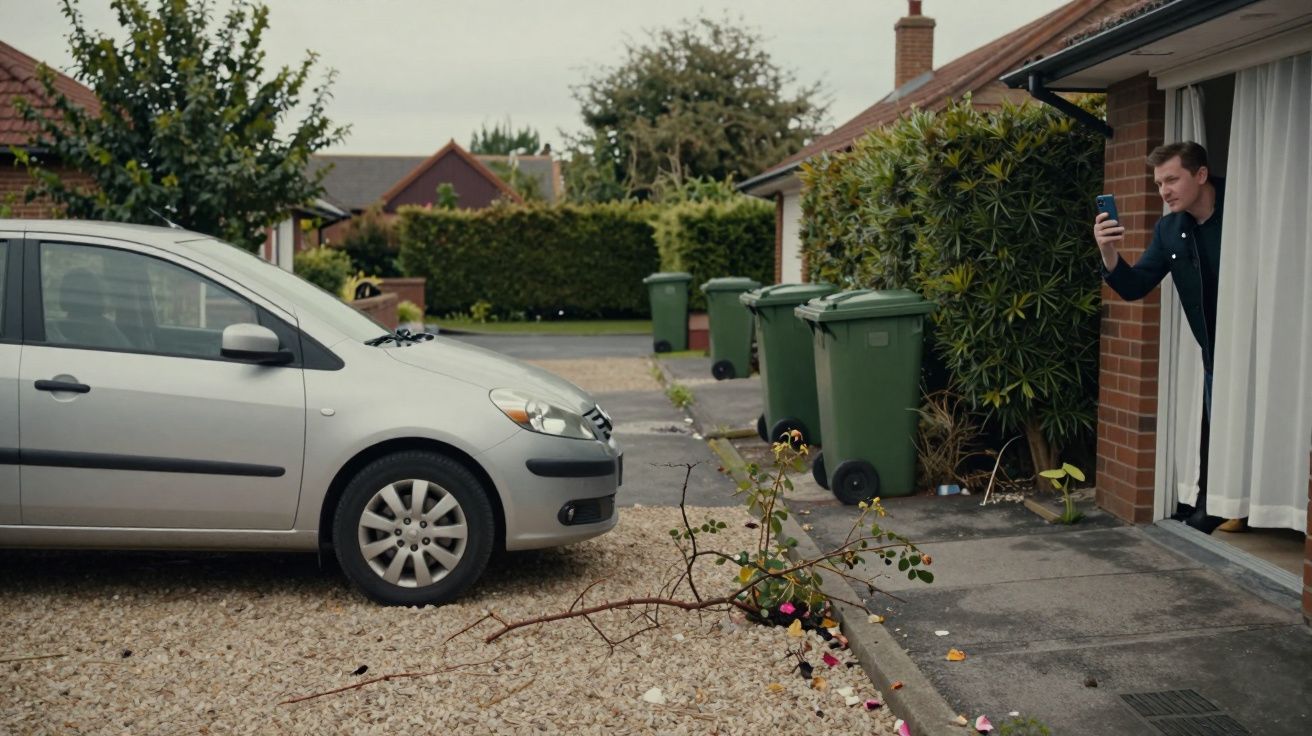
The first thing you notice is the silence. Mid‑morning in a cul‑de‑sac, bins neatly lined, hanging baskets trying their best, the kind of street estate agents describe as “sought‑after” and everyone else forgets as soon as they’ve turned the corner. Then your eye catches it: lawn gone, gravel in, a silver hatchback parked nose‑in where roses used to be.
Next door’s curtains twitch. Farther down, someone has already screenshotted the council’s planning portal. A few weeks earlier, a letter had landed on the doormat written in that careful, official tone: “Council said it breached planning rules.” One neighbour calls it “an eyesore”, another calls it “my land, my choice.” The argument is, technically, about a front‑garden parking space. It’s really about rules, fairness, and who gets to decide what a quiet street looks like.
We’ve all had that moment when a small change on the block-an extra car, a tall fence, a new extension-makes the air feel slightly different. With front‑garden parking, the air can crackle.
How a single parking space becomes a planning battle
On paper, nothing dramatic happened. A homeowner, tired of doing the parallel‑parking dance every evening, decided to turn most of the front garden into hardstanding. The driveway contractors arrived with a skip and a vibrating plate, the turf went out, the blocks went in. Nose‑to‑tail parking eased overnight.
A few days later, someone rang the council.
Maybe they were worried about drainage after last year’s flash floods. Maybe the dropped kerb meant they’d lost “their” regular space on the road. Maybe it was the simple feeling that if they’d had to apply for an extension, everyone else should play by the book too. Motives are rarely printed on complaint forms.
What is printed is the response. An officer visits, takes photos, checks satellite images from a few years back. A standard letter follows: it appears the works don’t match permitted development rights; in council language, the change “constitutes a breach of planning control”. For the homeowner, that reads like a rebuke. For the street WhatsApp group, it’s petrol on an already‑nervous conversation.
The irony is that, in many cases, nobody-neither the householder nor the neighbour-is entirely sure which rule has supposedly been broken.
The hidden rulebook beneath your paving slabs
Front gardens feel private, but they sit at the edge of several quiet systems: planning, highways, drainage, even your property’s legal covenants. Converting them to parking can trip more wires than people realise.
In much of England and Wales, you can create off‑street parking without a full planning application, but only if you stay within some fairly specific lines:
- Surface and drainage: If you’re covering more than 5 square metres with an impermeable surface that doesn’t drain to a soakaway or permeable area within your property, permission is normally required. The rule is there because too many paved front gardens push rainwater straight into overworked drains.
- Dropped kerb (“vehicle crossover”): Lowering the kerb and strengthening the pavement is usually a separate permission from the highways authority, even if the paving itself is permitted development. Councils care about sight lines, utilities under the pavement, and pedestrians with buggies or wheelchairs.
- Boundaries and visibility: High walls, fences or pillars next to a highway have their own height limits. A 1.8‑metre brick wall tight up against a driveway entrance is likely to raise eyebrows in the planning office and among drivers leaving the cul‑de‑sac.
- Designations and conditions: Conservation areas, Article 4 Directions, or conditions attached to past planning permissions can strip away usual rights. What’s routine in one estate is a technical breach two roads over.
None of this is intuitive. There’s no friendly sign at the garden gate saying “Permeable blocks only beyond this point.” You just see your own lack of parking and a brochure full of tidy resin drives.
Let’s be honest: nobody reads the National Planning Policy Framework for fun.
What councils mean by “breach” (and what actually happens)
“Breach of planning control” sounds like a summons; in reality, it’s a status, not a siren. It simply means development has taken place without the necessary permission or outside permitted development rights. From there, a few different paths open up.
Councils start with discretion, not bulldozers. Planning enforcement is about whether it’s expedient to act in the public interest, not about punishing every technical slip. Broadly, officers have three main options:
- Do nothing formal, if the impact is minor or within policy aims. They may log the case and close it, even though a breach technically occurred.
- Invite a retrospective planning application, so they can assess the scheme properly and, if acceptable, regularise it with conditions (for example, adding planting or changing surfacing to permeable materials).
- Serve an enforcement notice requiring alterations or, in rarer cases, removal. Ignoring a valid notice can become a criminal offence.
Timeframes matter. Operational development (like paving and dropped kerbs) is generally subject to a four‑year immunity period if no action is taken. After that, it becomes lawful by passage of time. Long‑term use as parking has its own ten‑year rule.
For the cul‑de‑sac, the key thing is this: a “breach” doesn’t automatically mean diggers will be back in to reinstate the lawn. It means there’s now a question on the council’s desk about harm, policy, and whether the new parking space does more good than damage.
When a driveway splits a street in two
On a rational level, a front‑garden parking space solves problems. Fewer cars jostling for kerbside spots. Less reversing around blind bends. Space for a visiting carer or accessible parking right by the door.
On an emotional level, it can feel like an incursion.
One neighbour worries about “urban creep”-the slow spread of tarmac and block paving, the loss of soft edges and front‑garden chats over the privet hedge. Another fears water pooling at the bottom of the close because everyone’s rain now hammers straight into the gulley. Someone else notices their bay window now overlooks a bonnet rather than a clematis.
Parking also carries an unspoken language of status and entitlement. The house with a drive has “sorted itself out”; the terrace still circling in the evenings hasn’t. When a council letter confirms that a driveway was installed outside the rules, resentment can harden: They broke the rules and got rewarded with a space.
What often goes unsaid is that most people value three overlapping things:
- Predictability: knowing roughly what the street will look and feel like in five years.
- Fairness: a belief that rules apply consistently, not just to the conscientious.
- Voice: at least being heard before the character of the street shifts.
When those three are missing, a slab of concrete becomes the stand‑in for everything else.
If it’s your front garden: steps that lower the temperature
If you’re eyeing up your lawn with a measuring tape-or staring at fresh paving while clutching a council letter-there are ways to calm things down, on paper and on the pavement.
Before you build or pave
- Check the basics, in writing. Use your council’s online planning guidance and the Planning Portal to see what’s normally allowed. If in doubt, ask for pre‑application advice or a lawful development certificate.
- Talk to highways about the dropped kerb. They care about safety and standards; it’s cheaper than being told to remove an unauthorised crossover later.
- Choose permeable solutions. Gravel, permeable block, or systems with soakaways tick drainage boxes and ease flood worries. A simple planting strip along the front or side can go a long way visually too.
- Give neighbours a heads‑up. A quick chat-“we’re thinking of adding a small parking space, here’s roughly what it’ll look like”-won’t guarantee agreement, but it can take some sting out of the surprise.
If the work is already done and eyebrows are raised
- Read the council’s letter carefully. Are they alleging a particular breach (e.g. impermeable surfacing, no permission for the crossover), or simply inviting discussion?
- Consider a retrospective application. It can feel like admitting wrongdoing; it’s really just formalising what exists, sometimes with tweaks.
- Mitigate visibly. Adding soft landscaping, ensuring no overhanging vehicles block the pavement, and keeping sight lines clear all help demonstrate you’re acting in good faith.
- Keep communication factual. In the street group or over the fence, stick to what you’re doing to address the issues rather than who “snitched”. The system relies on complaints; going to war with the complainant rarely improves anything.
Think of it less as defending a slab of paving and more as renegotiating a small part of the shared environment.
Reading the fine print beneath the front‑garden row
A front‑garden parking dispute is rarely just about the garden. It’s the point where private choices collide with shared risks: drainage, safety, street character, precedent. Councils sit awkwardly in the middle, trying to weigh individual convenience against collective impact with limited staff and a lot of files.
For residents, the only real levers are information and tone. You can:
- Learn which rules actually apply, so the argument isn’t fuelled by myth.
- Use design-permeable surfaces, planting, modest scale-to shrink the genuine harms.
- Choose conversations that de‑escalate, even when you’re furious about “that letter”.
The cul‑de‑sac will keep its secrets. In a year or two, the gravel might be softened by pots and shrubs, the council case closed, the drama reduced to an anecdote for new arrivals: “Do you remember the great driveway saga?” Underneath, the same question will linger every time someone thinks about changing a front garden: how do we make room for our cars without paving over the things that make a street worth living on?
| Issue | What it actually involves | Why the street cares |
|---|---|---|
| Surface & drainage | Permeable vs solid paving, soakaways, run‑off direction | Flood risk, soggy pavements, overwhelmed drains |
| Dropped kerb | Lowering kerb, strengthening pavement, visibility | Safety, lost kerbside spaces, trip hazards |
| Appearance & planting | Extent of hardstanding, boundary treatments, greenery | Character of the street, property values, wildlife & shade |
FAQ:
- Do I always need planning permission to park on my front garden? Not always. Small areas of permeable surfacing with suitable drainage can be permitted development. Larger, impermeable areas or locations with special designations, like conservation areas, are more likely to need permission.
- Is creating a driveway without permission a criminal offence? The act itself is usually a civil planning matter, not a crime. It becomes a potential offence only if you ignore a valid enforcement notice requiring you to put things right.
- Can a neighbour complain anonymously? Yes. Councils generally accept anonymous or confidential complaints; they focus on the alleged breach, not who reported it.
- What if my property deeds ban parking in the front garden? That’s a separate legal issue. Even if the council is content, a private covenant can still be enforceable by the party who benefits from it, often the original developer or an estate management company.
- How can I check if an existing front‑garden parking space is lawful? Ask the council whether there’s any planning history or enforcement record. A lawful development certificate can formally confirm long‑established use, especially if the drive has existed for several years without challenge.




Comments (0)
No comments yet. Be the first to comment!
Leave a Comment