The lead snaps tight before you have even locked the front door. Your shoulder jolts, coffee sloshes, and the nice image of a “relaxing dog walk” evaporates as your dog drags you towards the nearest lamppost. You have tried headcollars, front‑clip harnesses, even that spiky collar the trainer at the park swore by. None of it feels good, and none of it really lasts.
Ask modern behaviourists what they do instead and they rarely reach for harsher kit. They reach for a clock.
The quiet secret is not a stronger collar, but a calmer start. A short, deliberate pre‑walk ritual that takes five minutes, resets your dog’s brain, and teaches loose‑lead skills before you ever step outside.
Why dogs pull in the first place
Dogs do not pull because they are “dominant” or “naughty”. They pull because it works. For most pets, the sequence is simple: door opens, lead goes tight, human follows. The environment – birds, scents, other dogs – then winds them up even more.
From a behaviourist’s point of view, three forces collide:
- Arousal: excitement and frustration spike the moment the lead appears.
- Reinforcement: every step forwards on a tight lead teaches, “pulling gets me where I want”.
- Rehearsal: the more often this happens, the more automatic it becomes.
Inside the house, you still have leverage. Your dog’s adrenaline is lower, distractions are fewer, and small choices are easier to reward. Outside the door, those odds reverse.
“Most lead pulling problems are won or lost in the 30 seconds either side of the front door,” one UK behaviourist told me. “Change that window, and the walk feels different without changing the collar at all.”
The 5‑minute pre‑walk ritual (step by step)
This routine is not a drill sergeant’s parade. It is a short, predictable sequence that tells your dog, “We start walks calmly and together, not by sprinting.”
You can do it in a hallway, living room, or just inside your front door.
Minute 0–1: The calm kit check
Before the lead even appears, you are teaching that “walk prep” is low‑key, not a rave.
- Pick up the harness and lead quietly, no squeals, no high‑pitched “Walkies!”
- Ask for one simple known behaviour: sit, stand on a mat, or just four paws on the floor.
- Clip the harness and lead on only when your dog offers that calm position, even for a second.
- Mark it with a word (“yes”) and feed a treat low by your knee, not up by your face.
If they bounce or spin, pause. Harness goes behind your back, you wait a beat, then try again. The message is gentle but clear: calm earns progress, chaos pauses it.
Minute 1–2: Decompression sniff at home
Next, you give their nose a job before the pavement does.
- Scatter five to ten tiny treats on a towel, snuffle mat, or just the floor.
- Say a consistent cue such as “find it”, and let your dog sniff them out on lead.
- Keep the lead loose while they forage; no steering, no “heel”.
Sniffing is not a distraction from training; it is part of it. For most dogs it lowers heart rate and shifts them into a more thoughtful state, so they are less likely to hit the door like a rocket.
Minute 2–3: Connection games in a quiet corner
Now you warm up the skills you wish you had on the street, but in easy mode.
Two simple games work well:
- Hand target:
- Present your hand by your knee.
- When your dog touches it with their nose, say “yes” and reward.
- Take one step, present hand again, reward by your leg.
- Present your hand by your knee.
- Name‑then‑treat by your side:
- Say your dog’s name once.
- When they glance at you, drop a treat on the floor just beside your ankle.
- Say your dog’s name once.
You are rehearsing a loop: hear you, move towards you, get paid next to you. A dozen tiny reps indoors make it far easier for your dog to offer the same behaviour when a pigeon appears later.
Minute 3–4: Lead pressure practice indoors
This is where you start to change the pulling habit directly, in a room where nothing exciting is happening.
- Stand still, holding the lead at a comfortable length (1.5–2 metres).
- Gently follow your dog if they move, until the lead just begins to go tight.
- The moment they soften the lead – even by half a step back or a head turn – mark and reward near your leg.
- Take one or two slow steps, then repeat.
You are teaching a language: tight lead means “nothing moves”; soft lead means “we go and good things happen”. No jerks, no yanks, no “checking” them. The dog learns to release the pressure themselves.
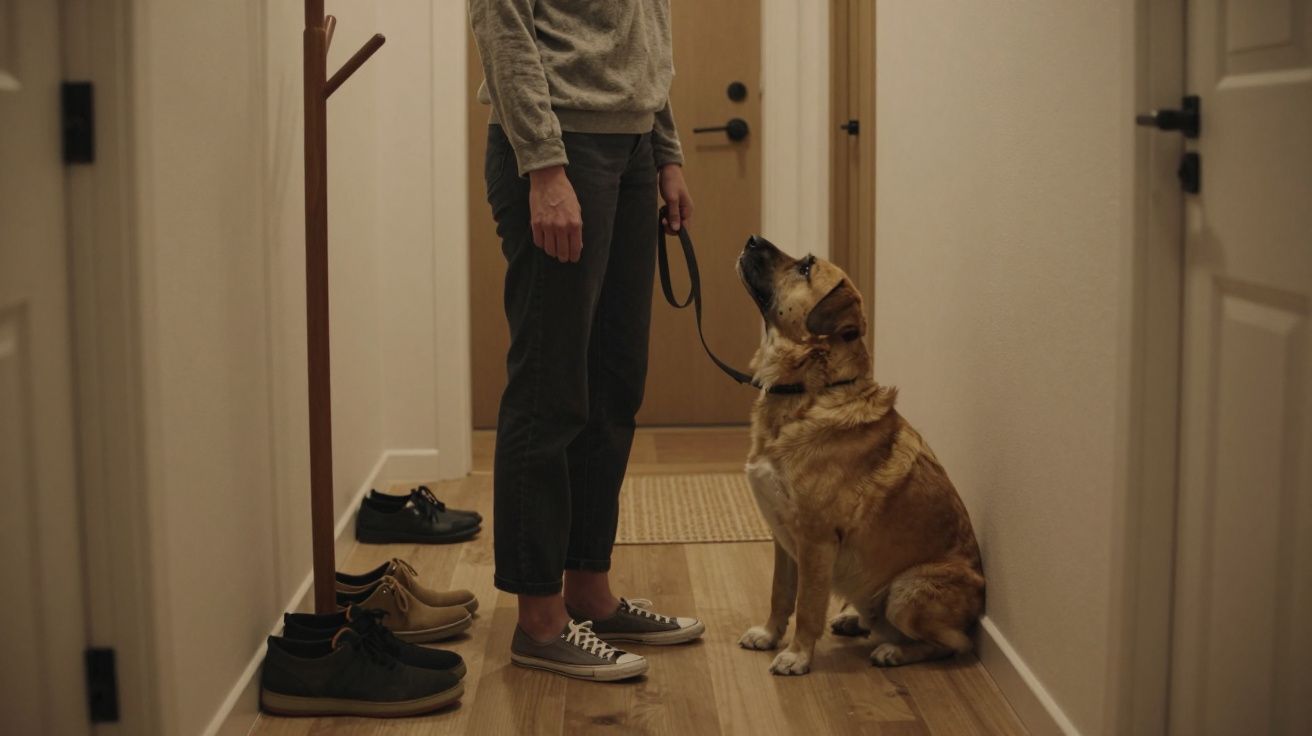
Minute 4–5: Doorway decisions and first sniff stop
Finally, you move to the threshold, the place where habits usually explode.
- Walk towards the door on a loose lead. If it tightens, you simply stop.
- When the lead softens, say “yes”, move forward again.
- Touch the handle, maybe crack the door. If they lunge, you calmly close it and wait.
- When they can stand or sit with a slack lead as the door opens, you add a clear release cue: “Let’s go.”
Step outside and, within five to ten paces, offer a planned sniff stop at a verge or tree. That first controlled sniff is their pay‑off for staying with you, turning the start of the walk from tug‑of‑war into shared routine.
What behaviourists are actually changing
On the surface, this looks like simple obedience. Underneath, four key processes are shifting:
- Arousal curve: those first two minutes bleed off the manic edge before it hits the pavement.
- Reinforcement history: moving forward starts to depend on a loose lead, not a tight one.
- Predictability: a consistent ritual reduces anxiety for many dogs; they know what comes next.
- Attachment: those tiny check‑ins and hand targets teach your dog that you are part of the walk, not dead weight on the other end.
Behaviourists like this approach because it nudges emotion and habit, not just posture. A dog who feels calmer and knows how to earn movement is easier to walk than one who is merely held back by equipment.
Common mistakes that sabotage loose‑lead walking
Most owners are not “doing it wrong” on purpose. They are just working against their own goals without realising.
Using the walk itself as the only reward
If pulling barrels the dog straight to the park, the park is paying for the pulling.
- Vary destinations so that “forward” is not always a jackpot.
- Build in mini sniff stops and food rewards for good lead manners along the way.
- Sometimes turn back from the gate if the lead is a clothesline; try again calmly, even if only for two houses.
Practising only when the dog is already wild
Trying to teach loose‑lead skills when a squirrel is sprinting or three dogs are barking at a fence is like teaching algebra at a funfair.
Start your routine:
- Before meals, when your dog is a bit hungry but not frantic.
- On quiet streets or at off‑peak times.
- Indoors and in the garden long before you ask for the same behaviour on a busy high street.
Swapping kit instead of habits
Harnesses and collars matter for comfort and safety. They do not replace training.
Gentle, behaviourist‑friendly guidelines:
- Choose a well‑fitting Y‑front harness or flat collar; avoid tools that tighten, pinch or shock.
- Use a 1.5–2 metre lead; very short leads often create constant tension.
- Keep your hand low and relaxed, not braced against your hip in permanent resistance.
The pre‑walk ritual simply gives all that good equipment a chance to shine.
Quick map of the 5‑minute ritual
| Minute | Focus | What you are teaching |
|---|---|---|
| 0–1 | Calm kit on | Stillness makes walks start; fizz pauses them |
| 1–2 | Indoor sniff | Nose work lowers arousal, even on lead |
| 2–3 | Connection games | Checking in with you predicts good things |
| 3–4 | Lead pressure | Soft lead moves; tight lead stalls |
| 4–5 | Doorway & first sniff | Loose lead is the ticket to outside and smells |
Think of it as warming up your dog’s brain the way an athlete warms up their muscles. Five minutes now saves fifteen minutes of wrestling later.
How to fit this into real life
No one lives with a textbook dog or a textbook schedule. Behaviourists adapt the ritual rather than insisting on perfection.
If you are short on time:
- Do a compressed version: 30 seconds of calm kit, 30 seconds of scatter feed, 60 seconds of lead practice near the door.
- Rotate elements on different days instead of cramming all of them into every walk.
- Use lifts, stairwells, or car parks as neutral practice zones if your street is chaos.
If you share the dog with family, agree on two or three non‑negotiables: lead stays loose to open the door, one quick sniff game before each walk, and no one being towed to the park “just this once”. Consistency wins more than intensity.
When to seek extra help
A pre‑walk ritual is powerful, but it is not a magic spell. Some dogs pull because they are anxious, reactive, or in pain.
Contact a qualified behaviourist or vet if:
- Your dog lunges, barks, or spins at people, dogs, cars or bikes.
- They gasp, cough, or sound distressed on the lead.
- You feel unsafe or physically overmatched on walks.
Good professionals will usually start by refining your pre‑walk window anyway, then layer in tailored exercises for fear, frustration, or physical issues.
FAQ:
- Will this work if my dog has been pulling for years? Yes, older habits take longer to shift, but the ritual still changes the pattern at the door and adds new ways for your dog to earn movement. Expect gradual improvement over weeks, not an overnight miracle.
- Do I have to use food rewards? Food is an efficient, low‑effort pay‑cheque for most dogs, especially in boring hallways. You can also mix in sniffing spots, access to a favourite route, or a toss of a ball in safe areas as extra rewards.
- What if my dog will not calm down long enough to start the ritual? Begin after a short garden break or brief play to take the edge off, and reward even half‑seconds of calmer behaviour. Keep your voice and movements slow; if you get louder or faster, most dogs match your energy.
- Can I still let my dog have a good, fast walk? Absolutely. The goal is not a rigid “heel” for 45 minutes. Once you have had periods of loose lead and connection, you can cue a longer line or off‑lead run in safe spaces, then return to your ritual when you clip back on.
- How long before I see a difference outside? Many owners notice a softer start within a week of daily practice. Solid loose‑lead walking in tougher environments often takes a few dozen short, consistent walks, plus the same calm rules at every door.




Comments (0)
No comments yet. Be the first to comment!
Leave a Comment