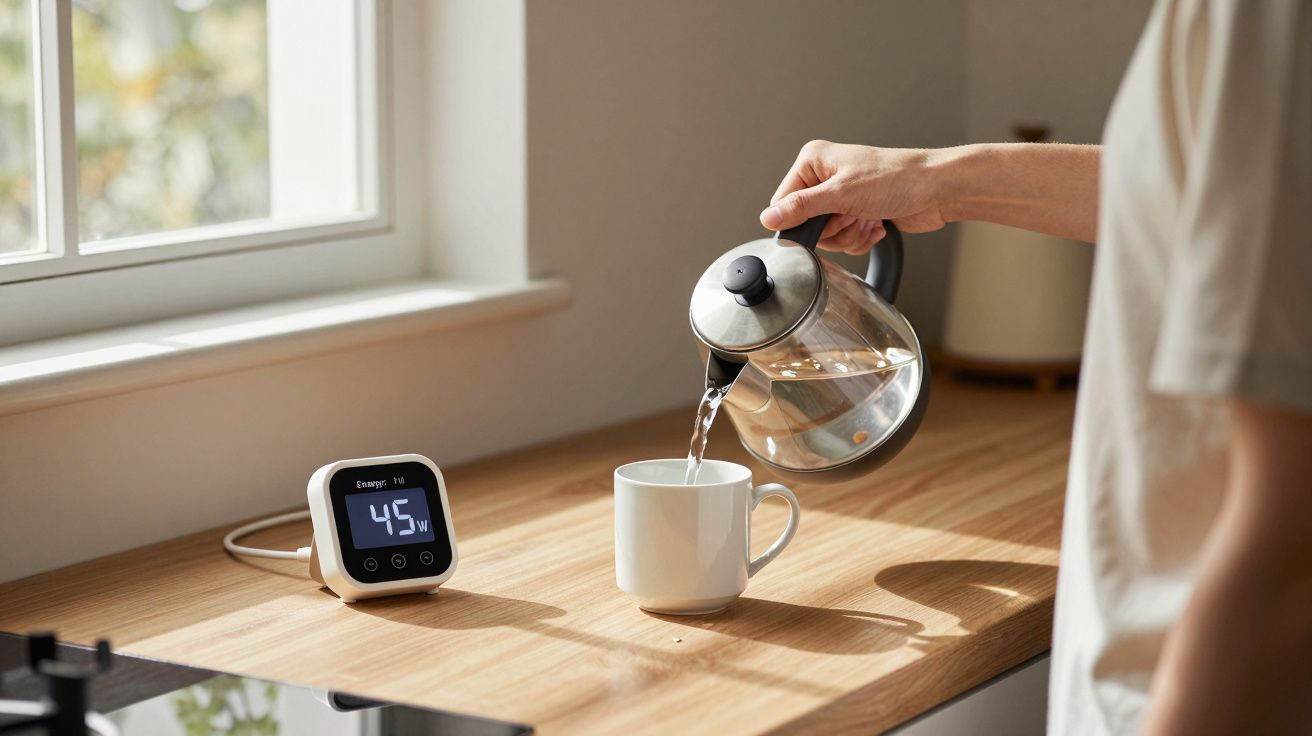
You stand in the kitchen on autopilot, half-awake, kettle in one hand, mug in the other. The habit is older than your energy bills: flip the lid, run the tap, fill it “so it’s done in one”. The water gurgles up to the top mark, you tap the switch, and wait for the familiar rumble.
Two minutes later, you pour one mug, maybe two. The rest of that perfectly good hot water goes straight down the sink when it’s cooled, or sits there until the next “just-top-it-up” boil. You don’t think of it as waste. It’s just how mornings are.
Energy advisers see it differently. To them, every extra inch of water in that kettle is paid for in pence and carbon, over and over again. One compared it to “pouring money down the sink in slow motion” - a handful of coins at a time, quietly leaving your account with every brew. The change they suggest isn’t dramatic. It’s a tiny shift in where you stop.
In a test kitchen in Birmingham, an efficiency consultant once clipped a plug-in monitor between an ordinary 3 kW kettle and the socket. One full boil, numbers flash. One two-cup boil, numbers again. No lectures, no guilt. Just the simple, unnerving realisation: the difference between “a bit extra” and “just enough” is visible on the meter, and it’s not small once you multiply it by a year of tea.
The hidden price of boiling “just in case”
Boiling water is one of the most energy-hungry things you do at home. A typical electric kettle in the UK is rated at around 3,000 watts (3 kW). That’s the same power draw as having thirty 100-watt bulbs on at once - all for a few minutes, several times a day.
Energy specialists break it down like this:
- Boiling 1 litre of water from cold to just-boiling uses roughly 0.1–0.12 kWh.
- At an electricity price of around 28p per kWh, that’s about 3p–4p per full boil.
- Boiling only what you need for two mugs (about 500 ml) costs around half that.
Most UK kettles hold 1.5–1.7 litres. Fill to the top, and you’re paying to heat enough water for six or seven decent mugs when you probably only want one or two. The rest of that energy ends up as lukewarm water in the sink and a bit of gentle steam on your tiles.
On its own, a penny or two of waste doesn’t sound like a crisis. But habits multiply:
- Overfilling by one extra mug’s worth four times a day can easily waste £15–£25 a year in a typical home.
- Scale that across a busy office kitchen with non-stop boiling and it climbs into the hundreds.
That’s why experts reach for strong language. You’re not just boiling water “a bit higher”. You’re literally buying electricity to heat water you never drink.
It’s not just cost, either. Every unnecessary boil also adds to wear on the element and kettle base, and it nudges your household carbon footprint up for no reward. The fix isn’t a new gadget or a hair-shirt lifestyle. It’s a line in a window.
Why the max line on your kettle isn’t a target
Look closely at your kettle’s water window. You’ll usually see:
- A minimum mark (often around 0.5 litres)
- A maximum mark (often 1.5–1.7 litres)
- Sometimes cup icons or intermediate lines in between
Those marks are safety limits, not recommendations. The maximum line is there to stop water boiling over the spout or flooding the base. It’s the absolute most you should ever put in - not the ideal daily level “to be on the safe side”.
Most of us treat that top line as the default. We fill almost to it “because someone else might want a cuppa” or because it feels efficient to do a big boil. In practice, you pay twice:
- You pay in energy – all that extra water soaks up heat you don’t drink.
- You pay in time – a fuller kettle simply takes longer to boil, so you hover, waiting.
Professionals who do energy audits in homes and workplaces see the same pattern again and again. People aren’t extravagant; they’re just guessing. The kettle’s markings don’t help much if you don’t know what they correspond to in real mugs.
“The ‘max’ line is the cliff edge, not the goal,” one adviser put it. “For daily brews, you should rarely be anywhere near it.”
So where should you stop? The mark that actually matters
The sweet spot is brutally simple: just above the amount of water you’re actually about to drink.
As a rule of thumb:
- A standard mug is around 250–300 ml
- Two mugs need 500–600 ml
- Three mugs need 750–900 ml
Many kettles mark “3 cups / 4 cups” down the side. If yours does, aim for the line that matches the number of people you’re making tea for, plus a tiny buffer. If it doesn’t, do this once and then forget about the maths:
- Fill your favourite mug with cold water and pour it into the empty kettle.
- Note where the water level hits on the window – that’s your one-cup mark.
- Repeat for two mugs and three mugs; remember roughly where those sit.
You only have to learn this once. After that, you’re not guessing; you’re choosing.
For most households, the everyday “stop” point is:
- Just above the minimum if you’re making one large mug.
- Halfway between minimum and halfway up the window for two mugs.
- Around the middle for three to four mugs.
Anything beyond that should be the exception: pasta water, hot-water bottles, a houseful of visitors. If you can see the level racing towards the max line for a solo brew, you’re about to pay to heat the sink.
A quick look at what you’re really paying
These are ballpark figures for a 3 kW kettle, starting from cold tap water:
| Water level (approx.) | Energy per boil (kWh) | Cost per boil (at ~28p/kWh) |
|---|---|---|
| 500 ml (2 mugs) | ~0.05–0.06 | ~1.5p–2p |
| 1.0 litre (4 mugs) | ~0.10–0.12 | ~3p–4p |
| 1.7 litres (full) | ~0.17–0.20 | ~5p–6p |
Now picture doing that several times a day, all year. The “little bit extra” becomes a quiet, steady leak.
The tiny habits that cut the waste
Energy experts aren’t asking you to stand there with a measuring jug every morning. They suggest small, repeatable habits that take seconds:
Count the cups first
Decide how many drinks you’re actually making before you touch the tap. Fill to that point and stop.Re-boil less, reuse more
If there’s clean, recently boiled water left, you can re-boil it safely. Boiling the same half-full kettle over and over is still cheaper than filling it fresh to the brim each time.Keep the kettle descaled
Limescale acts like a jumper on the element, making it slightly less efficient and slowing the boil. A quick white-vinegar descale every month in hard-water areas keeps the energy going into the water, not the chalk.Match kettle to household
If you live alone or as a couple, a smaller-capacity kettle naturally discourages “fill it to the top” habits and has a lower max volume to waste.Position the kettle near the tap, not the sink
It sounds trivial, but standing over the sink invites you to overfill “just because you’re there”. A short reach from tap to kettle can nudge you into more precise pours.
None of this will halve your bill on its own. But in a country where kettles are flicked on millions of times a day, these tiny corrections add up - for your wallet and the grid.
Why this matters more in a cost-of-living squeeze
When prices were low, overfilling felt like a non-issue. Now, with unit rates under constant scrutiny and headlines about every extra kWh, hot water has stepped into the spotlight.
The kettle is unusual because:
- It’s high power, used often, and
- The waste is almost entirely in your control
You can’t easily change the insulation in a rented flat, or the age of your boiler. You can change where you stop pouring. It is, quite literally, the twist of a tap.
There’s also a psychological shift. Seeing a plug-in energy monitor spike when the kettle goes on, then fall faster when there’s less water in it, turns an abstract lecture about “efficiency” into something you can see and hear. Once you’ve watched a full kettle take nearly twice as long to click off as a half-full one, it’s difficult to unsee what’s happening inside.
If you think of each overfilled boil as dropping a coin into the sink, you start to fill more carefully, without really trying.
FAQ:
- Is it really that bad to overfill if I only do it once or twice a day?
The waste from a single boil is small, but habits compound. Over months and years, routinely heating unused water costs noticeably more than you think, especially in a busy household.- Is re-boiling water unsafe or “flat” for tea?
For most people and most UK tap water, re-boiling recently boiled water is safe. Very repeated boiling can slightly affect dissolved gases, which some tea enthusiasts notice, but for everyday brews it’s fine.- What if my kettle’s minimum fill is higher than one mug?
Many kettles have a 0.5 litre minimum, which is roughly two small mugs. If you regularly drink just one large mug, consider a smaller kettle or accept that you’ll almost always make enough for two.- Does using a hob or microwave instead of a kettle save energy?
Modern electric kettles are generally among the most efficient ways to boil water. The biggest savings usually come from how much you heat, not what you heat it with.- Does limescale really make a difference to energy use?
Yes, especially in hard-water areas. A thick layer of scale insulates the element, meaning slightly longer boil times and higher losses. Regular descaling keeps your kettle closer to its rated efficiency.



Comments (0)
No comments yet. Be the first to comment!
Leave a Comment