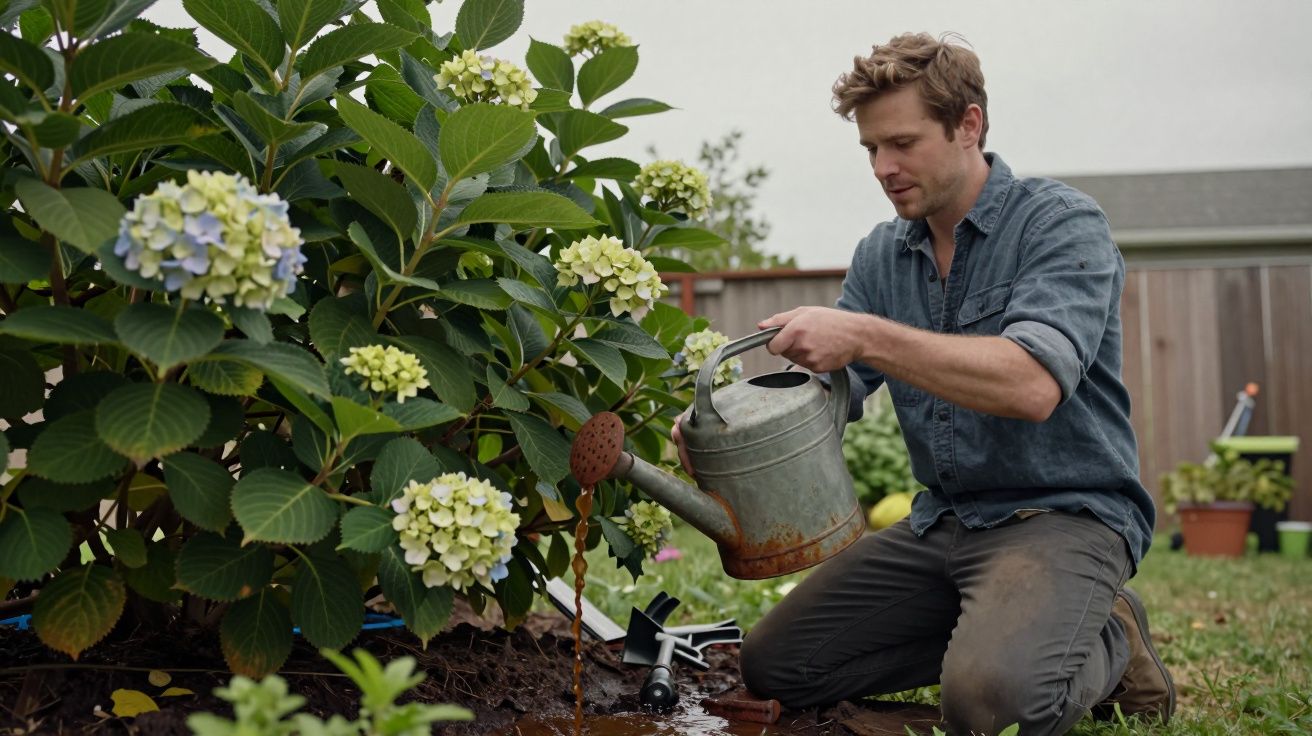
The watering can tilts and you hear it before you see it – a soft clink against metal. You glance inside and spot them: a cluster of rusty nails lounging at the bottom like they own the place. Your neighbour swears by it for “stronger roses” and “greener hydrangeas”. Social media calls it an old-fashioned, eco-friendly iron boost. Somewhere between folklore and clever reuse, gardeners are quietly divided.
You fill the can, swirl, and watch the water tint the faintest brown. Part of you likes the idea: no bottles, no complicated feeds, just a handful of forgotten fixings doing quiet work. Another part wonders what else is dissolving into that water. Is this a thrifty, low-waste tonic for tired plants, or are you slowly turning your soil into a rusty experiment you didn’t mean to run?
Why people drop rusty nails in watering cans
The belief is simple and surprisingly persistent: rusty iron equals iron-rich water, and iron-rich water equals greener leaves. Iron is essential for chlorophyll production, and when plants can’t access enough, new leaves fade to a pale, almost lemony yellow with dark green veins. Garden centres call it “iron deficiency” or “chlorosis”; old hands call it “time for some metal in the can”.
I first saw it properly at a shared allotment in Bristol. One plot holder had a battered galvanised can that rattled every time he moved it. He grinned, tipped it, and a few reddish-brown nails rolled into view. “Old trick from my grandad,” he said. “Hydrangeas love it.” Two plots down, another gardener rolled her eyes. “Or,” she muttered, “you could fix the soil and stop playing witch’s brew.”
The idea appeals because it feels low-tech, frugal, almost romantic. You’re not buying a product; you’re “feeding” plants with something you already have. We’ve all had that moment where a home-made fix feels more satisfying than another plastic bottle. The question is not whether iron matters – it does – but whether rusty nails in a can deliver the right kind, in the right way, without quiet side-effects.
What actually happens when nails rust in water
Rust looks dramatic, but from a plant’s point of view it’s a bit underwhelming. Most of that orange coating is iron oxide, which is largely insoluble in neutral tap water. Only a small fraction of iron will dissolve into a form roots can actually use, and how much depends on your water and your soil.
Here’s the unromantic version:
- In soft, slightly acidic water, a modest amount of iron can leach out over time.
- In hard, alkaline water (common in much of the UK), very little usable iron dissolves, and what does often locks up again once it hits limey soil.
- The real cause of “iron deficiency” symptoms is often not a lack of iron in the ground, but soil that’s too alkaline, compacted or waterlogged for roots to access what’s already there.
So yes, you might see a small benefit in pots of acid-loving plants watered with slightly rusty water, especially if your tap water is soft. But a handful of nails won’t magically fix yellowing leaves if the underlying issue is pH, poor drainage or lack of other nutrients.
“Rusty nails are more theatre than treatment,” says a horticulture tutor I met on a course in Manchester. “They can help a bit in very specific situations, but they don’t replace proper soil care.”
If you’re going to try it, how to do it with minimal risk
If curiosity wins and you’d like to experiment, treat it as a tiny supplement, not a cure-all. A few guardrails keep it from drifting into “soil disaster” territory.
Choose the right nails.
Use plain, uncoated steel nails only. Avoid galvanised, zinc-plated, copper-coated, painted or mystery nails from the bottom of a toolbox – coatings and mixed metals can leach things your plants don’t need.Go small and few.
For a standard 10-litre watering can, 10–15 small nails (3–5 cm) are plenty. You’re aiming for a gentle trickle of iron over time, not a scrapyard at the bottom of the can.Target the right plants.
Reserve rusty-nail water for ornamental, acid-loving plants in containers or isolated beds:- Hydrangeas (especially in pots)
- Camellias, azaleas, rhododendrons
- Blueberries in tubs
Avoid drenching lawns, young seedlings, or delicate alpines with experimental brews.
- Hydrangeas (especially in pots)
Don’t use it every time.
Alternate between normal watering and “nail water”. Think of it as an occasional tonic rather than a staple feed. Overloading iron can interfere with other nutrients like manganese and phosphorus, even if the risk from nails alone is fairly low.Watch for staining and sludge.
Rusty residue can stain paving and terracotta, and flakes can clog the rose of your can. Rinse the can now and then and check that water still flows freely.
If you try it and see no improvement after a few weeks, stop. The nails aren’t the missing piece, and continuing won’t change that.
When the rusty nail trick can quietly backfire
The danger isn’t usually dramatic toxicity; it’s subtle side-effects and misplaced confidence. You think you’ve given plants a boost, so you ignore the real problem.
Common pitfalls include:
Coated or mixed-metal nails.
Galvanised (zinc-coated), copper-plated or painted nails can leach metals and compounds you didn’t sign up for. In small doses they may not kill anything, but they’re not doing the soil food web any favours.Using it on already alkaline, limey soil.
In chalky gardens, iron locks up fast. Adding more via rusty water is like posting letters into a sealed box. The numbers go up on paper but never reach the plant.Masking poor soil structure.
Yellow leaves from waterlogging, compaction or root damage won’t be fixed by iron. If drainage is bad or roots are strangled, any “tonic” is just a distraction.Overdoing it in closed systems.
In small containers that are rarely leached through (especially under cover), repeated dosing with any one element can unbalance the mix over time, even if the source seems mild.Corroding your tools, not feeding your plants.
Leaving metal sitting in damp cans shortens the life of both. Rust spreads, seams weaken, and your “clever” iron supply turns into a pinhole leak you discover mid-watering.
The biggest risk is psychological: you keep chasing folk remedies while your soil quietly gets more compacted, drier, or more alkaline every season.
Better ways to fix yellowing leaves than a handful of nails
If plants are sulking, the nail trick is more of a side-note than a solution. A quick look at the pattern of yellowing tells you more than any folk remedy.
| What you see | Likely issue | What to try first |
|---|---|---|
| New leaves pale yellow with green veins, old leaves stay green | Iron deficiency (often from high pH) | Check pH, add ericaceous compost or sulphur, use chelated iron feed |
| Older leaves yellowing from the tips, new growth small and weak | Nitrogen deficiency | Apply a balanced, slow-release fertiliser or well-rotted compost |
| Random yellow patches, leaves droop, soil heavy and wet | Waterlogging / poor drainage | Improve drainage, ease compaction, raise pots on feet |
| Overall paleness, weak stems, little flowering | General underfeeding | Regular, balanced liquid feed during growing season |
Smarter, evidence-backed moves include:
Test or at least estimate your soil pH.
Cheap test kits are imperfect but helpful. Acid-lovers want soil around pH 4.5–6.5; in many UK gardens they struggle without help.Use chelated iron if iron really is the issue.
Products labelled as “sequestered iron” or “chelated iron” keep iron in a form plants can actually absorb, even in tricky soils. They’re more predictable than rusty nails and used at measured doses.Improve organic matter.
Compost and well-rotted manure improve structure, water-holding and nutrient availability. That often frees up iron already in the soil without adding more.Water wisely.
Over-watering in heavy soil often shows up as yellowing. Let the top few centimetres dry between waterings and consider adding grit or bark for drainage in pots.
“If I’m reaching for iron, it’s after I’ve checked pH, drainage and feeding,” says a head gardener I met in Devon. “The miracle fix is usually a fork and a bag of compost, not a rusty nail.”
A tiny habit that keeps plants greener for longer
The real “trick” isn’t at the bottom of the watering can; it’s in what you look at before you pour. Walk the garden with a mug of tea and notice patterns: which plants yellow first, where water sits after rain, which pots dry out faster than others. A five-minute wander tells you more than a year of folk tonics.
If you love the ritual of a few old nails rattling around, treat it as exactly that: a ritual. Enjoy it, run small experiments, but let it sit alongside – not instead of – the quiet, boring habits that actually keep plants thriving:
- Loosening compacted soil each spring.
- Topping beds and pots with fresh compost.
- Matching plants to the soil you realistically have, not the one you wish you had.
Rusty nails might make a tiny difference in the right corner of the right garden. Healthy soil will make a huge difference almost everywhere else.
FAQ:
- Is rusty nail water safe for vegetables and herbs?
In small, occasional amounts from plain steel nails, it’s unlikely to be harmful, but there’s no real advantage either. For anything you eat, it’s safer and more reliable to use standard, food-safe fertilisers and good compost rather than improvised metal supplements.- Will rusty nails change my soil pH and make it more acidic?
Not in any meaningful way. Rusty nails add iron, not acid. If you need to acidify soil for plants like blueberries, use ericaceous compost, elemental sulphur or specific soil acidifiers instead.- How long do the nails last in the can?
They’ll gradually corrode and thin over months to years, depending on how often the can stays wet. Once they crumble or shed lots of flakes, remove them and start fresh if you still want to use the method.- Are copper coins or wire better than iron nails?
No. Copper is a different element entirely and can be toxic to plants and beneficial soil life in excess. Stick to iron if you’re experimenting, and only in small doses.- Isn’t this the same as buying an iron supplement from the garden centre?
Not really. Commercial iron feeds use chelated forms designed to stay available to plants at certain pH ranges and are dosed precisely. Rusty nails provide an unpredictable, usually low amount of largely insoluble iron, with none of the guidance on how much or how often to use it.


Comments (0)
No comments yet. Be the first to comment!
Leave a Comment