The first thing I saw that morning wasn’t the kettle or the cereal boxes. It was the tangle.
A white extension lead sat in the middle of the kitchen worktop like a tired octopus. One leg to a phone charger, one to a tablet, one to a smart speaker, one to a battery pack somebody swore they’d lost months ago. A smartwatch dangled off the edge, its cable hovering dangerously close to the hob. The toaster had been evicted to make space. The actual plug socket hidden behind it was full, of course. That was why the octopus existed in the first place.
While the coffee machine chugged into life, the multi‑plug made a faint, worrying buzz. The little red switch glowed. A child came in, dropped a school iPad on the only clear patch of worktop and asked, “Is there a spare charger?” There wasn’t. There never is.
A few weeks later, during a routine electrical inspection, the electrician barely glanced at the extension lead before saying, “You know you don’t have to live like that, don’t you?” He flicked the socket off at the wall, moved the toaster back, and sketched a rectangle in the air under the wall units. “You want a charging station there. Hard‑wired. Couple of USB‑Cs. Job done. Phones off the worktop, extension in the bin.”
That was the first time I properly heard the phrase wall‑mounted charging station. It has been following me around kitchens ever since.
The moment the extension lead becomes the unofficial power station
Most of us didn’t plan to turn our kitchen into a gadget pit stop. It just sort of…happened.
The kitchen tends to be where the first spare socket lives. It’s where you drop your keys, your post and, eventually, your phone. Add a second phone, a work laptop, a Bluetooth speaker, a smartwatch, wireless earbuds, the kids’ tablets, the robot vacuum base station, the rechargeable hand vacuum, the kitchen radio and the plug‑in air freshener. Before long, the original twin socket is hiding behind an ecosystem of adaptors.
Electricians see the same patterns again and again:
- Extension leads permanently on the worktop, half‑coiled, half‑dangling.
- Four‑way blocks daisy‑chained into each other “just for now” that somehow became permanent.
- Chargers plugged into the same outlet as a kettle or toaster, right next to the sink.
- Cables trailed across hobs, draining boards and handles because the lead is always 30cm too short.
Individually, none of these are a disaster. Collectively, they add up to clutter, low‑level risk and a background hum of annoyance. You unplug the slow cooker so you can charge your phone. Someone unplugs the fridge to plug in their laptop. The router gets knocked off the worktop. Nobody knows which USB lead belongs to whom.
The modern kitchen has quietly become the home’s unplanned charging hub. The wall‑mounted charging station is what happens when you plan it on purpose.
What electricians mean by a wall‑mounted charging station
The phrase sounds a bit sci‑fi. In practice, it’s much simpler: a dedicated strip or cluster of sockets, fixed to the wall or underneath cupboards, designed specifically for everyday charging.
Electricians describe three main versions they install in UK homes:
Socket rails under the wall units
A slim bar running along the back of the worktop, with several switched sockets and built‑in USB‑A and USB‑C ports. It keeps plugs off the actual surface and away from splashes, but close enough to be useful.Pop‑up or flip‑up chargers in the worktop
Cylinders or rectangular units that sit flush most of the time, then rise up with extra sockets and USBs when you need them. Popular on islands where there are no wall units to hide things under.Charging shelves or “drop zones”
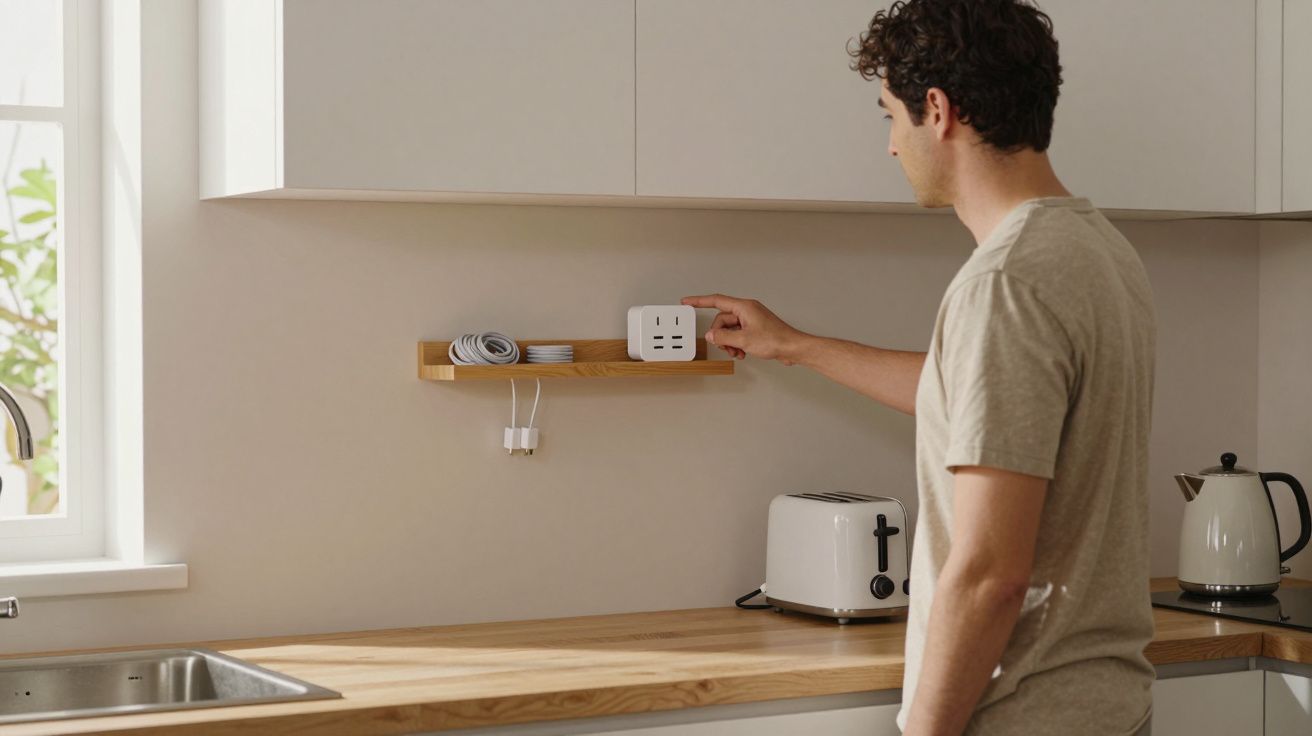
A small wall‑mounted shelf with integrated sockets and USBs, often near the kitchen door or by the fridge. Devices sit on the shelf while charging, instead of sprawling across your main prep space.
Whichever style you pick, the principle is the same. The electrician takes a spurred supply from your existing ring main (or includes it in a full rewire), routes it neatly inside the wall or trunking, and lands it where you actually drop your gadgets. No dangling blocks. No guessing which socket is safe to overload. Everything is screwed down and labelled.
The smarter units now include:
- USB‑C fast‑charge ports for phones and tablets.
- Built‑in surge protection to protect both devices and the rest of your circuits.
- Master switches so you can kill all charging with one flick when you go to bed.
It’s not a separate circuit. It’s a curated corner of the one you already rely on.
Why electricians prefer them to multi‑way adaptors
When you ask electricians what makes them wince in kitchens, extension blocks are very near the top of the list.
They point to three main reasons.
1. Load and heat
UK sockets are robust, but they’re designed with some assumptions about what you’ll plug in. A single four‑gang adaptor running a phone, two tablets, a laptop and a slow cooker might be technically within the 13‑amp fuse, yet still running hot for hours at a time. Add in a cheap, unbranded block and worn contacts and you’ve created a point of failure you’ll only notice when it’s too late.
A wall‑mounted station spreads the load across multiple properly wired outlets, often with individual switches. The wiring is sized correctly. The connections are fixed. There’s less heat trapped behind appliances and tea towels.
2. Water and steam
Kitchens are wet. Worktops get wiped, spills happen, kettles steam. That’s fine for a correctly sited double socket with proper splash‑back clearance. It’s less ideal for a £6 extension lead that’s migrated towards the sink because somebody needed an extra metre of cable.
Electricians can site a charging rail or shelf:
- Above the normal splash line.
- Clear of the hob.
- Far enough from the sink to keep sockets out of the danger zone, while still reachable.
It looks like aesthetics. It’s actually safety.
3. Clutter and cable strain
Leads hanging over edges don’t just look messy; they pull. On the adaptor, on the charger heads, on the devices themselves when someone catches one with an elbow. That’s how plugs crack, sockets loosen and phones hit tiles.
A fixed charging area with short, tidy cables and somewhere for each device to sit reduces constant mechanical strain. It also quietly solves one surprisingly common issue electricians mention: people losing chargers behind appliances and fishing for them while things are still live.
How they’re installed in real kitchens
This is where the fantasy of “a neat little bar of sockets” meets the reality of plaster dust and cable routes.
Electricians divide kitchens into two broad camps:
- New or recently refitted kitchens – easiest, because cables can be run before units and splashbacks go in. Charging stations are designed in from the start, often with matching finishes.
- Existing kitchens – still very possible, but may involve surface trunking, carefully lifted tiles, or cutting small channels into plaster to hide the cables.
A typical retrofit for a short charging rail or shelf often looks like this:
- Survey and testing – they check your existing ring main, protective devices and spare capacity.
- Agree the location – ideally where you already dump your phones, post and keys, not where a brochure says it “should” go.
- Isolate the circuit – power off, confirm dead, no heroic DIY shortcuts.
- Run the supply – from a nearby socket or junction box, usually up inside a cupboard or trunking, not diagonally across the wall.
- Fix and connect the unit – following manufacturer’s instructions and BS 7671 wiring regulations.
- Test and certify – you get the reassurance (and paperwork) that it’s compliant.
For a straightforward job linking into an accessible socket on the same wall, UK electricians will quote anything from £120–£300, depending on the kit you choose and the state of your existing wiring. More complex routes, listed buildings, fancy pop‑up units or worktop cuts push it higher.
Worth noting: in England and Wales, most kitchen electrical work is covered by Part P of the Building Regulations. Translation: get someone who can test, notify and certify properly. That NICEIC / NAPIT logo on the van matters more than the colour of the socket fronts.
Planning a charging station that actually fits your life
The point of a wall‑mounted charging station is not to add another shiny thing. It’s to remove a daily irritation. That only works if you plan it around how you actually live, not how your kitchen looked on the estate agent’s listing.
Electricians suggest thinking through four questions before they arrive:
Where do gadgets naturally pile up now?
That’s your starting point. Fighting your habits rarely works.What really needs daily charging in the kitchen?
Be honest. Maybe the work laptop should live elsewhere, but the family phones and a couple of tablets are realistic.How many ports do you actually need at once?
Add up the devices you’d hate to find at 3% battery on a Monday morning. Then add one spare.Which way is the clutter flowing?
If your island is always covered, a wall shelf by the door might work better. If the windowsill is the current charging graveyard, an under‑cabinet rail above it could reclaim that space.
A quick way to sketch this out:
| Choice | What it changes | Worth knowing |
|---|---|---|
| Under‑cabinet rail | Keeps sockets off the worktop | Great for long stretches of wall, less good on islands |
| Pop‑up worktop unit | Power in the middle of the room | Needs a hole cut in the surface and good sealing |
| Charging shelf | Devices live off the worktop entirely | Doubles as a key/post drop zone; make sure it’s at eye level, not head‑bump level |
Remember: this is not the place to plug in your air fryer or slow cooker. Electricians like to keep high‑load appliances on their own standard sockets, and your charging station focused on low‑power devices. Protects both the wiring and the worktop real estate.
The small rituals that make it feel different
When the extension lead finally goes, what changes isn’t just the look of the room. It’s the small, boring rituals.
One family I spoke to had their electrician install a short rail with two normal sockets and four USB‑C ports under a cupboard near the back door. Below it, they added a simple wooden shelf with a lip.
Within a week:
- All phones slept there at night instead of beside beds.
- The extension block disappeared from the worktop.
- The “have you seen my charger?” arguments dropped sharply.
In another house, a pop‑up unit on the island became the rule: if it’s plugged in there, it’s Fair Game Community Charging. That simple boundary stopped trailing cables across the actual cooking area.
You don’t need a chore chart. You need:
- Short, labelled leads that live at the station, not roaming cables borrowed from bedrooms.
- A habit of flicking the master switch off at bedtime.
- An agreement about which devices get priority when space is tight.
It sounds almost comically small. Yet anyone who has ever tried to roll pastry around a node of tangled wires will tell you: visual calm on a worktop is worth something.
Common doubts (and what electricians actually say)
Electricians hear the same questions on repeat when they suggest charging stations. The answers are usually less dramatic than people expect.
- Isn’t a wall‑mounted charger just overkill for a couple of phones?
It depends what “a couple” means. In most modern households, once you count phones, tablets, earbuds, watches and speakers, you’re rarely under six devices. A fixed solution isn’t about luxury; it’s about not overloading a £10 block for the sake of kit worth thousands.- Will it look ugly or “too commercial”?
Manufacturers have caught up with domestic taste. You can match socket finishes to your existing plates, choose low‑profile rails, or tuck units under cabinets so you hardly see them. Electricians are surprisingly opinionated about this; they don’t like ugly lines either.- What about wireless charging pads instead?
They’re handy, and some charging shelves now integrate Qi pads, but they still need a proper supply behind them. A hard‑wired station can feed wireless pads and give you cabled options for laptops, e‑readers and older devices.- Is it really safer than my current set‑up?
In almost every case electricians see, yes. Properly installed fixed wiring, RCD protection, fewer adaptors and less cable strain all reduce common fault points. Nothing is 100% foolproof, but you’re moving from “makes do” to “designed for purpose”.- We’re renting – is there anything we can do?
You’re right to be cautious about permanent changes. Some landlords will agree to an upgrade if a qualified electrician does the work and the fixtures stay with the property. Short of that, look for individually switched, surge‑protected extension blocks that can be screwed to the underside of cabinets rather than left loose on the worktop. It’s not the full station, but it’s a step away from the floor‑level octopus.
The quiet satisfaction of one less tangle
A few days after the electrician left, I stood in the kitchen in the half‑light, kettle on, listening to…nothing. No faint buzz from an overworked adaptor. No cable dragging across the chopping board. Just a neat rail of sockets under the cupboard, a tidy bundle of short leads on a shelf, and a blank, clear run of worktop that looked strangely grown‑up.
The smart meter didn’t do anything dramatic. The total load was roughly the same. But the feeling of control shifted. I knew where everything plugged in. I knew nothing was hiding behind appliances, straining a socket I couldn’t see. I knew one innocent spillage wouldn’t immediately find its way into a cheap plastic block.
We’re not going to rewire the national grid by tidying our charging habits. We are, however, allowed to admit that some of the clutter and low‑level risk in our homes is entirely optional.
Next time you step over a loop of cable to reach the tea bags, look at that glowing little multi‑plug in the corner and ask yourself a simple electrician’s question: Does this need to be loose? Or could it live on the wall, doing the same job without taking over the room?






Comments (0)
No comments yet. Be the first to comment!
Leave a Comment