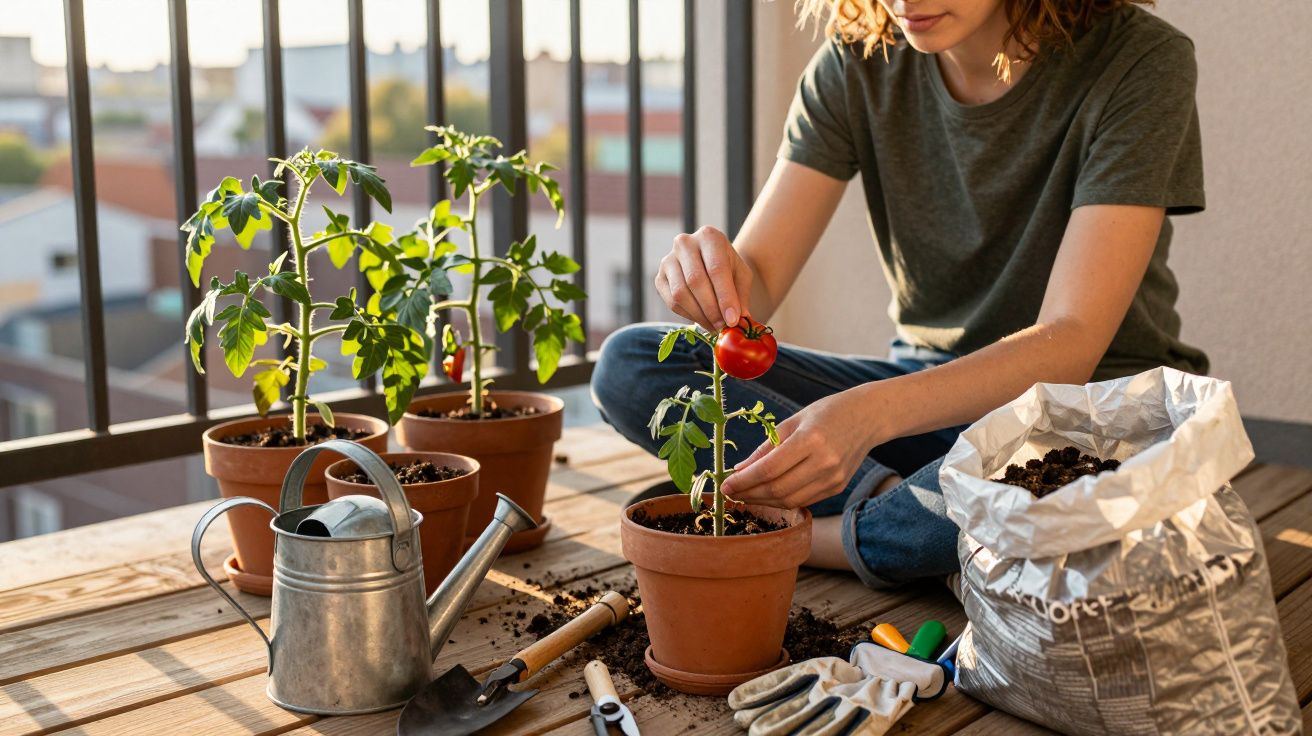
Late light on the balcony, chair pulled close to the rail, the city softening underneath you. The tomatoes should be doing their part: thick stems, a tangle of yellow flowers, the sharp green smell when you brush past them with a glass in your hand. Instead, the plants lean and flop, all stem and no substance, leaves reaching for more of a sun they already have.
You water. You talk to them. You’ve tried pinching out side‑shoots and tying them neatly to canes. A neighbour swears by banana skins, someone else by aspirin in the watering can. Still, week after week, the same thin promise: leggy growth, barely any fruit.
On a balcony, tomatoes live or die by what’s under the surface. In a border, roots can wander off to find what they need. In a pot, every mistake is magnified and there is nowhere to escape. The compost you chose in a rush back in April is still making decisions for you in August.
You don’t need magic fertiliser or a bigger balcony. You need to stop your soil sabotaging the plants before they’ve even set their first truss of flowers.
Why balcony tomatoes so often sulk
Tomatoes are greedy, shallow‑rooted and fast. They want warmth, constant but not soggy moisture, and a steady feed. In open ground, that’s spread through a whole bed of soil. In a pot, it’s compressed into ten or twenty litres of mix that has to act as fridge, water tank and pantry all at once.
Balcony conditions turn the volume up. Containers dry faster in wind. Concrete and brick bounce heat back at the leaves. Rain often never reaches the compost because of overhangs. A mix that might just about cope in a big border quickly runs out of breath in a pot.
When plants respond by stretching upwards, it’s easy to blame “too little light” or “a bad variety”. Often, the real culprits are in the pot: soil that’s too light, too heavy, or simply exhausted.
Soil mistake n°1: Fluffy compost, empty cupboard
The most common balcony error is filling pots with straight, very light multipurpose compost and assuming that’s enough for the season. Fresh out of the bag, it looks perfect: dark, springy, promising. Six weeks later it’s a different story.
High‑peat or ultra‑light peat‑free mixes hold water and air well at first, but they simply don’t contain enough long‑lasting nutrients for a hungry crop. The first flush of growth burns through what’s there. Roots hit a kind of invisible wall. Above ground, stems keep stretching but leaves pale, flowers drop and fruit stays small or never forms.
You can see the symptoms:
- Tall, spindly plants with long gaps between leaves.
- Lots of green growth early on, then a stall.
- Flowers that appear, then shrivel without setting fruit.
The fix is to think of compost as a base, not the whole meal. Tomatoes in pots need:
- A mix with some real structure (a bit of loam or garden soil, if it’s not contaminated).
- Slow‑release fertiliser in the compost from the start.
- Regular liquid feeds once the first flowers appear.
A simple balcony‑friendly blend per 10 litres of mix:
- 7 L good peat‑free multipurpose compost
- 2 L loam‑based compost or clean garden soil
- 1 L perlite or fine grit for drainage
- A handful of slow‑release tomato fertiliser or pelleted organic fertiliser
That extra weight and food stops the plant racing upwards on empty, then stalling before it ever thinks about tomatoes.
Soil mistake n°2: Heavy, airless mixes that drown the roots
At the other extreme sits the “use what’s there” approach: scooping garden soil into pots, topping with a bit of compost, maybe adding a spadeful of half‑rotted compost from the bottom of the heap. It feels thrifty and solid. On a balcony, it’s a trap.
Pure garden soil in a container compacts quickly. Add constant balcony watering and you get a dense, airless plug. Roots struggle to breathe; they sit in cold, wet soil that takes too long to drain. Above ground, plants react oddly: they may look lush and dark green at first, but stems are weak, growth is uneven, and any hot spell leaves them sulking.
Air in the root zone matters as much as water. Without it, tomatoes respond a bit like plants grown on a windowsill in too small a pot: tall, floppy, desperate. Fruit set is poor because stressed roots can’t support the energy‑hungry business of making trusses and ripening clusters.
To avoid building a swamp in the pot:
- Never use straight garden soil for balcony tomatoes.
- Skip heavy “topsoil” bags marketed for lawns – they’re too dense alone.
- Make sure every container has generous drainage holes and a thin layer of crock or coarse bark, not a solid layer of stones that clogs.
Then balance your mix:
- One part loam or soil for minerals and weight.
- Two parts quality compost for organic matter.
- Enough perlite, coarse sand or fine gravel that a handful of moist mix feels crumbly, not sticky.
Water should run out of the bottom within seconds, not minutes. The surface should dry slightly between waterings while the core stays just moist. That sweet spot keeps roots exploring sideways, building a wide, strong base that supports flower and fruit, not just another foot of stem.
Soil mistake n°3: Pots that run out of soil by July
The third mistake isn’t just what the soil is made of, but how much of it there is. Balcony gardeners often squeeze tomatoes into any spare pot: old herb containers, decorative planters, shallow troughs. The plant looks fine in May. By late July, it’s equivalent to asking a teenager to live off a side plate.
A standard cordon (tall) tomato wants roughly 10–15 litres of compost per plant, minimum. Bush and dwarf types cope with slightly less, but anything under 8 litres makes life a battle. In small volumes, even a perfect mix collapses: it dries within hours, nutrients flush away with each watering, and roots circle the pot, hitting hard plastic instead of more soil.
That constant stress pushes plants into survival mode. They stretch, searching for better ground that never arrives. They may throw out lots of leaves to capture more light and water, but they lack the reserves to set and swell fruit.
Two simple rules:
- One tall tomato per 30 cm pot or larger, filled right to a couple of centimetres below the rim.
- No more than two plants in a standard grow bag, and even then, sitting the bag in a crate or tub of extra compost makes a big difference.
Top up soil levels mid‑season if the mix slumps. A shallow pot that started full in May can be half‑empty by August; adding a collar of extra compost around the stem gives roots another layer to colonise and somewhere fresh to find food.
Building the right pot from the start
If you fix the soil, most balcony tomato problems calm down. Light, variety choice and pruning matter, but it’s what’s under your feet that decides whether you’re picking fruit or just watering disappointment.
A simple balcony tomato setup:
Choose the container
- 30–40 cm diameter, 10–15 L minimum for tall varieties.
- Big drainage holes, no solid saucer of standing water.
- 30–40 cm diameter, 10–15 L minimum for tall varieties.
Mix your soil
- 70% good peat‑free compost
- 20% loam‑based compost or clean garden soil
- 10% perlite, fine gravel or coarse sand
- Add slow‑release fertiliser pellets at planting.
- 70% good peat‑free compost
Plant deep
- Bury the stem up to the first true leaves.
- Tomatoes root along buried stems, giving more root in the same pot.
- Bury the stem up to the first true leaves.
Feed the soil, not just the plant
- Start weekly tomato feed when the first flowers open.
- Top‑dress with a couple of centimetres of fresh compost mid‑season.
- Start weekly tomato feed when the first flowers open.
Watch the signals
- Pale new leaves: soil running out of nitrogen.
- Flowers falling: soil too dry or too wet, or suddenly starved.
- Very lush, leafy growth with few flowers: too much nitrogen, not enough potash.
- Pale new leaves: soil running out of nitrogen.
A small tweak to what’s in the pot often changes the story on the balcony.
Key balcony tomato soil pitfalls at a glance
| Mistake | What happens | Simple fix |
|---|---|---|
| Pure fluffy compost, no reserves | Early sprint, then pale, leggy, fruitless plants | Add loam + slow‑release feed, start liquid feeds with flowers |
| Heavy, compacted soil | Weak roots, stressed, uneven growth | Lighten with compost + perlite, ensure fast drainage |
| Too little soil volume | Pots dry fast, nutrients vanish, roots pot‑bound | Use 10–15 L per plant, top up slumped compost mid‑season |
FAQ:
- Can I reuse last year’s compost for tomatoes? You can reuse part of it, but not on its own. Sieve out old roots, then mix roughly half old compost with half fresh compost and some slow‑release fertiliser. Avoid growing tomatoes in the same mix two years running if you’ve had disease problems.
- Are grow bags good enough on a balcony? They can work, but they’re shallow and dry quickly. Stand the bag in a large crate or tub, cut big planting holes, and heap extra compost around each plant to increase depth and volume.
- Is adding gravel at the bottom of the pot helpful for drainage? A thin layer of crock to stop holes blocking is fine, but a thick layer of stones creates a “perched water table” where water sits just above the gravel. It’s better to improve drainage throughout the mix with perlite or coarse material.
- Do cherry tomatoes need the same soil as big beefsteaks? Yes. Cherry types are often even more vigorous above ground, so they still need rich, well‑drained soil and a decent volume of it. The difference is in the fruit size, not the root appetite.
- How often should I feed tomatoes in pots? Once the first flowers appear, feed weekly with a high‑potash tomato fertiliser, following the label. In hot spells with lots of watering, an extra light feed mid‑week helps replace what leaches out of the soil.






Comments (0)
No comments yet. Be the first to comment!
Leave a Comment