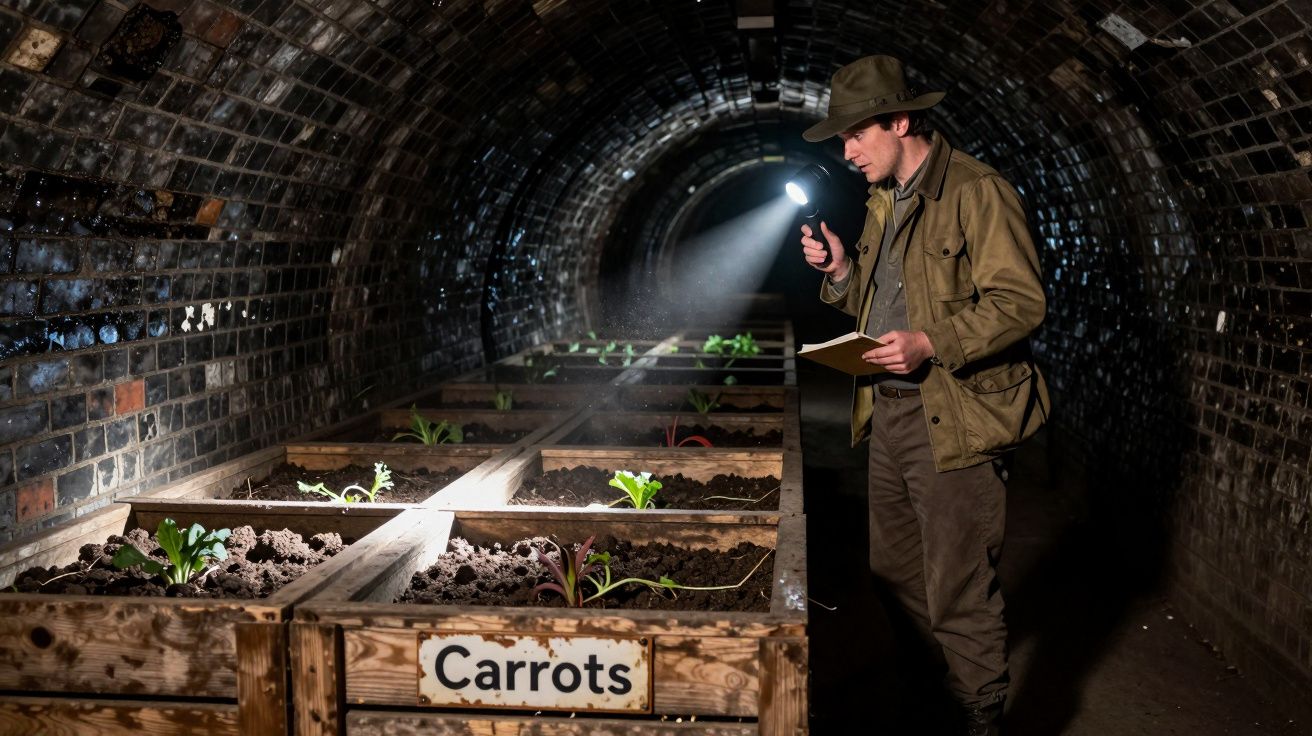
The first thing they noticed wasn’t the brickwork or the rusted cables.
It was the smell.
Not the sour, metallic tang you expect in a disused Tube tunnel, but something softer and strangely familiar: dry earth, old wood, a ghost of compost and cabbage. One of the archaeologists crouched down, ran a torch along the curved wall, and the light caught it – a row of low timber boxes, packed tight against the tunnel’s edge like sleeping suitcases.
On the side of one, in fading pencil, someone had written a single word: “Carrots”.
For a moment, the air raid sirens and dust of 1940 seemed closer than the traffic rumbling above.
They weren’t just standing in another abandoned piece of London’s infrastructure. They were standing in what looked very much like a vegetable garden, built in secret under the city while bombs fell overhead.
The underground allotment London forgot
During the Blitz, Londoners famously slept on Tube platforms, packed shoulder to shoulder along tracks that no trains would use at night. The stations filled with bunks, first-aid posts and makeshift canteens. Above ground, official propaganda urged people to “Dig for Victory” in parks, verges and back gardens.
Hidden in one disused tunnel, it seems, someone took that slogan literally – and downwards.
The tunnel in question was an unfinished spur, sealed off from the public and used for storage. Wartime records mention it only in passing: “ancillary space for shelter provisioning”. No diagrams, no planting plans. Just a vague note in the margin of a file that sat untouched for eighty years.
What the archaeologists have pulled from the dust fills in the gaps. Shallow wooden troughs lined with hessian. Thin metal hoops bent into low frames for cloches. Ceramic shards that once held paraffin lamps or simple electric bulbs. Soil samples flecked with seeds of fast-growing greens: lettuce, radish, spring onions, beetroot leaves.
Not a quaint hobby plot, but a dense, efficient strip of food production – carved into the side of a Tube line.
Why growing veg in a Tube tunnel wasn’t as mad as it sounds
At first glance, it seems impossible. Plants need light; tunnels are dark. You picture pale, leggy stems reaching hopelessly towards a bare bulb.
The picture that emerges is subtler. Wartime engineers already wired shelter tunnels for lighting and ventilation. Adding a few extra rows of lamps above low beds wasn’t a huge technical leap, especially for shade-tolerant crops and seedlings destined for daylight upstairs. Mushrooms and sprouting beans, which thrive in the half‑light, would have loved it.
The tunnel also had two huge advantages that no bomb‑scarred back garden could match:
- A stable temperature, cool in summer, relatively mild in winter.
- Protection from shrapnel, smoke and the shower of soot and glass that ruined many outdoor plots.
In that controlled, if gloomy, environment, you could coax a surprising amount of food from a few dozen square metres. Leafy veg, baby roots, trays of cress and mustard, herbs to brighten the famously drab rations – enough, archaeologists estimate, to give several hundred shelterers the occasional fresh addition to their tinned stew or bread.
Ration books provided calories. Underground greens provided vitamins and morale.
What the archaeologists actually found in the dark
The romance of the story is one thing; the evidence is another. To work out what really grew here – and how – the team had to read tiny clues that most eyes would skip.
Under one planter, they lifted a compacted layer of soil and sent it for analysis. Under the microscope: fragments of onion skin, beetroot pigment, even traces of phosphorus and potash from wartime fertiliser. Stuck to a nail in the timber, a scrap of waxed paper with the printed words “Allotment Mixture – 2oz”.
On the tunnel wall, faint chalk marks divided the space into rectangles, each labelled with initials and dates. It looked less like graffiti, more like a rota: who watered, who sowed, who harvested.
One small metal tag, green with age, carried the stamped words “W.V.S. – Kitchen”. The Women’s Voluntary Service ran countless canteens during the war, turning donated produce into meals in church halls and shelters. The tag suggests they may have had a hand in organising this subterranean patch too.
Piece by piece, the picture sharpened: this was not an eccentric one‑man experiment. It was a system.
“It’s like finding a village allotment squeezed into a railway carriage,” one researcher said. “Nothing is wasted. Every board, every lampshade, every centimetre of soil has a job.”
- Wooden troughs and soil chemistry point to leafy veg and quick roots.
- Lamp fittings and soot marks reveal how they solved the light problem.
- Labels, chalk marks and tags hint at an organised, mostly female workforce.
The quiet logistics of feeding hundreds from the shadows
Imagine a winter evening in 1941. Families file down the station steps with blankets and enamel mugs, tired from work and queueing for food. The shelter wardens check names; the distant thud of bombs starts up again over the river.
In a side‑tunnel, a small group moves in the opposite direction. They check the soil with bare fingers, pinch off yellowing leaves, snip handfuls of cress and spinach with blunt scissors. A battered handcart waits, loaded with empty crates and soup pots.
What they’re doing is technically nothing extraordinary. It’s just gardening.
What makes it extraordinary is where and why. Official rationing was already stretched. Fresh produce was seasonal, patchy and often beyond the reach of those who had lost homes, gardens and income. An underground “micro‑allotment” offered three crucial things:
- Reliability. It didn’t matter if the allotments above were bombed or the lorry of cabbages was delayed. The tunnel kept ticking over.
- Proximity. Food grown metres from the bunk beds could be in a stew within the hour, with no fuel wasted on transport.
- Privacy. In a city raw with fear and rumours of shortages, it was easier to manage a small, sensitive supply quietly than to publicise it.
No one suggests this tunnel alone kept a borough alive. But for those who queued at the shelter canteen window and tasted something fresh and green in their bowl, it might have felt like a small miracle – and a reminder that life could grow in the grimmest corners.
Why this hidden garden still matters now
On paper, the discovery is a footnote: a quirky wartime innovation, halfway between an allotment and a science experiment. In practice, it lands very differently when you picture the people who tended it.
Someone had to carry sacks of soil and manure down those stairs. Someone had to learn, fast, which crops would tolerate low light and cramped beds. Someone had to water, in the middle of air raids, and then sleep a few metres away, knowing they’d do it again tomorrow.
Strip away the romance, and what’s left is an idea that feels oddly modern: using “dead space” in a city to grow food close to where people actually are. Disused tunnels, basement corners, rooftop sheds – the sort of places most of us never look at twice.
Today we call it urban farming, vertical gardens, hydroponics. In 1941, in a sealed Tube spur, it was just survival with a trowel.
There’s a quiet lesson for the present hidden in that soil:
- Food systems can be more flexible than we think.
- Tiny, local plots add up when the big systems falter.
- The cleverness we need in a crisis often starts with whoever is standing nearest to the problem.
A wartime gardener hauling compost down a spiral staircase probably didn’t think of themselves as innovative. They were filling stomachs and passing time between sirens. The innovation label came later.
| Key point | Detail | Why it matters now |
|---|---|---|
| Hidden, organised food production | Evidence of structured beds, rotas and canteen links | Shows how improvised systems can quietly underpin resilience |
| Using “useless” urban space | A sealed tunnel became a micro‑allotment | Encourages us to see basements, roofs and corners as potential food sites |
| Small harvests, big impact | Greens and roots for a few hundred people | Reminds us that modest yields can still transform daily life |
Reading the tunnels differently
Once you know about the underground garden, the Tube map starts to look different. Each grey spur and abandoned loop is no longer just an engineer’s afterthought. It might have been a storeroom, a billet, a first‑aid post – or, in at least one case, a strip of quiet soil under electric light.
Most of the people who sowed and watered here are gone. Their names are chalk dust on damp brick. The vegetables they grew were eaten in silence between explosions, not photographed for the papers.
But the idea they left behind has a way of tunnelling forward.
Every time a city school grows salad in a lightwell, or a community cuts planters into an old car park, they’re closer to that hidden plot than they realise.
Somewhere in a lab, a tray of soil from the tunnel is still drying, still giving up its secrets seed by seed. The war it served is long over. The question it poses – how do we feed each other when the usual answers fail? – is very much alive.
FAQ:
- How do archaeologists know vegetables were grown in the tunnel? Soil analysis, seed fragments, fertiliser traces, planting boxes and labelled tags together form a strong picture of deliberate crop growing rather than simple storage or rubbish.
- What kind of crops were likely grown underground? Evidence points to fast, compact plants such as leafy greens, radishes, spring onions, herbs and possibly mushrooms or sprouting beans, which cope better with low light and restricted space.
- Was this garden officially sanctioned or a secret project? Records are thin, but links to shelter provisioning and the Women’s Voluntary Service suggest at least quiet approval, even if it never featured in public propaganda.
- Could a similar system work in modern cities? Yes, and in many places it already does: basement farms, container gardens in car parks and repurposed industrial sites all echo the same principle of using marginal spaces for local food.
- Why keep the garden hidden during the Blitz? Announcing a special, limited food source in a stressed, hungry city could have caused unrest. Keeping it low‑key made it easier to manage fairly and protect from theft or sabotage.





Comments (0)
No comments yet. Be the first to comment!
Leave a Comment