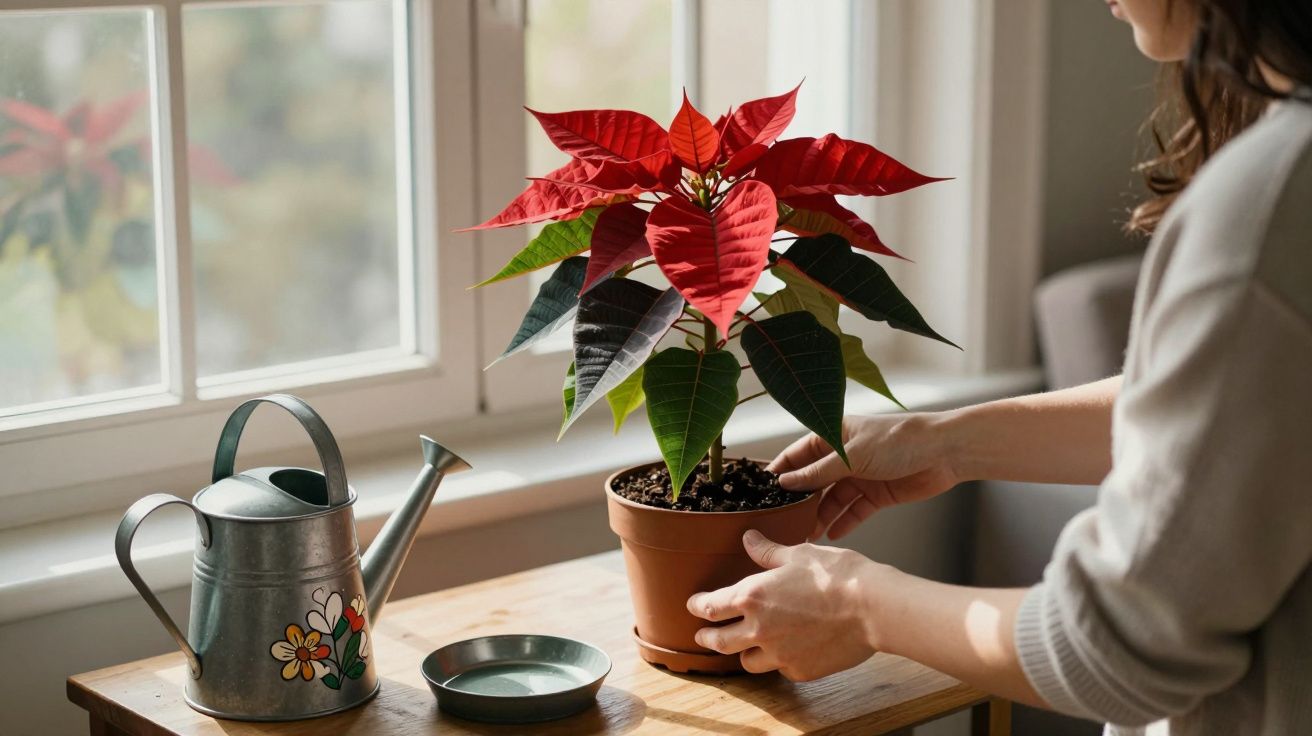
The red bracts are still glowing in the living room, but the soil already looks like a moral dilemma. Do you water “a little, just in case”? Wait until it droops and pray? Most poinsettias in British homes don’t actually die at Christmas. They fade slowly through January, dropping leaves one by one, while you second‑guess every jug of water.
Nurseries don’t do guesswork. They follow a steady rhythm that keeps poinsettias not just alive but properly presentable until Easter displays roll round. The good news: you can copy that rhythm in a flat with one plant as easily as they do in a glasshouse with thousands.
Think of it less as “green fingers” and more as a reliable routine: soak, drain, wait, repeat.
Why your poinsettia “suddenly” collapses in January
From the plant’s point of view, nothing is sudden. The roots have been struggling for days.
Poinsettias hate two things more than anything else: sitting in cold, wet compost and being chilled below about 15°C. The classic British combo of a draughty sill, radiator underneath and a decorative foil pot cover is, bluntly, a slow‑motion disaster.
Overwatering is usually the main villain. A poinsettia can cope with you being slightly late with the watering can. It cannot cope with its roots drowning in a saucer of water for three days.
The “sudden death” many people notice is almost always root rot finally showing on the leaves.
Once roots rot, they can’t move water to the top of the plant, so the leaves wilt and fall even though the compost feels wet. That’s why simply “watering a bit” every couple of days is the worst thing you can do.
The nursery rule: soak, drain, then hands off
Commercial growers work with a simple pattern that protects the roots:
- Water thoroughly so the whole root ball is moist.
- Let the excess drain completely – no standing in water.
- Leave it alone until the top of the compost has clearly dried again.
They do not trickle water over the surface whenever they walk past. They give a proper drink, then a clear rest.
In practice, that looks like this:
- Water in the morning, not late evening.
- Water from above, slowly, until a little runs out of the bottom.
- Empty the saucer or decorative cachepot after about 15–20 minutes.
- Do not water again until the top 2–3cm of compost feels dry and the pot feels lighter when you lift it.
This soak‑drain‑rest cycle is what keeps the fine feeder roots healthy. Healthy roots mean the coloured bracts can stay bright for months instead of weeks.
The quiet schedule from Christmas to Easter
How often does that full cycle happen in a typical heated UK home? Nurseries roughly work with this rhythm and adjust by eye.
Late November to New Year: the “display” phase
The plant has just arrived from a warm, bright glasshouse and is in peak condition.
- Likely frequency: every 4–7 days.
- Target: compost evenly moist but never soggy.
- Your cue: the top feels dry to the touch, the pot feels a bit lighter, leaves still firm.
Because central heating is often running hard, water can evaporate faster than you think. But resist the urge to top up between proper waterings.
January to February: the “survival” phase
Light levels are at their lowest, radiators are on, and the plant is no longer being forced to flower. Growth slows.
- Likely frequency: every 7–10 days.
- Target: let the top few centimetres dry properly before each soak.
- Your cue: the surface looks pale and dry, the pot feels noticeably lighter, but the leaves are still mostly horizontal, not limp.
When light is low, the plant uses less water. Keeping the old December rhythm in January is how many poinsettias quietly rot.
This is the time to be stingier, not kinder.
March to Easter: the “green houseplant” phase
If you’ve made it to March with most leaves intact, you’re already ahead. The red bracts may be fading; the plant behaves more like a standard green foliage plant.
- Likely frequency: every 7–12 days, depending on temperature and light.
- Target: slightly on the dry side rather than slightly wet.
- Your cue: same as January, but you may find you can stretch a day or two longer between waterings.
At this point, many nurseries are moving stock on and focusing on new crops, not keeping poinsettias show‑perfect. For a home plant, though, the same schedule still works.
How to tell if your poinsettia is thirsty – or drowning
Your fingers and a quick lift are more reliable than any calendar. Nurseries check, then water; they don’t water, then hope.
| Sign you notice | What it usually means | What to do |
|---|---|---|
| Top 2–3cm of compost dry, pot feels lighter, leaves still firm | Time for a proper drink | Do a full soak, then drain |
| Leaves drooping, compost dry and pulling from the pot edge | Mild drought stress | Water thoroughly; it will usually perk up within hours |
| Lower leaves yellowing and dropping, compost stays dark and cold | Overwatering / poor drainage | Let it dry longer, tip out any standing water |
| Leaves dull, edges brown, near a cold window or draught | Cold damage | Move to a warmer, draught‑free, bright spot |
Aim to water because the plant tells you to, not because it’s Sunday.
Copying nursery conditions in an ordinary home
You cannot turn your living room into a commercial glasshouse, but you can copy the parts that matter most.
- Light: Bright, indirect light is ideal – a south‑ or west‑facing window with sheer curtains, or a bright spot a little back from an east‑facing window. Deep shade means the plant uses almost no water and slowly sheds leaves.
- Temperature: Poinsettias prefer 18–22°C. Avoid anything below 15°C and sudden drafts from opened windows or front doors.
- Radiators and fires: Don’t bake it. A plant perched directly above a radiator dries too fast on top while roots sit in unevenly warm compost.
- Pot covers: Decorative foil or ceramic sleeves trap water. Either remove them for watering or tip out every drop from the bottom after each soak.
Think of your poinsettia as a slightly fussy guest: it wants bright company, steady warmth and dry feet.
If you get those three right, the watering schedule becomes easier to judge.
One watering session, step by step
Here’s the exact routine many growers teach new staff – scaled down for one plant on a windowsill.
- Check first. Press a finger into the compost up to your first knuckle. If it feels cool and damp, leave it. If it feels dry and the pot is light, proceed.
- Move to the sink or bath. Take the plant out of any outer decorative pot or sleeve.
- Water slowly from above. Use room‑temperature water. Pour evenly over the compost, not just in one spot, until you see a little water emerge from the drainage holes.
- Wait 15–20 minutes. Let the pot sit in the empty sink so any excess drains fully.
- Empty and return. If you use a saucer or decorative pot, make sure there is no water left underneath when you put it back.
- Hands off. Don’t water again until the top has clearly dried and the plant has signalled it is ready.
Shortcuts – a quick splash here, a bit left in the saucer there – are exactly what nurseries avoid.
Common mistakes that quietly wreck poinsettias
Most failures come from a small cluster of very fixable habits.
- “Little and often” watering. Keeps the surface damp and the root ball sour. Switch to full drinks with proper drying time.
- Never emptying the saucer. Standing water rots roots. If you want a pretty pot, treat it like a sleeve, not a reservoir.
- Leaving it in its shop sleeve. Those crinkly plastic sleeves are for transport only. They trap moisture and heat.
- Parking it by the front door. Every time the door opens, the plant gets a chill. Repeated cold shocks are as bad as one big one.
- Misting the bracts. It marks and spots the coloured leaves, and does nothing useful for humidity at root level.
Changing just one or two of these often doubles the lifespan of a plant that “always dies by mid‑January”.
A simple weekly check that keeps you on track
Instead of worrying daily, borrow a small nursery habit: a quick structured check once or twice a week.
- Pick two check days (say Wednesday and Sunday).
- On those days, lift the pot, feel the compost, scan the leaves.
- If it clearly needs water, do the full soak–drain routine there and then.
- If not, walk away. Trust the plant, not the calendar.
Over a few weeks, you’ll notice your own household pattern. For many UK homes that lands near once a week in winter, stretching a bit longer if the room is cool and bright.
FAQ:
- Can I keep my poinsettia for next Christmas as well? Yes, but that’s a separate project. To re‑colour the bracts you’ll need strict light and dark periods from early autumn. For this year, focus on keeping it healthy until spring; a strong plant is the only good starting point for re‑flowering later.
- Is it better to underwater than overwater? Within reason, yes. A slightly dry poinsettia that you water thoroughly will usually recover. A plant sitting in cold, wet compost for a week often will not.
- Should I repot it after Christmas? Not during winter. Nurseries keep poinsettias slightly pot‑bound for a reason: too much fresh compost stays wet and cold. If the plant is still going strong in late spring, you can move it into a slightly larger pot with fresh, free‑draining compost.
- Do I need special fertiliser to keep it alive to Easter? Not usually. A healthy plant in its original nursery compost has enough nutrients to see it through winter. If it’s still leafy in March, a weak general liquid feed once a month is sufficient.






Comments (0)
No comments yet. Be the first to comment!
Leave a Comment