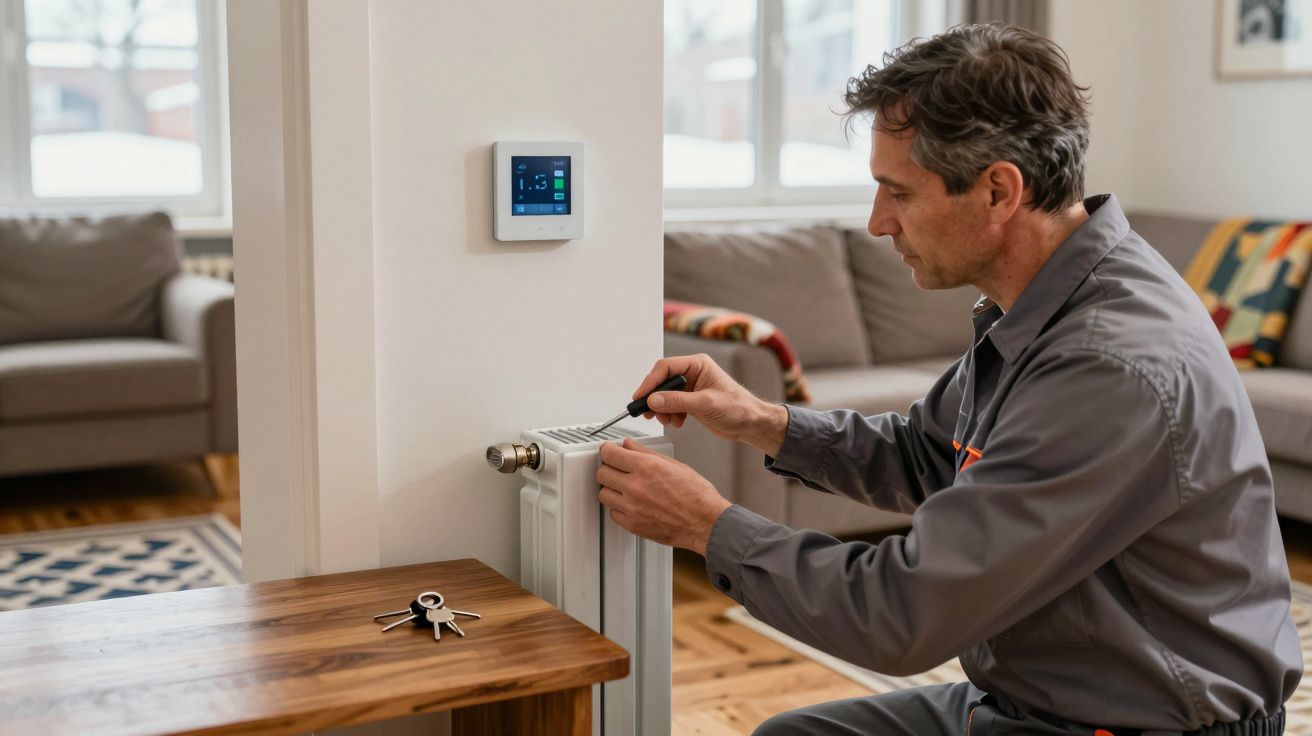
The living room radiator ticked away, too hot to rest a palm on. The boiler light was on, the smart thermostat swore it was “heating to 20°C”, and yet the air still had that thin, stubborn chill. You put on another jumper, maybe nudge the thermostat up a notch, and wonder if winter has outsmarted you.
A heating engineer later walked through the same room, ran a hand along each radiator in turn, and asked a question that sounded oddly simple: “Is this a bleed problem or a balance problem?” Ten minutes and a small screwdriver later, the room finally felt like central heating was meant to feel.
For years, most of us have learnt one basic trick: if a radiator’s not right, bleed it. Little key, hiss of air, job done. Sometimes that works. Often it doesn’t. What many engineers wish you knew is that there is a second, quieter culprit that wastes far more heat: an unbalanced system that never sends the right share of hot water to the right rooms.
Once you know how to ask the bleed‑or‑balance question, your radiators stop being a mystery. They become clues.
The one-line question that changes how your house heats up
Here’s the rule that many engineers use on every call‑out:
When a room feels cold, but the radiator is hot, ask: “Is this a bleed issue or a balance issue?”
It sounds almost too neat. Yet that tiny shift changes what you look for.
Instead of “the heating’s rubbish”, you start noticing patterns: where the heat goes first, which radiators sulk at the edge of the circuit, how the boiler behaves when everything’s on. You move from guessing to diagnosing.
Very roughly:
- Bleeding deals with air stuck at the top of a radiator.
- Balancing deals with water flow through the whole system.
Engineers want you to separate those in your mind because the fixes – and the risks – are different. Reaching for the bleed key when your system actually needs balancing is like letting air out of a perfectly good tyre while ignoring a bent wheel. You feel busy but solve nothing.
Bleeding vs balancing: what’s actually going on?
Both problems end up in the same place: rooms that don’t feel as warm as they should for the money you’re burning.
Inside your system, a pump pushes hot water from the boiler through pipes and radiators, then back again. The boiler likes a certain flow of water and a certain temperature drop between “out” and “back”. Get that right and it runs efficiently. Get it wrong and it short‑cycles, strains, and wastes gas.
Bleeding: when air gets in the way
Air rises to the top of radiators. When enough collects, you see and feel:
- Radiator warm at the bottom, cool or stone‑cold at the top
- Sloshing or gurgling noises when heating fires up
- Slightly quicker boiler cycling as parts of the system don’t fill properly
Bleeding lets that trapped air escape so water can reach the full panel again. It’s a local fix, one radiator at a time.
Balancing: when the flow’s all wrong
Balancing is about giving each radiator its fair share of hot water. Without it, the flow races through the easy radiators near the boiler and barely trickles through the long pipe runs to cold rooms.
Signs of poor balance include:
- Radiators closest to the boiler blazing hot; distant ones lukewarm
- Upstairs roasting while downstairs never quite gets there (or vice versa)
- Boiler firing, then cutting out after a short burst, over and over
- Loud rushing water in some radiators, almost nothing in others
Balancing uses the lockshield valves (the small capped valves, usually on the opposite end to the thermostat head) to gently throttle some radiators so others get a chance. It’s a whole‑system tweak, not a quick local vent.
Quick comparison at a glance
| Symptom you notice | Likely bleed issue | Likely balance issue |
|---|---|---|
| Top cold, bottom hot on a single radiator | ✓ | |
| All radiators warm, but some rooms still chilly | ✓ | |
| Loud gurgling, “running water” sounds | ✓ | ✓ (if flow too high) |
| Radiators near boiler scorchingly hot, far ones tepid | ✓ | |
| One radiator stays cold even after bleeding | ✓ (or stuck valve/sludge) |
The table isn’t a diagnosis, but it gives you the right next question to ask.
How to do a safe, simple bleed
Bleeding is still useful, as long as you know when to stop blaming air for everything.
Before you start
- Turn the heating off and let radiators cool a bit – warm is fine, scalding is not.
- Grab:
- A radiator key (or flat‑head screwdriver for some modern valves)
- A cloth or small bowl for drips
- Kitchen roll to protect carpets or skirting
The basic bleed steps
Find the bleed valve
Usually at the top corner of the radiator, a small square or slot.Position the cloth or bowl
Hold it just under the valve to catch any water.Turn the key slowly, anti‑clockwise
You should hear a hiss of air. That’s what you want.- Keep turning only until you get a steady trickle of water.
- Then turn it back clockwise to close firmly, but don’t overtighten.
Check your boiler pressure (sealed systems)
If you have a combi or pressurised system, look at the pressure gauge:- Around 1.0–1.5 bar when cold is typical (check your manual).
- If it’s dropped low after bleeding several radiators, you may need to top it up using the filling loop – carefully, and only to the recommended level.
Turn the heating back on and re‑check
Once radiators are hot again, feel the top. If it’s evenly warm, the bleed worked.
A few points engineers quietly wish more people knew:
- If you bleed the same radiator every few weeks, air is getting in somewhere. That needs investigation.
- Bleeding a lot of radiators without watching pressure can pull the system too low, making the boiler lock out.
- If the top is warm but the middle or bottom stay cold, you likely have sludge, not air. Bleeding won’t fix that.
When it’s not air at all: the classic balance problems
“My radiators were hot but the room stayed cold” is almost the textbook line for a balance issue. The metal is doing its best. The room still loses heat faster than that particular radiator can replace it – often because the system is sending most of the hot water somewhere else.
Common balance‑type complaints:
- The hallway radiator is nuclear, but the back bedroom limps along at “just about tolerable”.
- Switching one cold radiator off makes others hotter.
- The boiler “short cycles”: fires strongly, then cuts out every few minutes even though your rooms are still cold.
“Hot metal doesn’t equal warm room,” as one engineer puts it. “You want the right metal hot at the right time.”
What balancing actually involves
Balancing is a bit more fiddly than bleeding, which is why many people hand it to a professional. The basic idea:
- Open all radiator valves fully, both TRVs (thermostatic heads) and lockshields.
- Turn the heating on and let the system warm up.
- Measure or feel the temperature difference between the flow (pipe into the radiator) and return (pipe out).
- On radiators that get too hot too quickly, slightly close the lockshield to restrict flow.
- On colder radiators, leave the lockshield more open so they get more flow.
- Aim for a gentle, even warm‑up across the house and a sensible temperature drop across the whole system (often around 10–20°C, depending on boiler type).
Professionals will often use clip‑on thermometers or digital probes to do this precisely. You can have a go by touch – carefully – but tiny turns matter. A quarter of a turn can change a lot.
Should you balance it yourself?
You can try, especially on a simple system with only a handful of radiators. However:
- It’s easy to get lost and end up worse off than when you started.
- Condensing boilers work best when correctly balanced; bad DIY guesses can lower efficiency.
- If you’re not confident identifying valves and pipework, call an engineer and specifically ask for a system balance, not just a “service”.
The key thing is not who does it, but that the word “balance” enters the conversation.
The 5-minute check: bleed or balance?
Next time a room feels cold, walk the house once with the heating on and pay attention to four things:
Radiator pattern
- One or two radiators with cold tops? Think bleed.
- Whole ends of the house underperforming? Think balance.
Boiler behaviour
- Long, steady runs followed by rests: usually healthy.
- Rapid on‑off cycling while rooms are still cool: often poor balance or sizing.
Noise
- Gurgling and sloshing: air or very high flow.
- Loud rushing water in a few radiators: likely too much flow there, starving others.
TRVs and valves
- Make sure all TRVs you expect to be “on” are actually set high enough.
- Check that lockshield caps are present and haven’t been knocked half shut by accident.
From that mini‑audit, ask yourself the one‑line question. If your gut answer is “balance”, that’s exactly the phrase to use when you ring for help.
How to talk to a heating engineer (and get the right fix)
Engineers hear “my heating’s rubbish” all winter. What helps them – and you – is a short, specific description.
Useful phrases:
- “Radiators near the boiler get very hot. The ones in X room barely warm up.”
- “The tops are hot; it’s the room that stays cold.”
- “We’ve bled them. No trapped air now.”
- “The boiler keeps firing for a couple of minutes, then turning off, then on again.”
Then the question they quietly love:
“Do you think this is a bleed issue, a balance issue, or something else entirely?”
That tells them you understand there’s a system to tune, not just a magic button to press. It nudges the visit away from “bleed and go” and towards checking pump speed, lockshields, boiler settings and, if needed, sludge and pipework.
If money is tight, be upfront:
- Ask them to prioritise key rooms (living room, main bedroom) for balancing if there isn’t time to do the entire house.
- Request that they show you which valves they adjusted, so you understand the layout for the future.
A half‑balanced house is still better than none.
Small habits that turn heat into comfort, not waste
Once the system is properly bled and balanced, a few low‑effort tweaks keep it that way:
- Don’t hide radiators behind heavy curtains or big sofas if you can avoid it.
- Use TRVs sensibly: slightly cooler in hallways and bedrooms, warmer in living spaces.
- Have the boiler and system checked every couple of years, especially if you notice new noises or uneven heating.
- After any plumbing or radiator changes, ask explicitly: “Will you balance the system afterwards?”
When the flow is right, something subtle changes. Rooms warm evenly. The boiler sounds calmer. You stop chasing the thermostat up and down.
The house doesn’t become tropical. It just feels…even.
FAQ:
- Is bleeding radiators dangerous? Done carefully, it’s usually safe. The main risks are hot water burns and dropping boiler pressure too low on sealed systems. Let radiators cool a bit first, open valves slowly, and always check the pressure gauge afterwards.
- How often should a system be balanced? There’s no fixed schedule. It’s worth checking after major changes – adding or removing radiators, fitting a new boiler, or altering pipework. Otherwise, rebalance when you notice clear signs: some rooms much colder, uneven warm‑up, or short cycling.
- Will balancing actually save me money? A well‑balanced system lets your boiler run in longer, more efficient cycles and reach set temperatures without overshooting. That usually cuts gas use and wear on components, especially on modern condensing boilers that like a steady flow and cooler return temperatures.
- Can I just turn up the pump speed instead of balancing? Increasing pump speed can mask problems in the short term but often makes noise worse and can still leave distant radiators under‑supplied. Balancing works with the pump, not against it, and is the correct fix for distribution issues.
- What if one radiator still won’t heat after bleeding and balancing? That often points to a stuck valve, closed lockshield, or sludge blockage in the radiator or pipe. An engineer can test flow, free or replace valves, and advise on power‑flushing or replacing very clogged radiators.




Comments (0)
No comments yet. Be the first to comment!
Leave a Comment