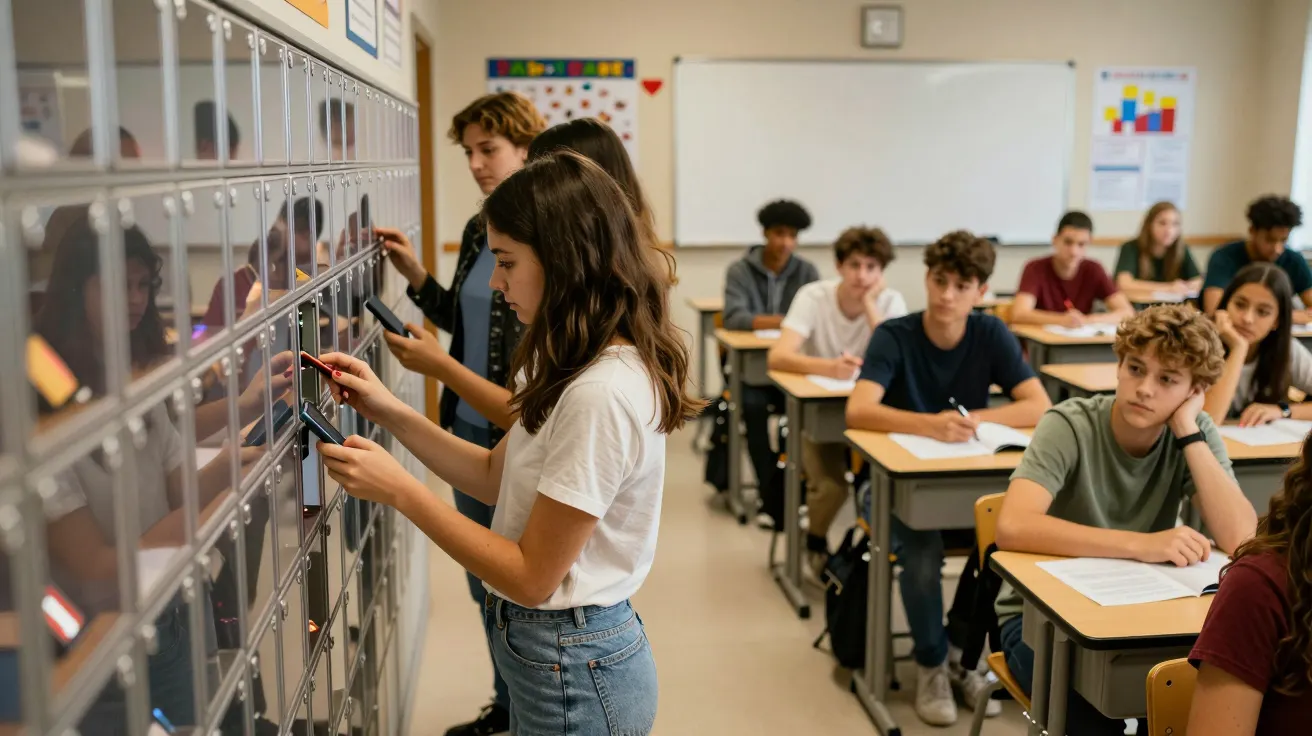
The bell goes and thirty teenagers surge towards a metal cupboard by the classroom door, phones flashing briefly in their hands before they slide into numbered slots. One boy hesitates, fingers tight around his screen, then drops it in and walks to his seat a little more slowly than the rest. By the time the door clicks shut on the “phone locker”, the room already sounds different: chairs scraping, not notification pings.
Outside, on the parents’ WhatsApp group, the debate is louder. Some celebrate “finally, they can concentrate”, others bristle at the idea of their child being unreachable for six hours a day. In corridors and canteens, meanwhile, pupils trade more practical information: where to buy a cheap decoy handset, which teacher actually checks the lockers, how to sneak a smartwatch under an oversized cuff.
This is what happens when a tiny object becomes the gravity centre of learning, safety, and teenage identity all at once. The box on the classroom wall is about far more than screens. It’s about who gets to press pause.
Why schools are locking phones away now
Smartphones have crept from pockets onto desks and under tables, turning every lull in a lesson into a scroll-shaped temptation. Teachers talk about attention not as a light you switch on, but as a muscle already tired before first period, worn thin by late-night messages and always-on social feeds. The phone locker is one of the bluntest tools schools have reached for to protect what’s left.
Headteachers point to rising concerns about online bullying, viral dares, and high-stakes missteps that start with a camera click in the loos. In crowded urban schools, a single incident filmed and shared can derail a week’s worth of lessons. Lockers promise a simple equation: no phone in hand, no footage to upload.
New guidance in some parts of the UK encourages “clear, consistently enforced” mobile phone policies. For many leaders, a visible storage unit in every classroom feels more workable than endless reminders to “put it away”. A box with numbers adds ritual and removes argument. In theory.
“We tried ‘off and in the bag’; we tried ‘only at break’. Every lesson started with a negotiation,” one head of year admits. “The lockers mean we can start with teaching.”
What teachers say they’re seeing
Ask staff in schools that have brought in lockers and a pattern surfaces. There are still behaviour issues, of course, but the nature of some conflicts has shifted. Arguments over who filmed whom in the corridor drop; disputes over borrowed glue sticks creep back in. Low-level distraction now comes more from whispered gossip than glowing screens.
Several teachers describe a quieter hum in the first ten minutes of a lesson, a stretch that used to be punctuated by phantom vibrations and students checking “just one thing” under the table. Without the option, pupils either settle quicker or find more old-fashioned ways to fidget - doodling, tapping, looking out of the window. It’s not a miracle cure, but it does change the soundtrack.
Staff also notice fewer public flare-ups over confiscations. When the rule is that everyone’s phone goes in a slot at the start, an individual challenge becomes a challenge to the system, not to the teacher personally. That small shift can defuse some of the heat.
There are trade-offs. One pastoral lead mentions the Year 11 pupil who used to step out for a private call with a counsellor at lunchtime and now must plan around office phones and supervision. Another points out that pupils who use accessibility apps for dyslexia or hearing support need exceptions, which can create tensions around fairness. The box on the wall does not know who relies on their device as a lifeline rather than a distraction.
Parents caught between safety and sanity
For many parents, the idea of their child spending the school day without a phone lands like a relief. No more covert messaging threads about who sits with whom at lunch. No more buzzing during English because someone in another borough has started drama. A firm boundary, set by somebody else, can feel like a gift.
Others see the same policy and taste panic. Phones are not just entertainment; they are trackers, torches, and emergency lines in a world that doesn’t always feel safe. A Year 8 walking home in winter feels easier to bear when you can check their location on an app or expect a quick “on the bus” text. Shut lockers between eight-thirty and three-thirty turn that thread into a gap.
Then there are more subtle fears. For children managing chronic conditions, parents may worry that a missed call about a medication change or a sudden illness will take longer to reach them. Schools usually offer office lines and agreed plans, but they do not ring in your coat pocket on the Number 42.
Most families are juggling competing hopes:
- A calmer learning environment where teachers teach more and police screens less.
- A sense of safety on the way to and from school, especially for older pupils.
- Some space for teenagers to manage small issues themselves without a constant back‑channel to home.
- Assurance that when something does go wrong, the adults can still talk.
The same phone that interrupts a French lesson is the one a parent imagines their child holding in a lockdown. No policy can entirely dissolve that tension.
Teenagers: new rules, old creativity
If adults talk in terms of policy and safety, teenagers talk in tactics. Within weeks of phone lockers appearing, pupils in many schools can list the unofficial workarounds as easily as the locker numbers.
Some bring a decoy: an old handset or a cheap second device that lives in the slot while the real phone stays in a blazer pocket. Others take the SIM card out before school and tuck it into a pencil case, leaving a blocked phone behind while their actual number rides along with them in a smaller device or a smartwatch. A few simply refuse and absorb the detentions, turning the phone into a badge of quiet rebellion.
There are softer versions too. Pupils compliant in class but glued to their screens the second the bell goes, rapidly making up for “lost” time by scrolling through six hours of messages on the walk home. Lockers can compress habits rather than transform them, shifting the binge rather than dialling it down.
Psychologists point out that adolescence is when autonomy is practised in thousands of small decisions. Banning phones outright risks turning those decisions into secret experiments instead of shared learning. A well‑run policy, they argue, works best when it comes with conversation: what’s hard about being offline, what feels better after a week, what you miss and what you don’t.
“Young people will always probe the fence,” one school counsellor says. “The question is whether we stand on the other side shouting, or walk with them and explain why it’s there.”
Different stakeholders, different stakes
A single metal locker can mean very different things depending on where you stand.
| Perspective | Main worry | What they hope for |
|---|---|---|
| Teacher | Disruption and conflict over phones | Focused lessons, fewer arguments |
| Parent | Safety and contact in emergencies | Calmer children, clearer boundaries |
| Pupil | Losing autonomy, missing out socially | Less pressure to be ‘always on’ (even if they won’t say it aloud) |
Understanding those layers matters when the first disciplinary letters go home or the first complaints land in governors’ inboxes. Without that, it is easy to paint one group as overreacting and another as uncaring, when most are just protecting what they see as fragile: learning, safety, independence.
Making phone limits work beyond the classroom
Lockers can redraw the school day, but what happens at home often decides whether the change sticks or snaps back. You cannot completely outsource digital habits to a metal cupboard on a Monday morning.
A simple approach some families and schools are trying looks less like a ban and more like a rhythm:
- Create a “parking spot” at home - a bowl, shelf, or small box where phones go during dinner or homework. Name it, make it visible, and use it yourself.
- Set one or two phone‑free windows each day (for example, 8–8.30pm, or the first 30 minutes after school) and keep them consistent rather than ambitious.
- Talk about the first week of lockers like an experiment, not a verdict. Ask what felt different in lessons, and share honestly what felt different at your end too.
- Agree an emergency plan so everyone knows: if something urgent happens, here is how school will contact home, and here is how home can reach school.
Let’s be honest: nobody follows these rules perfectly. Some days the phone stays in the kitchen; other days it travels room to room tagged to your hip. What matters is not spotless compliance but the sense that screens are part of family life, not the invisible boss of it.
For schools, the gentler tweaks often help most: making sure exceptions are clear and fair, training staff to handle disputes with calm rather than power struggles, and checking in with pupils who rely heavily on phones for anxiety or communication before the policy hits. Lockers change the hardware; relationships do the rest.
What to watch as phone lockers spread
The story of classroom phone lockers is still being written. Over the next few years, the questions worth asking may sound less like “are you for or against?” and more like:
- Do pupils in locker schools report feeling more focused or just more frustrated?
- Does bullying shift platform or actually reduce in intensity and reach?
- Can schools keep emergency communication robust without slipping back into “just text me from under the desk”?
- Are there quieter gains, like more face‑to‑face friendships or pupils who discover they quite like a lunchtime without notifications?
Policy rarely keeps pace with technology, and technology rarely waits for us to agree how to live with it. For now, a metal box by the classroom door is where those two speeds collide. Whether it becomes an anchor for calmer learning or simply another battlefield in the phone wars will depend less on the latch, and more on how everyone talks about what goes inside.
FAQ:
- Are phone lockers actually proven to improve attainment? Evidence so far is mixed and still emerging. Some schools report better concentration and fewer behaviour incidents, but exam gains are harder to pin directly on lockers alone.
- What if my child needs their phone for medical or accessibility reasons? Most schools make individual arrangements for pupils using devices for health or support apps. Ask for a written plan so your child and their teachers know exactly what’s allowed.
- Isn’t banning phones teaching avoidance rather than self‑control? Lockers reduce temptation in a specific context so attention can recover. Self‑control still needs practising at home, on the bus, and in social time where rules are looser.
- Can pupils’ phones be searched if they’re in lockers? In the UK, schools have limited powers to search devices under certain conditions. Policies should explain when and how this might happen; you can request to see the detail.
- What’s a realistic step for families not ready for strict bans? Start with modest, predictable phone‑free moments - during meals, in bedrooms overnight, or the first half hour after school - and build from there once those feel normal.


Comments (0)
No comments yet. Be the first to comment!
Leave a Comment