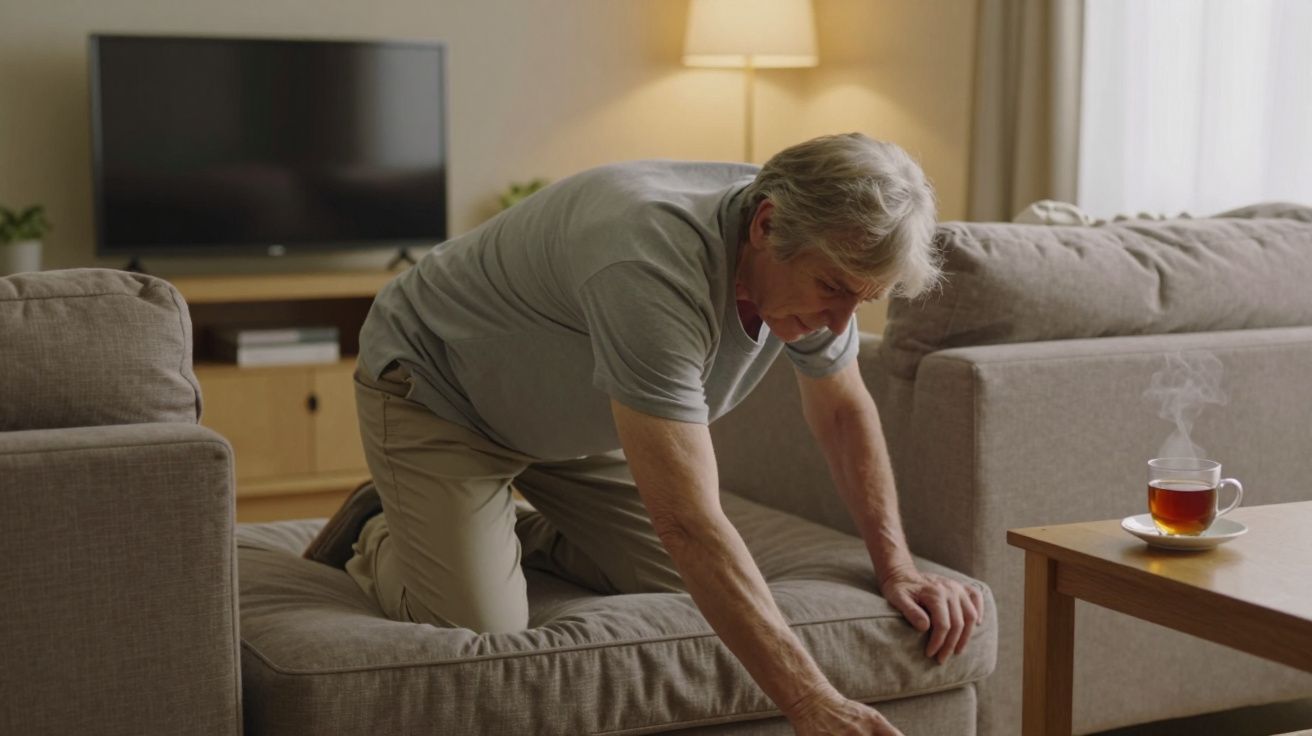
The first thing you notice isn’t the pain, it’s the sound. A soft grunt as someone pushes themselves out of a low sofa. The quick hand to the lower back. The pause before walking off. Sitting is meant to be rest, yet for many over‑60s, it’s quietly becoming the moment their hips and spine stiffen up the most.
In one NHS physio clinic, a therapist dragged a plastic spine to the edge of a chair and curled it into a tight C‑shape. The model pelvis tipped backwards, the vertebrae squeezed at the back. “This,” she said, “is the posture that’s doing half my waiting list.” Not dramatic falls. Not heavy lifting. Just one way of sitting, held for hours.
The sitting habit that slowly stiffens your spine
NHS physiotherapists give it a blunt name: the long slump.
It’s that deep, rounded sitting position you fall into on low, soft chairs and sofas: pelvis rolled under, tailbone tucked, shoulders rounded, chin poking forward. Your knees often end up slightly higher than your hips, your weight on the back of the pelvis rather than the sitting bones.
A quick slouch isn’t the issue. Bodies are built to move in and out of shapes. The problem is parking yourself in this C‑shape for long stretches – evenings in front of the TV, long car journeys, scrolling on a tablet in a recliner. Over time, that quiet, familiar slump is what loads your lower back and hips in exactly the way they like least after 60.
Here’s the uncomfortable bit physios see every day: for many people with back and hip pain, the worst position isn’t bending or walking. It’s the way they sit.
Why this posture hits over‑60s harder
Your spine and hips haven’t suddenly become fragile at 60, but the margin for error is smaller.
Discs between the vertebrae naturally dry out a little with age, so they’re less squishy and forgiving. Sit in a strong C‑curve and you repeatedly squeeze the back of those discs, nudging the soft material inside towards sensitive structures over and over again. That’s when stiffness turns into sciatica‑type symptoms for some people.
Around the hips, years of sitting with the legs bent keep the hip flexors short and the glutes underused. In the long slump, those glutes more or less switch off. The work shifts to smaller, more irritable muscles near the spine and into the front of the hips. When you finally stand up, everything has to wake up at once.
NHS physios also worry about balance. If your usual pattern is: sit in a deep C‑shape, lean heavily on your hands, then heave yourself upright, you slowly lose the strength and confidence to get up without support. That’s how a “bit of stiffness” in your 60s can quietly set up mobility problems in your 70s.
To be clear, nobody is asking you to sit bolt upright like a guardsman. The goal is simply to spend less time at the extremes – less time in that full, end‑range slump your joints tolerate poorly now.
How to spot the “long slump” in your own home
Most people don’t realise how often they sit like this until someone points it out. Try these simple checks around the house.
- The sofa test: Sit in your usual spot and try to stand up without using your hands. If you have to rock or push hard, your seat is probably too low and too soft, encouraging that deep slump.
- The pelvic check: When you sit, notice whether you’re on the bony points under your buttocks (your sitting bones) or rolled back on the tailbone. Tailbone = long slump territory.
- The rib–hip gap: Place a hand on your lower ribs and one on the top of your pelvis. In a big slump they almost meet. In a kinder posture there’s a bit more space.
NHS physios often start by changing where and how people sit, not by handing out complicated exercises. Small tweaks to your favourite chair beat expensive gadgets you never use.
How to sit instead (without feeling like a soldier)
Think “relaxed upright”, not “ramrod straight”. A posture you can actually keep while you read, watch TV or have a cuppa.
Aim for:
- Hips level with or slightly above knees
Use a firm cushion to raise low seats. This opens the hips and makes it easier to sit on your sitting bones instead of the tailbone. - Pelvis gently tipped forwards
Shuffle your bottom right to the back of the chair, then tilt your pelvis so you feel the weight move onto the sitting bones. A small rolled towel or lumbar cushion in the small of your back can help. - Feet flat, weight shared
Both feet on the floor, not tucked under the chair or wrapped around the legs. This lets your legs support some of the load instead of dumping everything into your lower back. - Back supported, not pinned
Lean against the backrest, but allow tiny movements – shifting weight, adjusting your shoulders, changing leg position. Still is not the same as supported.
Physios often suggest the 20‑minute fidget rule: if you’ve been in the same posture for more than 20–30 minutes, it’s time to change something. Stand up, walk to the kitchen, or at least uncurl and reset your sitting bones.
Micro‑moves that undo a day of slumping
You don’t need an hour‑long routine. A few small, repeatable moves sprinkled through the day can keep hips and lower back happier.
Here are exercises NHS physios commonly teach over‑60s:
- Sit‑to‑stands from a higher chair
Raise your usual chair with a firm cushion if needed. Feet hip‑width apart, lean slightly forwards, stand up without using your hands if you can, then sit back down with control. Start with 5–10 repetitions, once or twice a day. This strengthens thighs and glutes – your built‑in anti‑slump muscles. - Seated pelvic tilts
Sit towards the front of a chair, feet flat. Gently roll your pelvis to slump a little, then roll the other way to gently arch the lower back. Small, comfortable movements, 10–15 times. You’re reminding your spine it has options beyond the C‑shape. - Hip flexor stretch at the worktop
Stand facing your kitchen worktop, hands on the edge. Step one foot back, bend the front knee and gently push the back hip forwards until you feel a mild stretch at the front of that hip. Hold 20–30 seconds, each side. This counteracts all the time spent with hips bent. - Standing back extensions
Stand tall, hands on the back of your hips. Gently lean backwards a little, looking straight ahead, then return to upright. 5–10 small, comfortable repetitions, especially after long sitting.
None of these should be painful. Slight stiffness or awareness is fine; sharp pain or nerve symptoms are your cue to ease back and, if needed, speak to a professional.
A small seating audit with big long‑term pay‑off
If NHS physios could sneak one thing onto every over‑60s’ to‑do list, it wouldn’t be “10,000 steps”. It would be a 15‑minute tour of your chairs.
Walk round your home and check: which seats leave you in a deep slump, which allow your hips to sit higher, which you can actually get out of easily? Change what you can – firmer cushions, a different favourite chair, a dining chair with better height for TV time.
It feels almost too ordinary to matter. Yet the position you sit in for hours a day quietly teaches your spine and hips how to behave. Shift that habit, and a surprising amount of stiffness and aching has less chance to take root.
| Key point | Detail | Why it matters |
|---|---|---|
| Avoid the long C‑shaped slump | Low, soft seats, pelvis rolled under, tailbone bearing weight | Reduces constant strain on discs, joints and hip flexors |
| Raise and firm up your seating | Cushion low chairs, choose firmer surfaces, hips ≥ knee height | Makes it easier to sit on sitting bones and stand up safely |
| Move every 20–30 minutes | Stand, walk, or reset posture briefly | Keeps joints lubricated and muscles active, not switched off |
FAQ:
- Do I really have to sit “properly” all the time? No. Brief slouching is fine; the issue is long, unbroken spells in a deep slump. Think variety and regular resets, not perfection.
- Is crossing my legs bad for my hips or back? Short periods are usually fine, but if you always sit heavily crossed to one side, it can feed asymmetry. Swap sides or uncross regularly, and prioritise the basics: hips level, feet flat most of the time.
- What if my favourite chair is very low and soft? Try adding a firm cushion to raise the height, or keep that chair for short spells and use a slightly higher, firmer one for longer sits. If you can’t stand up from it without using your hands, it’s not ideal as your main seat.
- Should I buy an expensive ergonomic chair? Helpful if you sit at a desk for hours, but not essential. Many NHS physios prefer simple, adjustable chairs plus good habits: hips at or above knee level, back supported, regular movement.
- When should I see a professional about back or hip pain? If pain lasts more than a few weeks, is severe, wakes you at night, or you notice leg weakness, loss of bladder/bowel control, or numbness in the groin area, seek urgent medical advice. Otherwise, your GP or an NHS physio can assess you and tailor a plan.



Comments (0)
No comments yet. Be the first to comment!
Leave a Comment