
You lose it over a dropped cup of milk and hear yourself saying a sentence you swore you would never use. The room goes quiet, the child goes small, and the guilt hits before the words have even landed. You know you are exhausted, overstretched, and one minor mishap away from tears most days. You also know you do not have time to disappear for a thirty‑minute meditation or write three pages in a journal.
Psychologists working with burnt‑out parents have quietly been offering something else: a three‑minute “micro‑reset”. No incense, no closed eyes, no apps. Just a tiny script you can run in the middle of the chaos to bring your nervous system down from red alert and respond like the parent you meant to be this morning.
This isn’t about becoming calm forever. It is about getting just calm enough right now to stop the spiral.
Why stressed parents can’t “just calm down”
When you are running on five hours’ broken sleep and a to‑do list that never shrinks, your brain stops operating like the thoughtful adult you are. It moves into survival mode. Small sounds feel loud. Minor defiance feels like a threat. Your heart rate creeps up and your muscles stay tensed long after the argument ends.
In that state, advice like “take a deep breath” or “count to ten” can feel insulting. Your system is already flooded with cortisol and adrenaline. One breath is a teaspoon in a house fire.
A micro‑reset works because it targets three things at once: your body, your attention, and the story in your head.
Rather than demanding a full lifestyle overhaul, it gives your brain a short, repeatable pattern that interrupts the stress loop in under three minutes. That is short enough to do while pasta boils, a toddler screams, or homework arguments simmer in the next room.
The 3‑minute micro‑reset psychologists teach
Different therapists use different names, but the structure is strikingly similar. Think of it as Pause – Anchor – Adjust. You use your body as the entry point, hook your attention to the present, then make one small, deliberate choice.
Here is how it breaks down in practice.
1. Pause your mouth, not your life (20–30 seconds)
You are about to snap, lecture, or say “For the last time…”. That is your cue.
- Close your lips gently and press your tongue to the roof of your mouth.
- Drop your shoulders by one notch, as if someone has just loosened your backpack straps.
- Say silently, “Pause”.
You do not walk away for ten minutes. You do not abandon the situation. You simply buy yourself one beat before you speak. That micro‑pause stops your brain from firing the same automatic script you always regret.
2. Anchor into your senses (60–90 seconds)
Your attention is usually in tomorrow’s meeting or yesterday’s argument. To reset, you drag it back into the room using your own body.
Psychologists often suggest a tiny sensory scan, like this:
- Look: Name three things you can see (the blue cup, the cereal on the floor, the sunlight on the worktop).
- Feel: Notice two points of contact (your feet in your shoes, your hands on the worktop).
- Hear: Name one sound (the hum of the fridge, a car outside, your child sniffling).
Say them quietly in your head or under your breath. No one needs to know you are doing it.
This works because your brain cannot fully stay in panic mode while it is busy labelling neutral details. You are telling your nervous system, “We are here, now. We are not in danger. We can choose what comes next.”
3. Adjust your body state with a tiny breath pattern (45–60 seconds)
Now you give your nervous system a concrete signal that the emergency is over. The goal is not bliss. It is “slightly less on fire”.
Use a simple pattern psychologists like because it is easy to remember with children around:
- Breathe in quietly through your nose for 4.
- Hold for 2.
- Breathe out through your mouth like a slow sigh for 6.
- Repeat 4 times.
The longer exhale nudges your body from fight‑or‑flight towards the “rest and digest” side of your nervous system. Four rounds take about a minute. You can do them while picking up Lego or wiping the counter.
If your child is watching, you can even say, “Mummy/Daddy needs a calm breath,” and exaggerate the sigh out. Many psychologists now coach parents to model this so children learn it by osmosis.
4. Choose one tiny next move (30–45 seconds)
The reset is not complete until you make a conscious micro‑decision. Otherwise you slide straight back into old habits.
Ask yourself one of these questions:
- “What matters most in the next 60 seconds?”
- “If I watched this on video later, what would I want to see myself do now?”
- “What would ‘slightly kinder’ look like, even if I am still angry?”
Then pick one small action and do only that:
- Lower your voice by one level, even if the words are the same.
- Say, “I am upset, but I am not going to shout. Let us both take a breath.”
- Move closer and kneel to your child’s eye level before you respond.
- Or, if safety allows, say, “I need one minute to calm my body. I will talk when the timer beeps.”
You are not trying to become the perfect parent in that moment. You are just installing a three‑minute gap between the trigger and your reaction.
How this looks in real family chaos
The power of the micro‑reset is that it fits into the messy places where other tools fall apart.
Imagine this:
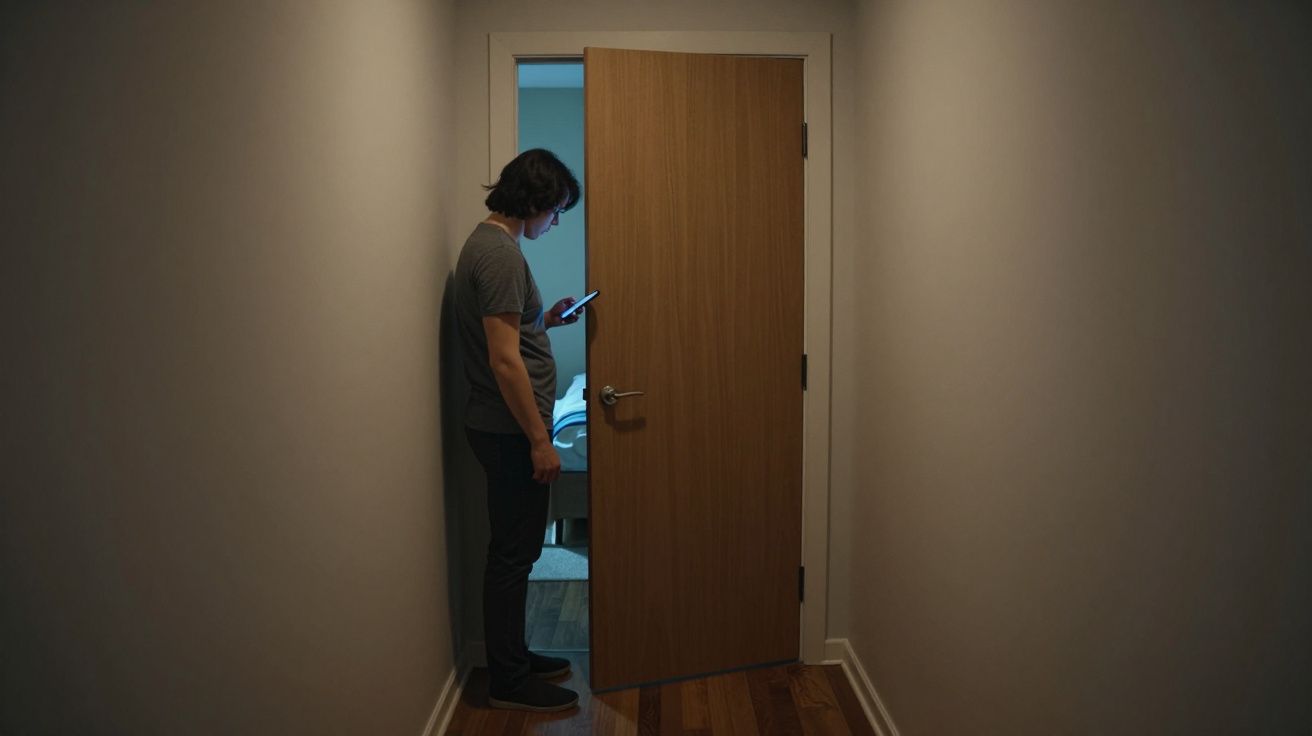
Your teen rolls their eyes and mutters, “Whatever,” then slams a door. Your chest tightens; the familiar rage rises. Instead of launching into a lecture through the wood, you feel your tongue touch the roof of your mouth. Pause.
You glance at the hallway light, the scuffed skirting board, the pile of shoes. You feel the floor under your feet, the roughness of the banister. You hear the washing machine. Three things, two touches, one sound.
You breathe: in‑2‑3‑4, hold‑2, out‑2‑3‑4‑5‑6. Four times. Your shoulders drop halfway through the second exhale.
Now you ask: “What matters most in the next minute?” You choose to knock once, gently, and say through the door, “I am angry and I care. I am going to get a glass of water and we will talk in five minutes.” Then you walk away.
Nothing magical has happened. The problem still exists. But you did not throw petrol on it. You protected the relationship and your own nervous system with a three‑minute pattern.
Where micro‑resets fit when you have zero time
You do not need a quiet room or a babysitter. You need tiny hooks in your day that remind you to run the sequence: Pause – Anchor – Adjust – Choose.
Common spots parents find:
- The first scream or whine of the day.
- The moment you feel your jaw clench in the car.
- When toys hit walls, doors slam, or siblings start to shriek.
- At the first “I hate you” from a frustrated child.
- When you catch yourself thinking, “I can’t do this,” for the third time.
Pair the reset with something physical you already do:
- Gripping the steering wheel at a red light.
- Standing at the kettle.
- Waiting for the microwave.
- Sitting on the loo with small hands banging on the door.
You are not adding a new task to your day. You are replacing three minutes of spiralling with three minutes of resetting.
Small tweaks that make it stick
Like any habit, micro‑resets work best when they become almost automatic. Psychologists often suggest a few simple scaffolds.
Give it a name your brain likes
Call it “three‑minute reset”, “red‑light routine”, or “cup‑of‑tea pause”. A label makes it easier to recall under stress. Some parents tell their children, “I’m doing my reset so I don’t shout,” which quietly models that adults also have big feelings and tools.
Practise once a day when you are not upset
Run through the whole sequence while nothing dramatic is happening: in the shower, on a walk, or while your child is happily watching TV. Your nervous system then recognises it faster when you are flooded.
Lower the bar shamelessly
You will forget sometimes. You will still shout. The work is not to become endlessly calm; it is to notice one moment sooner next time and reset there.
Think of progress as:
| Stage | What it looks like |
|---|---|
| Stage 1 | You explode and remember the reset ten minutes later. |
| Stage 2 | You explode, reset afterwards, and repair with your child. |
| Stage 3 | You feel the explosion coming, reset mid‑argument, and soften. |
| Stage 4 | You spot the trigger earlier and reset before you react. |
Every shift along that line matters. Your child does not need a flawless parent. They need a human who is willing to pause, repair, and keep trying.
Combine micro‑resets with basic care
No three‑minute technique can replace sleep, support, and boundaries, but it can stop things getting worse while you work on the bigger pieces. When you can, still aim for:
- One small pocket of rest that is truly yours each week.
- Saying “no” more often to non‑essential commitments.
- Asking for concrete help instead of waiting until breaking point.
The reset is not the whole solution. It is the bridge that gets you from survival mode to a place where you can even think about bigger changes.
FAQ:
- Is this just breathing with a fancy name? Breathing is part of it, but the micro‑reset also uses sensory focus and a deliberate micro‑decision. That combination interrupts stress more reliably than breathing alone.
- What if my child needs an immediate response for safety? Prioritise safety first. Move them, block the hit, remove the object. Once everyone is safe, run the reset before you start explaining or disciplining.
- I keep forgetting to do it. How do I remember? Pick one reliable trigger, such as the first whine after school or the sound of a door slam, and commit to resetting only then for a week. One consistent anchor beats vague good intentions.
- Can I teach this to my child as well? Yes. Many psychologists encourage parents to model it out loud: “I’m taking my three calm breaths so I can listen.” Older children can learn the full sequence; younger ones can copy the slow sighs.
- What if I still end up shouting? You can still use the reset afterwards. Calm your system, then apologise and repair: “I shouted. That wasn’t fair. I’m practising a new way and I’ll keep trying.” The repair is as powerful for children as getting it right the first time.



Comments (0)
No comments yet. Be the first to comment!
Leave a Comment