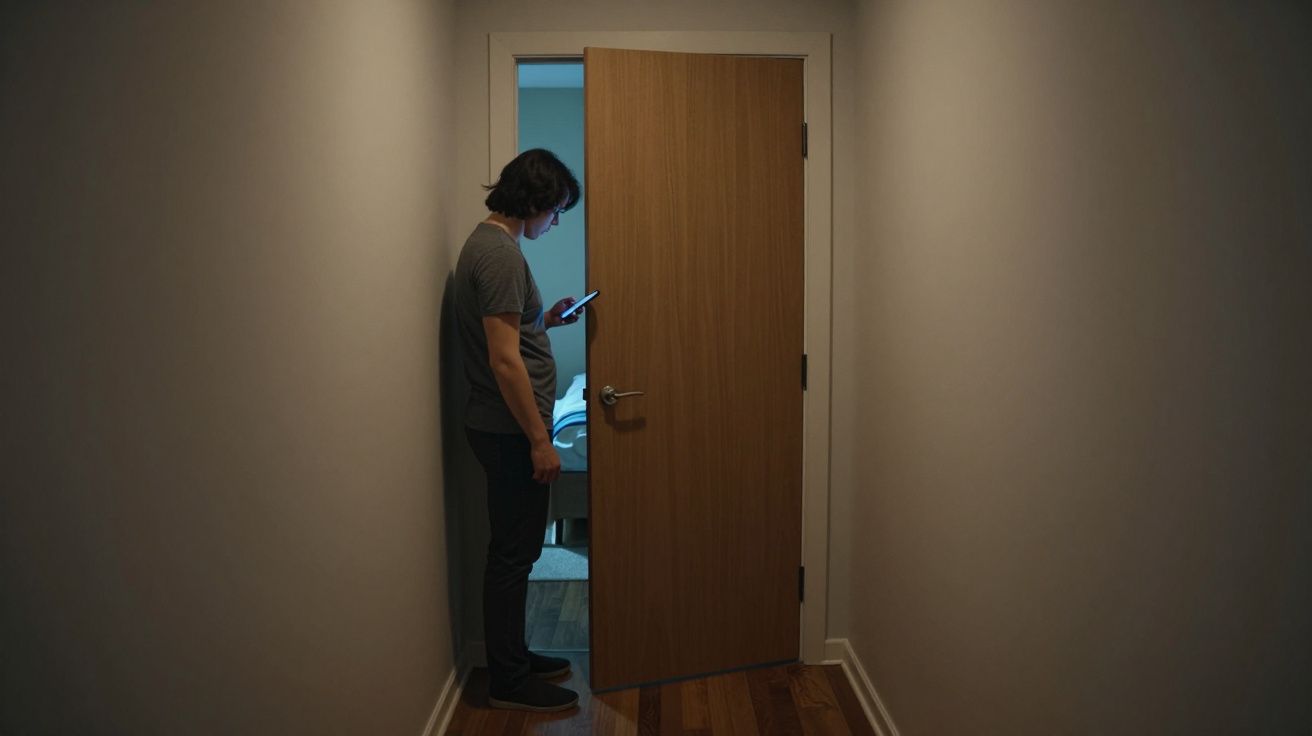
The landing is quiet, the hallway light already off. You pause outside their bedroom door and see it: that thin blue line slipping out from under the duvet. Not the reading lamp you bought with such optimism, but the unmistakable glow of a screen. You remind yourself that you set up the new “sleep mode” last weekend. The little moon icon is on. Notifications are muted. The phone is, technically, in bedtime mode.
And yet, on the other side of the door, your teenager is wide awake, thumb moving in a steady, practised rhythm. Scroll, tap, refresh. The promise on the settings screen - “Help you wind down for sleep” - floats through your mind like a slogan from another planet. If you’ve felt that strange mix of reassurance and unease since the latest update arrived, you’re not alone.
Because here’s the uncomfortable bit no pop-up ever tells you: a phone in sleep mode can still keep a brain very, very awake.
The update that calms parents more than it calms teenagers
On paper, the new sleep and focus features sound like everything you’ve been asking tech companies for. You can set a bedtime, dim the screen, turn it grey, silence most alerts, even swap the wallpaper for something that whispers “relax” instead of “refresh feed now”. Some phones now nudge you with gentle messages: “Time to wind down”, “Put your phone away for the night”.
It feels responsible. You tick the boxes, slide the sliders, and there’s a quiet sense of having finally “done something” about the late-night scrolling wars. The settings page becomes a kind of digital comfort blanket: look, the phone will handle it now. You can step back.
Except teenagers are faster than any update. In many homes, it takes about three nights for a young brain to map the loopholes:
- “I can just hit ‘ignore for today’.”
- “I’ll add all my friends as ‘allowed’ contacts so their messages still come through.”
- “Sleep mode only blocks some apps - this one still works fine.”
- “If I change the clock, the bedtime moves.”
The phone hasn’t suddenly become a strict parent. It’s still a pocket-sized entertainment system with a slightly nicer bedside manner.
The honest truth: sleep mode is a helpful tool, but it’s not a boundary. It soothes adults more than it actually restricts teens.
What “sleep mode” really does – and what it quietly ignores
Strip away the soft colours and friendly icons, and most sleep modes fall into three simple categories: they change what you see, what you hear, and what can interrupt you. Here’s how that looks in real life:
| Feature | What it promises | What often still happens |
|---|---|---|
| Dims / greys screen | Less stimulating, easier on the eyes | Brain still locked to the feed, just in grey |
| Silences alerts | Fewer pings to pull you back in | Teen checks apps manually every few minutes |
| App limits | Stops endless scrolling after a set time | “Extend 15 minutes” tapped on autopilot |
Sleep experts will tell you that light matters, of course. Blue light delayed too close to bedtime can nudge the body’s clock in the wrong direction. Quieter phones help too. But the problem keeping most teens awake isn’t simply light or sound. It’s arousal - that switched-on, slightly wired feeling you get when your brain thinks something important might happen any second.
Sleep mode rarely addresses that. It doesn’t change:
- The group chat going off about tomorrow’s drama.
- The cliffhanger in the show they’re streaming.
- The notification dot that appears the moment you open one app, luring you into three more.
A sleepy-looking interface doesn’t make a sleepy brain. It just makes the distractions look better behaved.
Why teenage brains outrun your phone’s best intentions
To understand why a muted phone can still steal an entire night, you have to peek inside a teenage brain. Around these years, the reward system - the bit that lights up for novelty, connection and “likes” - is on overdrive, while the parts in charge of long-term planning and self-control are still under construction.
That’s not a character flaw. It’s biology.
Social apps know this, even if they never say it out loud. Infinite scroll, “typing…” bubbles, streaks, red badges, and “seen at 00:14” receipts are all tiny levers on the same system: stay a bit longer, you might miss something. Sleep mode doesn’t remove those levers. It just turns the volume down a notch.
A tired adult brain might take the hint. A tired teenage brain thinks: “Everyone else is still online. I’ll be the only one who goes tomorrow not knowing what happened.” FOMO isn’t a slogan in a magazine for them; it’s a physical jolt in the chest.
Let’s be honest: no one really expects a 14-year-old to out-argue a multi-billion-pound attention industry at half past midnight. Telling them “just be sensible” is like asking someone to leave a party where all their friends are, while the music is still blasting.
That’s why software nudges without real-world boundaries almost always lose.
The false comfort of “but we’ve set the settings”
For many parents, the newest updates arrive with a sigh of relief. Finally, something official, built-in, backed by the brand. It feels more solid than the old “I’ll just trust them to put it down” approach, and much less confrontational than nightly stand-offs at the bedroom door.
The risk is subtle but real: we outsource our sense of responsibility to the handset.
- “We’ve set downtime, so it’s fine.”
- “The phone goes into sleep mode at 10, so she can’t be on it.”
- “He knows the limit - the app will log him out.”
Meanwhile, teenagers quickly learn that the worst that happens when the limit hits is… a pop-up. No confiscation, no router cut, no eye contact with an annoyed parent. Just a digital nudge they can snooze.
In that gap, something important can get lost: the family rule. The sense that bedtime is not a menu option, but part of how the household works. When the only barrier is a setting, arguments shift from “We agreed no screens after half ten” to “Mum, it still lets me - so what’s the problem?”
Settings should support your boundaries, not replace them.
Turning tech features into actual sleep: what helps in real homes
So if sleep mode on its own isn’t enough, what does shift the midnight scrolling habit? In most families, it’s not one grand gesture, but a handful of small, consistently boring decisions.
1. Move the charger, not just the settings
A phone that sleeps in the kitchen is harder to scroll than a phone that sleeps under the pillow. It’s obvious, almost embarrassingly so. But in study after study, the single strongest predictor of late-night use is whether the device is physically in the bedroom.
You don’t have to frame it as punishment. Call it a family upgrade:
- Everyone, adults included, charges phones in a hallway or kitchen “parking spot”.
- Set sleep mode and physically dock the phones at the same time.
- If there must be an exception (e.g. exam revision, late sports results), agree it in advance and keep it rare.
2. Use sleep mode as a helper, not the front line
Sleep features are genuinely useful when they’re backup singers, not the main act. Sit down with your teen and go through the settings together, not as a secret operation on their behalf.
You can:
- Turn off “always allow” for entertainment apps, leaving only true essentials.
- Remove the “extend time” shortcut for school nights, if your device allows.
- Set a clear, shared rule: when the sleep screen appears, the phone goes to the docking spot.
The aim isn’t to catch them out, but to show that the settings reflect family agreements, not replace them.
3. Make tomorrow morning part of the conversation
Teenagers live in now. Sleep, by definition, lives in later. Bridging that gap means bringing the consequences into the present, gently but plainly.
Instead of abstract lectures about “screens and sleep”, try specific links:
- “You were up past 1am; how did double maths feel at 9?”
- “You nodded off on the bus again - is the late scrolling actually worth it?”
- “You said you felt really low this week. Shall we do a two-week experiment of earlier nights and see if it shifts?”
They don’t need a TED Talk. They need help noticing cause and effect in their body, their mood, their friendships.
4. Put your own screen on the line
Nothing kills a rule faster than “Do as I say, not as I scroll.” If your phone lights up your face in bed while you’re telling them off for TikTok at 11.30, everyone in the room knows the rule is negotiable.
You don’t have to be perfect. But you can:
- Pick one or two nights a week where everyone does a proper digital curfew.
- Say out loud when you’re tempted to keep scrolling and then don’t: “I really want to keep reading, but I’m parking it now - tired me will thank me.”
- Let them see you using your own sleep mode settings as a genuine tool, not window dressing.
Self-control is contagious. So is hypocrisy.
5. Write a one-page “night-time tech” plan
When everything is foggy, teenagers (and adults) push against the edges to see where they really are. A simple written plan shrinks the fog.
Try this structure:
- Curfew time on school nights and weekends.
- Where phones sleep.
- What counts as an exception (and who decides).
- What happens if the rule slips (e.g. temporary earlier docking, a chat at the weekend).
Keep it on one side of paper. Put it on the fridge or by the charging station. Update it together twice a year. The goal isn’t military discipline; it’s reducing the number of nightly debates to near zero.
The bit no update can automate
Beneath all the icons and toggles sits something no operating system can deliver: trust. The quiet sense that you and your teenager are on the same side when it comes to their sleep and sanity, even when you disagree about bedtimes.
Tech can support that, or it can short-circuit it. A clever interface that lets them sneak around the rules while you think everything’s under control doesn’t bring peace; it just delays the argument to a groggier, grumpier morning.
So by all means, use the tools. Set the modes. Dim the screens. But don’t let the glow of a reassuring settings page replace the unglamorous work of:
- Clear limits.
- Boring consistency.
- Imperfect, honest conversations about why rest matters.
Night after night, it won’t be the moon icon that keeps their brain safe. It will be the slightly awkward, sometimes exhausting, always human boundary that sounds a lot like love when the house is quiet:
“That’s enough for tonight. The phone can wait. You can’t.”
FAQ:
Is sleep mode on my child’s phone useless, then?
Not at all. It can reduce noise, dim the screen and act as a helpful cue that it’s time to stop. The issue is treating it as the only solution. It works best alongside clear household rules and physical limits on where the phone sleeps.Should I secretly tighten the settings without telling them?
You can, but it often backfires. Teens are quick to spot changes and may respond with workaround behaviour or secrecy. A brief, upfront conversation - even if it’s awkward - tends to build more trust and better habits over time.What if my teenager needs their phone as an alarm clock?
A separate alarm clock is usually a cheap, powerful fix. If the phone must be in the room, keep it across the room on a desk, face-down, in sleep mode, with all non-essential apps blocked after curfew.How strict should I be about late-night messages from friends?
Focus on patterns, not rare events. An occasional late message about something important is different from routine midnight chatting. Agree that truly urgent issues can be handled another way (house phone, parent’s mobile) so the personal phone doesn’t have to be always-on.My child insists they “can’t sleep anyway, so might as well scroll”. What now?
Acknowledge the struggle, then experiment. Try two weeks of earlier screen cut-offs, plus a low-key wind-down routine (book, music, podcast). If sleep is still a real problem, consider speaking with your GP or a sleep specialist - but keep the night-time boundaries in place while you explore help.





Comments (0)
No comments yet. Be the first to comment!
Leave a Comment