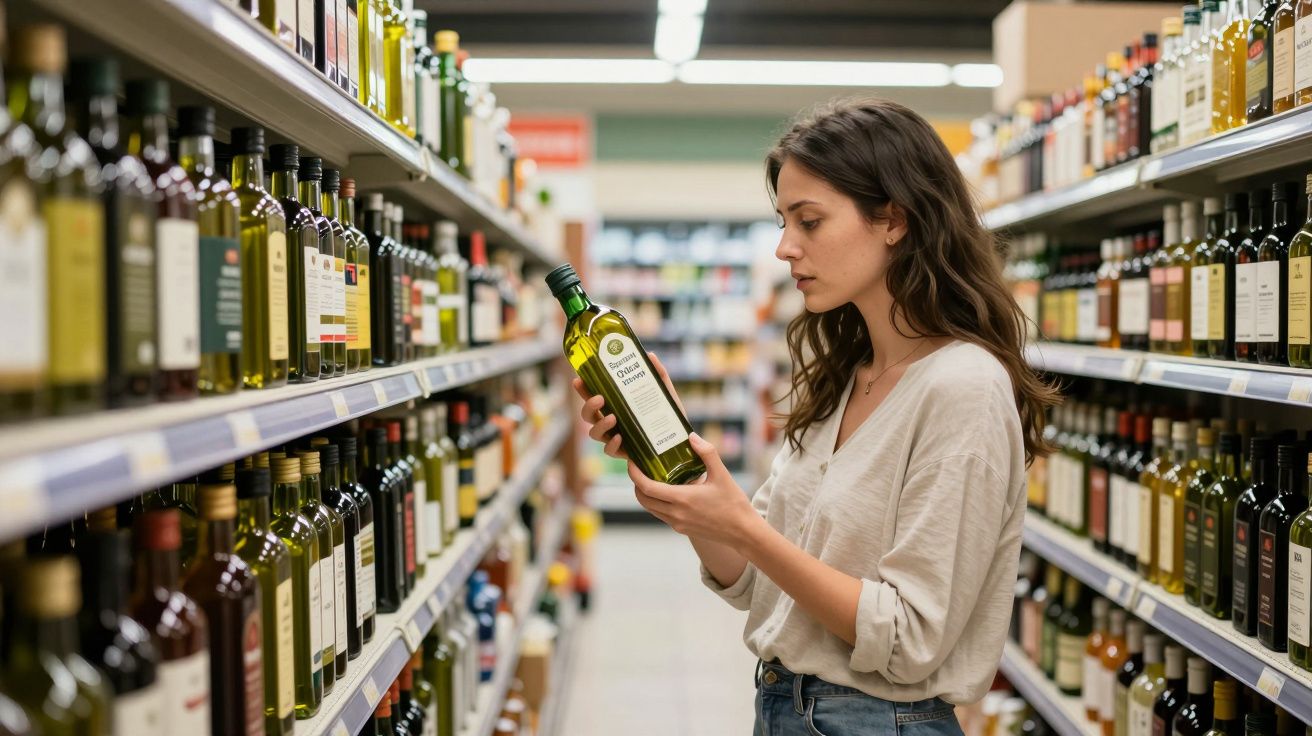
The shelf looked promising enough: rows of dark bottles, green labels, gold accents that whispered of Tuscan hills. Then your eye drops to the price. The supermarket’s own-brand extra virgin is half the cost of the fancy one next to it. You hover, bottle in hand, wondering if you’re about to bring home something grassy and peppery… or a flat, greasy disappointment.
Most labels claim the same things: “extra virgin”, “cold pressed”, maybe an olive grove sketched in soft watercolours. But the details that actually tell you whether the oil is any good are quieter, tucked into smaller print most people never read. Once you know where to look, you can spot the good stuff in seconds - even with a supermarket’s name on the front.
Why supermarket olive oil is confusing on purpose
Olive oil is one of those products where marketing and regulation collide. The law fixes certain words - “extra virgin” has a strict technical definition - but the bottle still leaves plenty of room to blur how fresh, how traceable and how carefully made the oil really is.
Big retailers blend oils from several countries and harvests to keep prices low and flavours consistent. That is not automatically bad. The problem is that the label can make a very average oil sound almost identical to a genuinely well-made one from the same shelf.
Three small clues usually separate the merely acceptable from the surprisingly good.
They are all printed on the bottle. You just need to know which lines matter, and which are there to make you feel better without saying very much at all.
Clue 1: The date line that tells you if it’s still alive
Most people glance at the “best before” date and, if it’s not last year, they’re satisfied. For olive oil, that’s like judging bread by the date it goes mouldy rather than when it was baked.
What you ideally want to see is a harvest date. That might be a specific month and year (“Harvest October 2023”) or simply “2023/24 harvest”. Oils are at their brightest in the first 12–18 months after pressing. A current or recent harvest is a strong sign the producer and retailer care about freshness, not just shelf life.
When there’s no harvest date, use the best-before line as a rough guide. Many producers stamp a best-before of 18–24 months after bottling. As a rule of thumb:
- If the best-before date is more than 18 months away, the oil is probably quite new.
- If it expires in the next few months, it may already taste tired, even if it’s legally “fine”.
Fresh oil smells of tomatoes, herbs, cut grass or green almonds; tired oil smells flat, waxy or faintly like old nuts.
In the own-brand aisle, the quiet win is a bottle with either a clear harvest date or a best-before that’s comfortably in the future, not scraping up against the present.
Clue 2: Where the olives really came from
The front label might show a single idyllic landscape. The back label tells the truth. This is where you find out whether the oil is from one place and one harvest, or a broad sweep of Europe in a single bottle.
Look for the line that says something like:
- “Origin: Spain”
- “Product of Greece”
- “Made in Italy from olives harvested in Italy”
These are all good signs. They mean the oil is from one country, often from a narrower region. Some supermarket own-brands now go further and name a specific area or cooperative; that usually signals a step up in quality focus.
Be wary of very broad wording such as:
- “Blend of EU and non-EU olive oils”
- “Contains olive oils of European Union origin”
- “Packed in Italy” without saying where the olives were grown
That doesn’t automatically make the oil bad, but it tells you price and volume were the priority. The wider the net, the easier it is to smooth out defects by blending, and the harder it is to trace how those olives were grown, picked and stored.
Protected names are a bonus. If you see symbols like PDO (Protected Designation of Origin) or PGI (Protected Geographical Indication), the oil has to meet additional regional rules. You can find these seals even on some own-brand “special selection” lines, and they often mark the best value on the shelf.
Clue 3: The quiet wording about how it was made
The third clue sits with the quality and process words - the ones that sound similar at first glance but mean very different things in practice.
You’re mainly looking for three pieces of information:
Grade
For everyday cooking and salads, you want the label to say “extra virgin olive oil” in full. Not just “olive oil”, not “pure olive oil”, not “light in taste”. Those softer terms usually hide a refined oil that’s been processed to remove flaws, along with much of the aroma and natural antioxidants.Temperature / extraction method
Phrases like “cold extracted” or “cold pressed” indicate the oil was obtained below a certain temperature, which helps preserve flavour and polyphenols. It’s not a gold-plated guarantee of greatness, but its absence - especially on a pricier bottle - is a hint corners may have been cut.Optional geeky details
Some better producers print extra figures such as “acidity 0.3%” or “polyphenols 250 mg/kg at bottling”. Supermarket own-brands rarely go this far, but when they do, it’s usually because they are quietly proud of the lab results. Lower acidity and decent polyphenol numbers correlate with better fruit and handling.
Here’s how those label phrases often stack up:
| Label phrase | What it really tells you | Quality hint |
|---|---|---|
| “Extra virgin olive oil, cold extracted” | Upper grade, gentle processing | Worth a try, especially if date and origin look good |
| “Extra virgin olive oil” only | Legally OK, but less detail | Check date and origin; can be fine or forgettable |
| “Olive oil” / “Light” / “Pure” | Refined, neutral-tasting blend | Skip for salads; fine for frying if cheap |
The more specific the label is about how the oil was made, the more likely someone cared about the flavour in the bottle.
A 30‑second label routine in the aisle
Once you’ve trained your eye, you don’t need to stand reading bottles for ages. A quick three-step scan is usually enough to find the best of the own-brand bunch.
Check the date:
Look for a harvest date first. If there isn’t one, glance at the best-before and favour bottles with at least a year left.Scan the origin line:
Prefer a single named country or region over a vague “EU and non-EU blend”. Bonus points for any PDO/PGI mention.Confirm the grade and process:
Make sure it says “extra virgin olive oil”. Upgrade again if you see “cold extracted/pressed” or any concrete lab-style figures.
If a supermarket’s premium own-label ticks all three boxes while a famous brand next to it only manages one, the cheaper bottle may well be the better oil.
When it’s worth paying more - and when it isn’t
For roasting vegetables, frying eggs or shallow-frying fish, you do not need the most poetic bottle in the shop. A decent, fresh, clearly labelled supermarket extra virgin will do the job beautifully, and those three clues will stop you overpaying for an impressive logo.
For raw uses - salad dressings, drizzling over tomatoes, finishing soups - the differences become obvious. This is where it pays to choose the best oil your budget allows, even if that means a slightly smaller bottle.
Think of olive oil like wine: the label cannot guarantee you’ll love the taste, but it can tell you who’s trying and who’s just filling bottles.
Once you start reading those quiet lines on the back, supermarket shelves become less of a gamble and more of a hunt. And every now and then, you’ll bring home an own-brand bottle that tastes like it belongs on a restaurant table - without the restaurant price.
FAQ:
- Does dark glass or a tin matter as much as the label? Dark glass and tins do help protect oil from light, which slows down ageing. But you still need to check the three label clues; good packaging cannot rescue an old, blended or over‑processed oil.
- Is a “mild” or “delicate” extra virgin lower quality? Not necessarily. Those words usually describe flavour, not defects. Some olives are naturally gentler. Use the same date, origin and process checks to judge quality, then choose an intensity you enjoy.
- Can I cook at high heat with extra virgin olive oil? Yes, for most home cooking. Fresh, decent extra virgin has a higher practical cooking tolerance than people think, especially for sautéing and roasting. For very high-heat frying, many people switch to a neutral oil on cost grounds rather than safety.
- How long does a good bottle stay good once opened? Ideally use it within 2–3 months and keep it somewhere cool and dark, with the cap firmly on. Even the best oil will lose its aroma if it lives on a sunny windowsill or next to the hob.


Comments (0)
No comments yet. Be the first to comment!
Leave a Comment