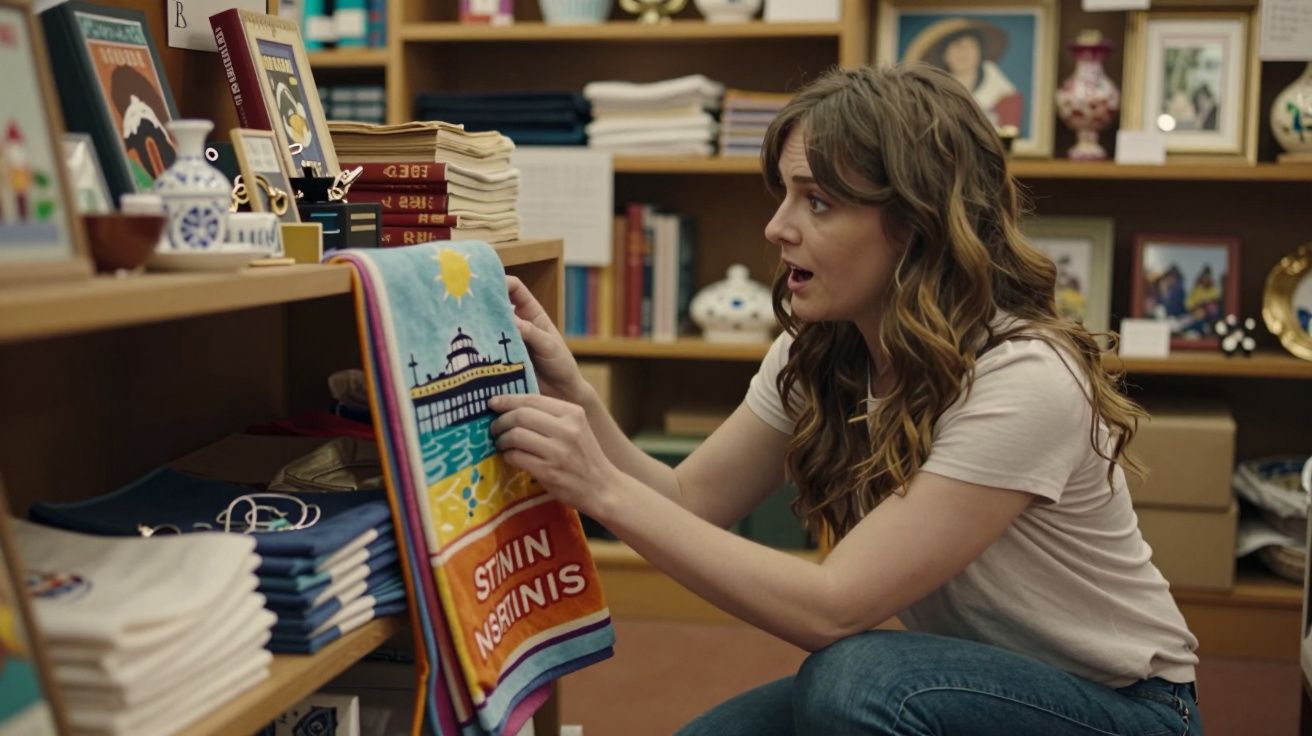
The tea towels were stuffed on the lowest shelf, badly folded, 99p scribbled on a curling sticker. I was doing the usual charity shop shuffle: scan the rails, check for a stray designer label, move on. Beside me, a vintage dealer friend went straight past the clothes and crouched by the bric-a-brac.
“Textiles first,” she said. “This is where the money hides.”
She flipped through the stack like records, pulling out a bold 1970s print of Brighton pier. “Irish linen, signed designer, still crisp. I’d list this at £80 and see what happens.” The assistant shrugged when we asked the price. “Oh, that old thing? Call it a quid.” Suddenly, the least glamorous item in the shop looked like a lottery ticket.
The unglamorous £1 item dealers are hunting
The bargain most people walk past this year? Vintage tea towels.
Not the grey, fraying ones hanging in your kitchen. The good stuff lives in charity shops and jumble sales: unused tourist designs, 1960s–80s illustration, limited-edition festival or exhibition towels, souvenir linen from seaside towns and vanished attractions. To most people, they’re just “new old stock”. To collectors, they’re décor, history and wall art.
Dealers talk about three magic ingredients: age, artwork and scarcity. When they line up, a 50p–£1 towel can nudge £40–£200 online. It’s not every towel, and it’s not instant riches. But if you know what to scan for, you stop leaving quiet money on the shelf.
Why tea towels are suddenly serious money
For years, tea towels were background clutter. They dried plates, stained quietly and went to the bin. Now they’re pinned on walls, framed above sideboards and styled in kitchen photoshoots. They sit in the same mental box as vintage posters and school charts, just smaller and cheaper.
Several trends have collided:
Printed nostalgia
Mid-century fonts, bright 70s palettes, kitschy maps of Britain’s coastline – they hit the same nerve as retro travel posters and enamel signs, but at a fraction of the price.Designers hiding in plain sight
Many British illustrators and textile artists designed for souvenir companies. Their signatures are on tea towels, even when they never made a “proper” art print.Tiny flats, flexible art
In rented homes and small kitchens, a linen towel pegged on a wooden hanger is easier (and lighter) than a framed print. Social media has turned these into a look.Sustainability
People who don’t want to buy new décor love the idea of rescuing a 40-year-old textile and giving it pride of place. It’s both upcycling and collecting.
“Tea towels are the new poster tubes,” one dealer told me. “People roll them up, ship them worldwide, and nobody at the charity shop clocked them as art.”
How to spot a £1 towel that could be worth £100+
The good news: you do not need to know every artist or pattern name. You just need to train your eye for a few tell-tale signs, then take 30 seconds per towel.
1. Feel the fabric first
Your fingertips are faster than your brain.
Irish linen / pure linen
Often marked “100% Irish Linen” or just “Pure Linen” on the edge or label. Feels crisp, slightly slubby, cool to the touch. Linen tends to hold colour beautifully over decades.Cotton / polycotton
Softer, more familiar “tea towel” feel. These can still be desirable if the design is strong, but linen is where the higher prices usually sit.
If it feels thin, limp and shiny in a cheap way, it’s probably modern and less interesting. Not always a deal-breaker, but you’re looking for textiles that feel substantial.
2. Scan for era and style
You’re trying to answer: does this look like it came from a particular decade, or from last year’s supermarket run?
Clues that excite dealers:
- Bold, flat colours and blocky shapes from the 1960s–70s
- Hand-drawn lettering, especially on maps of counties, cities or seaside towns
- Slightly odd, whimsical illustrations – anthropomorphic vegetables, dancing utensils, cartoon animals in aprons
- Commemorative themes: royal weddings, jubilees, festivals, steam railways, long-closed attractions
Generic fruit prints or dull check patterns are rarely the winners, unless paired with a big designer name.
3. Look for names, brands and places
Turn the towel sideways and read the borders. Names are your friends:
- Illustrator or artist signature in one corner
- Manufacturer marks like Ulster Weavers, Samuel Lamont, St Michael (Marks & Spencer’s old label), Heals, Habitat, Sanderson
- Place names: specific seaside towns, cathedrals, zoos, stately homes, museums, TV studios, now-demolished buildings
Local or vanished places are gold. A towel from an attraction that’s closed, or a venue that no longer exists, can create a small but intense collector market.
4. Check condition – but don’t be too precious
Perfection is nice but not mandatory.
- Best: unused, still crisp, maybe with original tag or fold lines
- Good: light creasing, a wash or two, colours still vibrant
- Avoid: large stains, threadbare areas, holes, big rust marks
A single faint tea ring might knock the value, but a rare design can still sell with small flaws. You’re a treasure hunter, not a museum curator.
5. Do a 30-second reality check
Before you buy a stack, do one quick pass:
- Would this look good on a wall?
- Can you clearly read the place, date or event?
- Does the design feel charming or distinctive, or just “fine”?
If you’re hesitating, leave it. The best pieces usually make you smile or raise an eyebrow immediately.
A quick cheat sheet for the charity shop aisle
| What to check | Why it matters |
|---|---|
| Fabric (linen vs cotton) | Linen is older, tougher, often more collectable |
| Era/style | 60s–80s graphic styles beat bland modern checks |
| Names & places | Designers, brands and specific locations drive value |
| Condition | Crisp and bright sells faster and higher |
What to do once you’ve found a good one
You’ve paid your £1 and brought it home. Now what?
Photograph it properly
Lay it flat, shoot in daylight, show the full design plus close-ups of any signatures, labels and flaws. Collectors like honesty more than filters.Research the design
Type any names, place names and phrases into a search engine and on eBay / Etsy. Check “sold” listings, not just asking prices, to see what actually achieved money.Decide your route: keep, gift or flip
- Keep it: wash gently, press with a warm iron and hang as art.
- Gift it: perfect housewarming or Christmas present for someone who loves that place or era.
- Flip it: list online with clear photos and keywords. Start at the lower end of similar sold prices and be prepared to wait for the right buyer.
- Keep it: wash gently, press with a warm iron and hang as art.
Store the rest like mini posters
Roll, don’t crumple. Keep them in a dry box or drawer, loosely layered, away from direct sunlight. Think of them as a budget print portfolio.
“Treat them like paper posters that happen to survive the washing machine,” a textile collector said. “The care is similar, the market’s just younger.”
Common mistakes that cost people money
Even seasoned thrifters miss the same patterns:
Grabbing every royal commemorative towel “just in case”
Many were printed in huge numbers. Look for unusual artwork, not just a date and a crown.Ignoring textiles in favour of obvious brands
It’s easy to chase Le Creuset and Pyrex. Meanwhile, the best profit per pound spent is quietly folded on the bottom shelf.Over-cleaning rare pieces
Harsh stain removers can fade prints or weaken old fibres. If a mark is stubborn and small, it may be better to disclose it than destroy the design.Assuming newer means worthless
Some 1990s and early 2000s designs linked to cult TV, artists or niche events are already collectable. Age helps, but culture matters more than calendar years.
Turning a casual browse into a quiet side hustle
You do not need to become a full-time dealer. You can simply add one slow, deliberate habit to your usual charity shop loop: always scan the textiles.
Start by:
- Checking the tea towel basket or rail every time you go in
- Giving yourself a simple rule: “I only buy it if it makes me smile and it’s linen”
- Keeping a note on your phone of interesting makers, places and signatures you learn
Over a few months, you’ll start recognising the same cheap, common designs – and the odd outlier that feels special. Those are the ones that turn 99p into something that feels a lot closer to a win.
FAQ:
- Are all linen tea towels valuable? No. Linen is a strong clue for age and quality, but design and subject matter matter more. A dull advert can be linen and still struggle to sell.
- How much can a single tea towel really sell for? Many good ones sit in the £15–£40 range. Rare designs by sought-after artists or from cult locations can push into the low hundreds, but treat that as a bonus, not a guarantee.
- Do I need to wash them before selling? If they’re visibly dirty or musty, a gentle cool wash and careful iron helps. For unused or mint examples, some collectors prefer “as found” with original folds.
- Where’s best to sell – online or at fairs? Online platforms give you access to niche collectors worldwide. Vintage fairs and markets are great if you enjoy talking to buyers and letting people handle the textiles.
- Is it worth keeping modern souvenir towels from holidays now? If the design is bold and the place or event feels special or short-lived, yes. Today’s gift-shop purchase can be tomorrow’s “I wish I’d kept that” collectible.






Comments (0)
No comments yet. Be the first to comment!
Leave a Comment