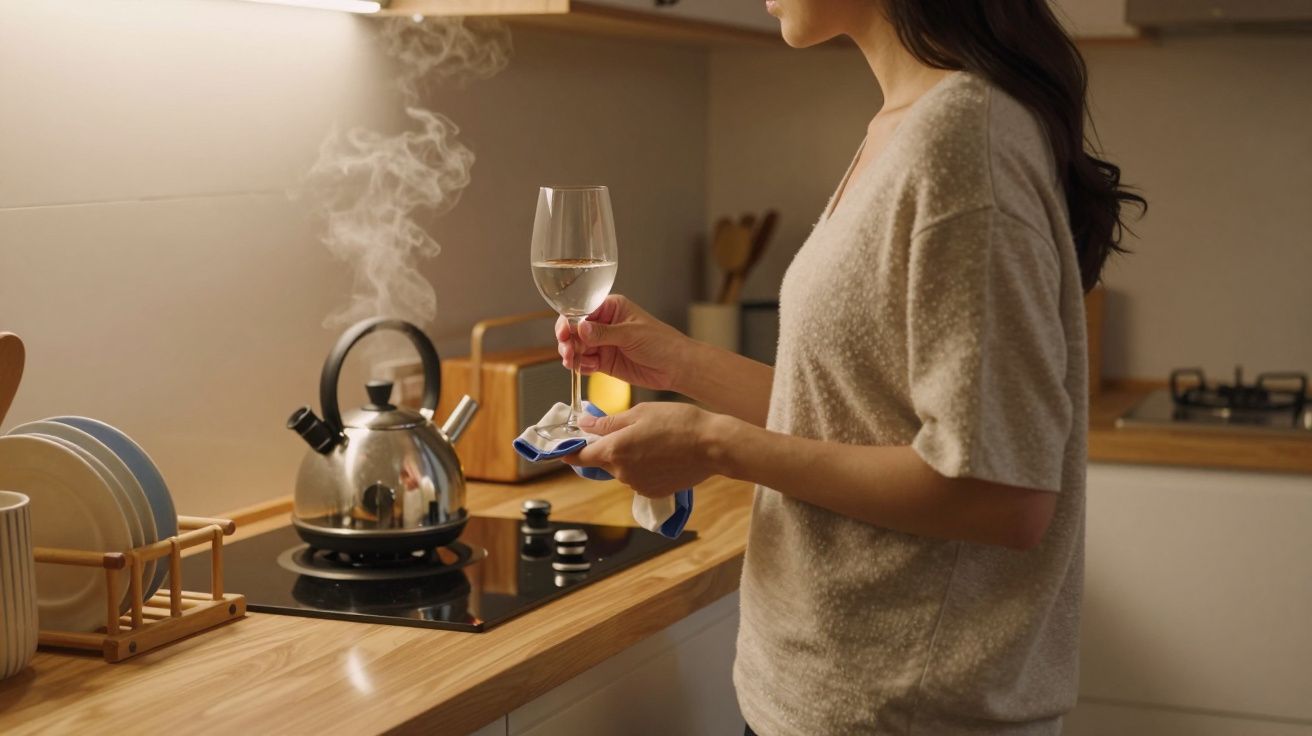
Steam beads on the kitchen window and the radio mumbles in the corner. You’ve emptied the dishwasher, stacked plates with a satisfying clink, and now you’re down to the last job: putting the glasses away. They looked sparkling when you pulled them out. Under the ceiling light, though, there it is again – that milky film and the faint rainbow smears you end up rubbing half‑heartedly on your jumper.
You grab the nearest tea towel from the oven handle. It’s the same one you used earlier for hands, a splash of pasta water and a hurried wipe around the hob. You polish, you breathe on the rim, you buff a bit harder. Somehow, the glass looks worse. Smudged. Slightly greasy. Definitely not “pub pour” ready.
It’s a tiny, domestic annoyance, the sort you shrug off until friends come round and someone holds a wine glass up to the light. Then you see every streak. You wonder if your dishwasher’s on the way out. Maybe the water’s too hard. Maybe all those Instagram people own secret, expensive products you don’t.
Most of the time, the problem isn’t your kit at all. It’s your tea towel. Or rather, what you’ve quietly taught that tea towel to do.
And once you fix that, you’re halfway to that crisp, pub‑style shine bartenders produce in seconds, seemingly without thinking.
The tea towel habit that ruins a good wash
The classic home mistake starts long before the glass reaches the cupboard. It begins in the wash basket.
Most of us throw every cloth into the same load: hand towels, cooker‑top wipers, the “good” linen, the one that caught the bacon fat, the one that mopped up last night’s red wine. We add a generous squeeze of detergent, maybe some fabric conditioner for softness, and call it done.
On plates and mugs, the leftover residue barely shows. On clear glass, it screams.
Detergent and softener both leave microscopic films on fabric. That’s their job. Detergent molecules cling to grease and grime; fabric softener coats fibres so they feel smooth. When you later press that cloth onto clean glass, you’re transferring a very thin layer of everything the towel has collected and everything the wash has added.
Add in a bit of lint from tired cotton fibres and a trace of oil from hand‑drying, and you’ve built yourself the perfect recipe for haze.
The result isn’t full‑on limescale fog, just that stubborn, cloudy look that never quite shifts, however much you rub.
Why your glasses go cloudy (and it’s not always limescale)
True cloudiness can come from three main places:
- Mineral deposits from hard water (that chalky, greyish film).
- Detergent or rinse‑aid residue from dishwashers or overly soapy hand‑washing.
- Fine scratches or etching from harsh powders or very old glassware.
Most people jump straight to blaming limescale. In a hard‑water area, that’s understandable. But a quick test is simple: rinse one “cloudy” glass inside and out with very hot water mixed with a splash of white vinegar, then let it air‑dry without touching it.
If it emerges clearer, your main enemy is residue. If it doesn’t change much, you may be dealing with long‑term etching or heavy mineral build‑up that needs a soak.
Either way, a dirty or over‑treated tea towel makes things worse. Instead of removing deposits, it smears them into a thin, even layer that catches the light. That’s why glasses look especially bad under spotlights or in daylight by a window.
Bartenders know this instinctively. They don’t use the bar mop that’s just wiped a sticky counter. They reach for a very particular kind of cloth – and they use it in a very particular way.
The pub‑style polishing routine, step by step
Watch a good bartender close up and you’ll see the same quiet choreography repeated all over the world. There’s no magic product. Just heat, steam and a ruthlessly clean, lint‑free cloth.
Here’s how to steal their method at home.
- Start hotter than you think
Glass needs warmth to release water marks. Either:- Run glasses through a full dishwasher cycle with a hot rinse, or
- Hand‑wash in very hot (but safe to handle) water, finishing with a clean, hot rinse, ideally with a dash of white vinegar in the final bowl.
- Run glasses through a full dishwasher cycle with a hot rinse, or
Let any excess water drip off for a few seconds. You want them damp and hot, not dripping.
- Use the right cloth – and only for glasses
Pick:- A clean, dry microfibre cloth labelled lint‑free, or
- A tightly‑woven linen or glass‑polishing towel reserved only for glass and shiny metal.
- A clean, dry microfibre cloth labelled lint‑free, or
Wash it separately or in a very simple load: hot water, minimum detergent, no fabric softener. Air‑dry rather than tumble if you can. This one cloth should never see bacon fat, tomato sauce or bathroom tiles.
- Add a little steam (the bartender’s shortcut)
In pubs, glasses come out of commercial dishwashers already hot and steamy. At home, you can mimic that:- Boil a kettle and let it sit for 20–30 seconds.
- Hold the glass above the spout so the steam rolls inside and over the bowl. Don’t scald yourself; angle your hands away from the plume.
- Boil a kettle and let it sit for 20–30 seconds.
The brief steam softens any remaining spots so they wipe clean rather than smear.
- Polish from the inside out, holding only the stem or base
Insert part of the cloth into the bowl of the glass. With one hand on the base or stem and the other twisting the cloth, gently rotate so the fabric makes full contact inside. Then move to the outer surface, always using a dry area of the cloth.
Avoid gripping the bowl with bare fingers as you work. Skin oils undo your effort faster than anything.
- Finish with a quick check under strong light
Hold the glass up to a bright light or window. A properly polished glass looks almost invisible – you see the outline, not the surface. If you spot a stubborn arc or fingerprint, a single, light pass with a clean corner of the cloth usually removes it.
This sounds fussy written down. In practice, once you’ve set yourself up with the right towel and habit, each glass takes ten seconds at most.
Small changes that quietly transform your glassware
You don’t need to turn your kitchen into a bar back to see a difference. A few quiet tweaks in how you wash and dry glasses will get you most of the way there.
Think in three steps: wash clean, rinse hot, dry smart.
Split your tea towels into “anything” and “glass only”
Mark the glass one with a loop of thread or a corner fold. Mentally treat it like you would a white shirt: it doesn’t do floors, it doesn’t do spills, and it doesn’t go near greasy pans.Dial back detergent and ditch fabric softener for glass loads
For any wash that includes your glass‑only cloths, use less detergent than the bottle suggests and skip softener entirely. The towels will feel slightly crisper – that’s good. Softness usually means residue.Rinse glasses with very hot water plus a hint of acid
A teaspoon or two of white vinegar in the final rinse bowl helps strip minerals and soap film. You won’t taste it once the glass is dry, but the clarity difference is immediate.Let some glasses air‑dry, then just “finish” with a cloth
For everyday tumblers, try draining them upside down on a rack until almost dry, then give a quick polish with your glass towel only where needed. This reduces how much you actually rub the surface, which in turn cuts down fine scratching over time.Store them so they stay clean
Once polished, place glasses upright in a cupboard away from the hob, not rim‑down on a dusty open shelf. If you’re in a particularly greasy kitchen, a simple sheet of kitchen paper over rarely used glasses keeps film off between uses.
None of this needs to be perfect. It just needs to be consistent. The more you separate “dirty jobs” from “finishing jobs” in your towel drawer, the less time you’ll spend battling streaks later.
Common mistakes, and what to do instead
| Habit to drop | What it causes | Easy swap |
|---|---|---|
| Using the same towel for hands, spills and glass | Grease and soap films smeared onto glass | One dedicated glass‑only cloth |
| Overloading the wash with detergent and softener | Residue on towels that transfers to glass | Half‑dose detergent, no softener on towel loads |
| Drying cool glasses with a cool cloth | Water marks that bake on later | Hot rinse + brief steam before polishing |
These shifts are small enough to slot into whatever routine you already have. You don’t need special sprays or tabs labelled “crystal care”. You just need to stop asking one overworked tea towel to do every job in the kitchen.
FAQ:
- Is cloudy glassware always ruined? Not necessarily. If a hot rinse with a bit of vinegar and a proper polish improves things, it’s residue rather than permanent etching. Deep, milky patches that don’t change at all may be damaged, especially on older or very cheap glass.
- Do I really need a separate towel just for glasses? If you care about a clear finish, yes. It’s the single biggest change you can make. One small microfibre cloth or glass‑polishing towel kept strictly for that purpose will out‑perform a stack of multipurpose tea towels.
- Can I still use the dishwasher for wine glasses? You can, but load them with space around each glass, use a good rinse aid, and choose a shorter, cooler cycle for very fine stemware. Then use the pub‑style polishing trick on any that matter for guests.
- Is microfibre better than cotton for polishing? For glass, usually yes. Microfibre sheds less lint and grabs more residue in one pass. High‑quality linen glass cloths are also excellent, but avoid fluffy cotton towels which tend to leave fibres behind.
- Will I smell vinegar on my drinks if I use it in the rinse? No, as long as you use a small amount and let the glass fully dry. The scent evaporates quickly; what’s left is a cleaner surface that water and wine both sit on more cleanly.
Comments (0)
No comments yet. Be the first to comment!
Leave a Comment