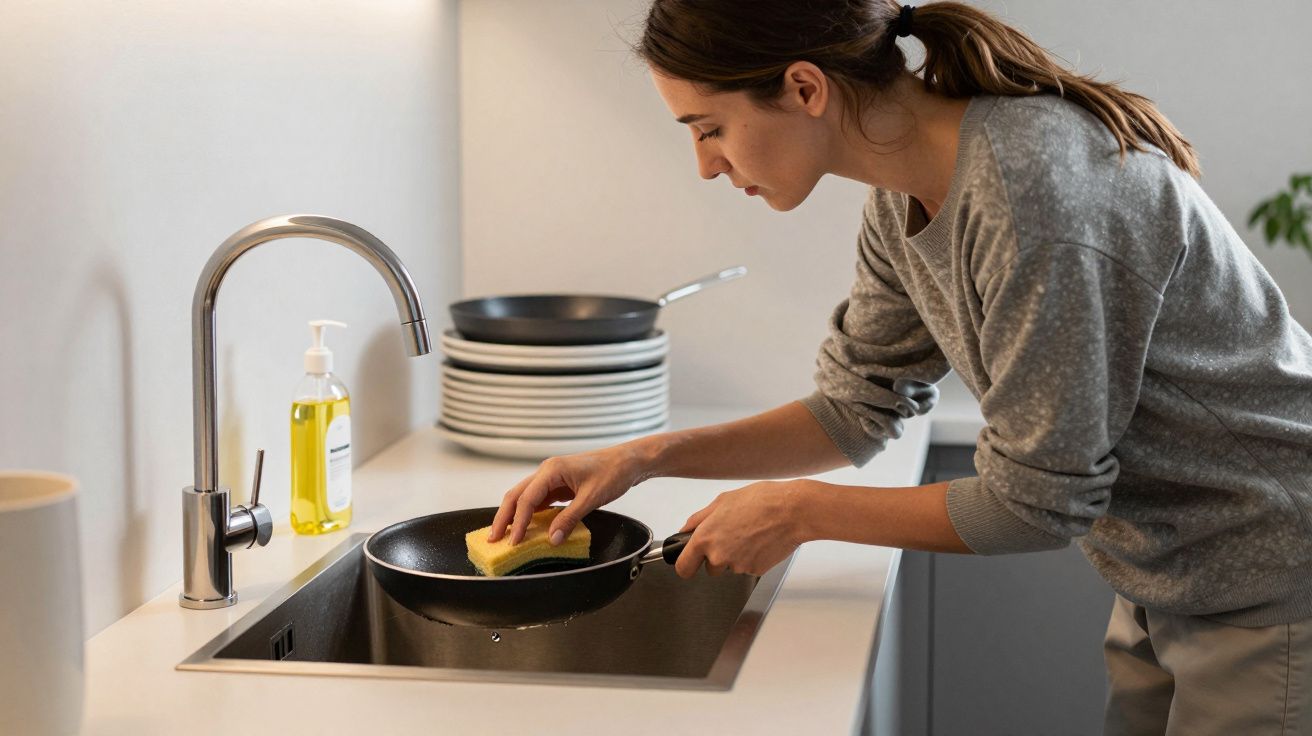
The pan was still hissing from dinner when she marched it to the sink.
Tap on full blast, cold water slamming into hot metal, a cloud of steam fogging her glasses. She grabbed the green scourer-the “good one” for burnt bits-and went to town. Circular scrubs, a squeeze of gritty cream cleaner, elbow pushing harder with every brown streak that refused to budge. Five minutes later the base looked “clean”, but the once-glossy black surface now had a faint grey haze and a few dull patches that never quite went away.
A week on, eggs started sticking in a pan that used to slide them out like a TV advert. She blamed the brand. Her chef cousin just raised an eyebrow, ran a thumb over the roughened surface and said quietly: “You’ve sanded the non-stick off. The cooking didn’t kill it. Your cleaning did.”
The biggest non‑stick killer in home kitchens isn’t high heat or metal spatulas; it’s aggressive scrubbing on a hot pan under a cold tap. Chefs baby their non‑stick not because they’re precious, but because they know the coating is thin, soft and easy to scar. The way you wash it decides how long it lasts.
Why scrubbing ruins non‑stick faster than cooking does
Non‑stick isn’t armour. It’s a microscopically thin coating bonded to aluminium or steel, designed to be slick, not hard. When it’s new, food beads and slides because the surface is smooth at a level your eye can’t see. Every time you hit it with a scratchy pad, gritty powder or the rough side of a sponge, you’re sanding that smoothness down a little more.
Cold water on a hot pan makes things worse. The metal underneath shrinks faster than the coating on top, creating tiny stresses and hairline cracks. Add forceful scrubbing while the surface is still softened by heat and you’re effectively peeling and chipping at the bond between coating and pan. It rarely looks dramatic. It just goes slightly matt, then slowly stickier, until you’re chasing scrambled egg around with more oil every morning.
Dishwashers don’t help either. Strong alkaline detergents and long, hot cycles nibble at non‑stick over time. In pro kitchens, non‑stick frying pans almost never go through the machine. They’re treated more like a cross between a Teflon sheet and a cast‑iron skillet: quick wipe, gentle wash, back on the rack.
The physics is boring but brutal. Non‑stick fails through thousands of tiny scratches, not one big one. Each rough clean removes a fraction of coating, exposes more base metal, and gives food more to cling to. Blaming the pan is easy. Blaming the scouring pad is closer to the truth.
How chefs actually wash non‑stick pans
Watch a chef at the sink after service and you’ll notice something almost suspicious: they look lazy with non‑stick. No frantic scrubbing, no mountain of suds, no punishment for burnt-on bits. The “secret” is that they avoid giving food a chance to weld on in the first place-and when it does, they let heat and water do the work, not abrasion.
Here’s the basic rhythm most pros follow:
Let the pan cool slightly first.
Not stone cold, not scorching hot. Warm enough that you can touch the handle comfortably. This avoids thermal shock from cold water and keeps any residue soft.Use hot water, not freezing.
They fill or swill the pan with very warm water and a drop of mild washing‑up liquid. Heat loosens fats and sugars far better than brute force.Deglaze, don’t scrape.
If something is really stuck, they’ll often pop the warm pan back on a low flame, add a splash of hot water (or even stock in service), let it simmer for 20–30 seconds and then tip it out. The softened bits wipe away with the soft side of a sponge or a non‑scratch brush.Soft tools only.
No steel wool, no green scourers, no gritty creams. Just the soft side of a sponge, a microfibre cloth, or a brush explicitly labelled “non‑scratch”. Two or three gentle passes, rinse, done.Dry straight away.
They don’t leave non‑stick soaking for hours, and they don’t stack it away wet. A quick towel‑dry stops water spots and keeps the base from corroding around the edges of the coating.
In real life, nobody treats every pan like fine china every night. Let’s be honest: on a tired Tuesday, you will be tempted to attack the brown ring around your omelette. The trick is to change what “attacking” looks like: more hot water and time, less grit and force.
Getting the best results (and avoiding rookie mistakes)
Most ruined coatings can be traced back to the same handful of habits. Change those, and even a mid‑range pan can last years instead of months.
The green scourer problem
Those classic green pads and stainless‑steel balls are designed to scratch. They’re brilliant on stainless steel, awful on non‑stick. Reserve them for roasting tins and solid metal pans.Cold tap on a screaming‑hot pan
That dramatic “whoosh” of steam feels satisfying, but it shocks the metal and coating. Let the pan cool for a couple of minutes, then rinse with warm water instead.Baking spray build‑up
Aerosol cooking sprays can leave a gummy film that browns into a permanent ring. A tiny bit of normal oil spread with a brush or paper towel is kinder and washes off cleanly.Soaking overnight in harsh detergent
A short soak in warm, mildly soapy water is fine. Leaving a pan for 12 hours in strong, undiluted detergent or dishwasher tabs can dull and lift the coating over time.Stacking pans bare
Pan on pan, metal on coating, bouncing every time you open the drawer. Slip a paper towel, cloth or pan protector between them so the bases don’t graze the non‑stick surface.
If something really is burnt on, think “re‑cook it off” rather than “scrub it off”: simmer a little water with a squirt of washing‑up liquid in the pan for a minute, let it stand until warm, then wipe. It’s boringly gentle-and weirdly effective.
A simple routine that keeps pans sliding
You don’t need a chef’s sink or schedule, just a consistent, low‑drama routine you can stick to when you’re half‑asleep.
A realistic pattern looks like this:
- Wipe out excess oil with a bit of kitchen roll while the pan is still warm.
- Let it cool for a couple of minutes away from the burner.
- Add hot water and a drop of washing‑up liquid; leave it on the side while you eat.
- Come back, use the soft side of a sponge or cloth, no pressing, no circles of rage.
- Rinse hot, dry with a towel, and store with something soft between pans.
Some chefs go one step further and “season” their non‑stick every so often: warm the clean, dry pan, rub in a teaspoon of neutral oil with a paper towel, let it cool and wipe off the excess. It doesn’t turn it into cast iron, but it can refresh the slickness and fill microscopic pores.
Key habits at a glance
| Habit | What to do | Why it matters |
|---|---|---|
| Cooling & rinsing | Let pan cool slightly; rinse with hot, not cold, water | Reduces thermal shock and micro‑cracks in coating |
| Tools & products | Soft sponge/cloth, mild liquid soap only | Prevents scratching and chemical erosion |
| Storage & care | Dry fully, don’t stack bare, occasional light oiling | Keeps surface smooth and extends non‑stick life |
The quiet fix hiding in your sink
Most non‑stick pans don’t “wear out” because you cooked too many stir‑fries. They fade because of small, impatient moments at the sink: the rushed scrub before work, the cold blast after a burnt dinner, the scourer you grabbed because it was already wet.
Switching from force to finesse isn’t glamorous. No one is posting reels of “gentle circular motion with the soft side of the sponge”. But you’ll feel it every time a fried egg slips out without a fight, six months after it would normally start gluing itself to the base.
Small, boring rituals beat constant replacements. Treat the coating like a delicate surface you’d like to keep for years, not a battlefield. Your food sticks less, your pans last longer, and your bin fills up with fewer abandoned “non‑stick” disappointments.
FAQ:
- Is it ever okay to use a scourer on non‑stick?
Ideally no. If you must tackle a stubborn spot, choose a pad labelled “non‑scratch” and use it lightly, after soaking and deglazing have done most of the work.- Can non‑stick pans go in the dishwasher?
Many are technically “dishwasher safe”, but frequent cycles with strong detergents shorten their life. For maximum longevity, hand‑wash them and save the machine for heavier cookware.- What if food always sticks now – is the pan dead?
If you can see bare metal, deep scratches or large dull patches, the coating is likely compromised and won’t truly be non‑stick again. You can still use it like a normal pan, but it’s time to replace it for delicate jobs like eggs or pancakes.- Does using metal utensils ruin non‑stick as quickly as bad cleaning?
Occasional light contact isn’t catastrophic, but repeated cutting or scraping with metal will scar the surface. Paired with harsh cleaning, it accelerates the damage. Silicone or wooden tools are kinder.- Are ceramic‑coated pans different?
They’re often harder but also more brittle. The same rules apply: avoid thermal shock, no abrasive pads, mild detergents only. Gentle cleaning is just as important, even if the marketing sounds tougher.




Comments (0)
No comments yet. Be the first to comment!
Leave a Comment