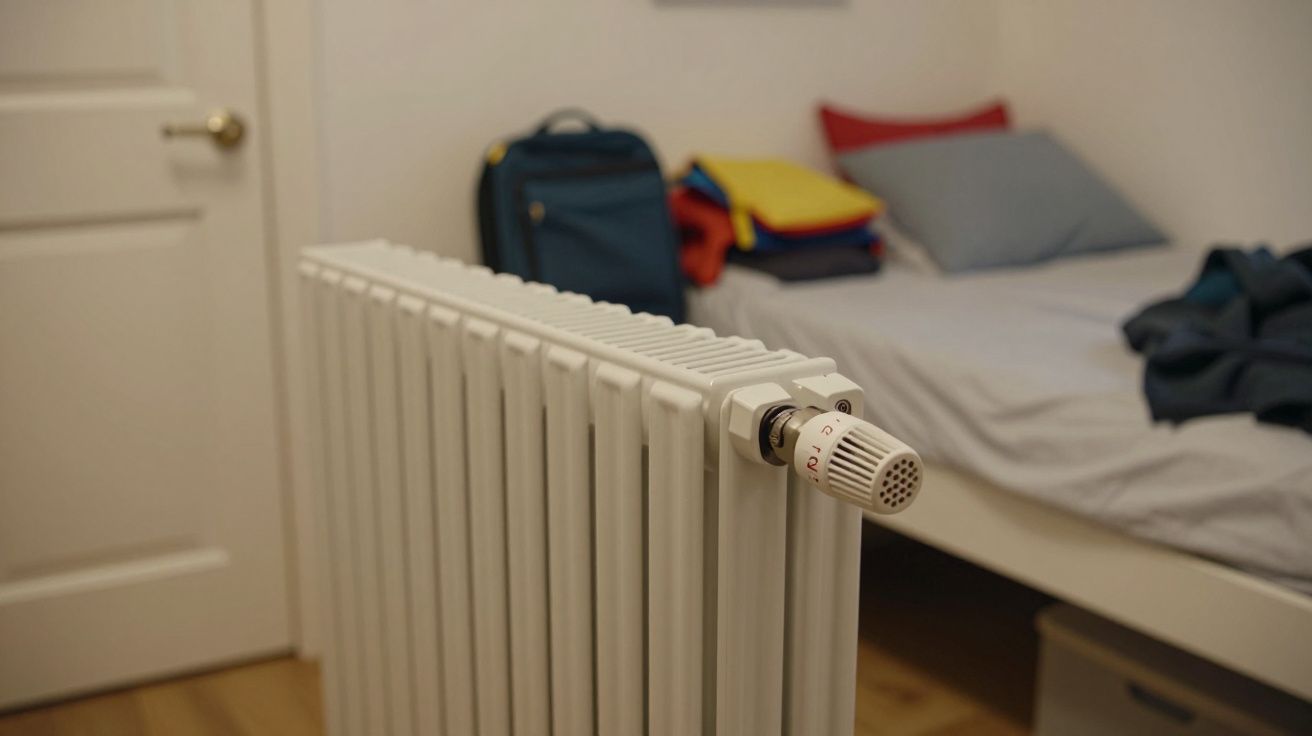
Most homes have that one room that’s more dumping ground than guest space. The door stays shut, the bed ends up as overflow storage, and for 10 months of the year you barely walk in there. The radiator, though, keeps doing its thing – either blasting away as if it’s a hotel suite, or sitting stone cold because you twisted the valve off one chilly afternoon and never touched it again.
On your bill, that quiet corner of the house isn’t actually quiet. In a typical three‑bed in the UK, a single spare‑room radiator can be the difference between a tolerable winter bill and one that makes you wince. Heating engineers see the same pattern over and over: people either overheat empty rooms or create icy pockets that make the rest of the system work less efficiently.
The annoying part is that the “right” setting isn’t fancy or expensive. It’s already sitting on the radiator, printed as a little snowflake or the number 1 or 2 on a plastic dial that most of us only ever turn all the way up or all the way down.
Somewhere between “sauna for the suitcases” and “unheated fridge of doom”, there’s a simple middle ground. And that’s the valve setting heating engineers quietly wish more people would use.
The spare‑room trap hiding in plain sight
Walk into a call‑out with a heating engineer and you start to notice a pattern. The living room is cosy, the hallway is fine, the thermostat says 20°C. Then they open the spare‑room door and get hit with one of two extremes.
Either:
- the room is toasty, radiator on full, window on tilt because “it gets a bit stuffy in here”, or
- the air feels like a garage in February, radiator turned firmly to 0, a faint whiff of damp in the corner.
Both feel like personal preferences. To the boiler and your bill, they’re both problems – just different flavours.
In the first case, you’re paying good money to keep a rarely used room at main‑living‑room temperatures. In the second, you’ve created a cold box stuck on the side of a warm house. That sharp temperature drop can pull heat out of the adjacent rooms faster, encourage condensation on cold walls and, if the door’s left open, confuse your thermostat into running the boiler harder.
Neither situation feels dramatic when you stand in the doorway. Over a full heating season, though, the spare‑room habit quietly adds up.
How one radiator can sneak about £150 onto your winter bills
The numbers aren’t exact for every house, but the order of magnitude is surprisingly consistent once you do the rough maths.
Take a fairly standard spare‑room radiator, maybe 1–1.5kW. If your heating is on for six hours a day over a five‑month winter, that’s roughly:
- 6 hours × 150 days = 900 hours of potential run time
- At 1kW output, about 900kWh of heat pushed into that one room
You don’t pay for heat, of course; you pay for gas or electricity before the boiler turns it into heat (with some losses on the way). By the time you factor in boiler efficiency and current unit prices, it’s easy for that one radiator, run at the same level as your main rooms, to account for £100–£150 of a typical winter’s bill.
You’re essentially paying for a room to be pleasantly warm just in case someone decides to sleep there twice a year.
On the flip side, people who slam the valve fully off sometimes cause a different kind of waste:
- The room drops to near‑outdoor temperatures.
- Moisture in the air condenses on cold walls and windows.
- You crack the heating up elsewhere trying to “chase away the chill”, or end up running an electric heater in there when guests do come, which is usually the most expensive heat of all.
In older or poorly insulated houses, the cold spare room also acts like a heat sink, dragging warmth from adjoining rooms. You pay more to keep those rooms comfortable, while the spare remains an icebox.
The sweet spot, engineers say, is much less dramatic – and involves trusting a small plastic head to do some thinking for you.
The valve setting that quietly does the smart work
If you’ve got a numbered head on your radiator (a thermostatic radiator valve, or TRV), that dial isn’t just decorative. Each number roughly corresponds to a target room temperature. The valve opens or closes automatically to maintain that level.
Most people do one of three things with it:
- leave every radiator on the same number,
- crank spare rooms up to match the main bedroom “just in case”, or
- turn unused rooms harshly to 0 and forget about them.
What heating engineers actually recommend for low‑use rooms is usually this:
Set spare‑room TRVs to the frost or low setting – usually the snowflake, 1 or 2 – and leave them there all winter, with the door mostly closed.
That low setting does three useful things at once:
- Prevents waste: The room isn’t being held at 20–21°C like the lounge; it’s ticking along more at 12–16°C. Your boiler spends far less energy warming it.
- Protects the room: You avoid the deep‑cold conditions that encourage condensation, mould and musty smells.
- Keeps the system happier: The radiator still takes a small share of the flow when the heating is on, which helps avoid over‑pressurising a few rads while leaving others stone cold.
The result feels unexciting: a room that’s cool but not hostile, with minimal risk of damp, costing a fraction of the fully‑on version and far less bother than the fully‑off one.
Rough guide to the numbers on your TRV
Every brand is slightly different, but this is a decent ballpark:
| TRV mark | Approx. room temperature | Typical use |
|---|---|---|
| * (snowflake) | 5–7°C | Frost protection only |
| 1 | 10–12°C | Unheated corridors, pipe protection |
| 2 | 15–16°C | Spare rooms, utility rooms |
| 3 | 18–19°C | Bedrooms |
| 4 | 20–21°C | Living rooms |
| 5 | 23–24°C | Very warm rooms / rarely needed |
For a spare bedroom that only sees occasional use, most engineers will tell you: live on 1 or 2, not on 0 and not on 4.
How to “fix” your spare room in five minutes
You don’t need tools, spreadsheets or a new boiler. Just a small reset and a bit of consistency.
Find the right valve
Make sure you’re looking at the TRV (the head with numbers or a snowflake), not the plain on/off valve at the other end of the radiator.Set the baseline
- Turn the spare‑room TRV to 1 or 2.
- If the room has a history of damp patches or feels very exposed, start at 2; otherwise try 1.
- Turn the spare‑room TRV to 1 or 2.
Close the door most of the time
Keeping the door mostly shut stops that cooler air sloshing into the hall and tricking the thermostat into running the boiler more than necessary.Live with it for a week
During your normal heating schedule, pop in once or twice:- If it feels freezing, nudge the valve up half a number.
- If it feels almost as warm as your main rooms, drop it half a number.
- If it feels freezing, nudge the valve up half a number.
Only turn it up for guests – then turn it back down
The day before someone sleeps in there, set the TRV to 3 and leave the door open for a few hours to let heat in. When they leave, put it straight back to 1–2. No “I’ll do it later”.
That’s it. One five‑minute tweak, then a “set and forget” habit that quietly chips away at your winter costs.
Myths that keep people burning money
A few persistent heating myths make spare rooms more expensive than they need to be.
“Radiators heat faster if I turn them to max”
They don’t. A TRV controls the final temperature, not the speed. A radiator on 3 and the same one on 5 will both get hot at the same pace when the boiler fires. The difference is that on 5 it will happily overshoot into sauna territory before it throttles back.
For a spare room, that means spending more money heating air no one is sitting in.
“Turning the spare room completely off saves the most”
It can reduce the direct cost of that one radiator, but you pay elsewhere:
- adjoining rooms may feel colder and need higher settings,
- the risk of condensation, mould and musty soft furnishings goes up,
- you’re more likely to resort to electric heaters at the last minute when the room is actually needed.
A low background setting is often cheaper and less hassle in real life than a deep‑freeze followed by emergency thawing.
“I should leave all doors open so heat can circulate”
Some circulation is good; it evens out hot and cold spots. But if you have one deliberately cooler room on the edge of the house, leaving that door wide open simply lets cold air leak into the core of the home, encouraging the thermostat to call for more heat.
Engineers often suggest the opposite: keep main living spaces and hallways comfortably warm with doors mostly open between those, and treat the spare room as a cooler bubble with its door usually closed.
The other quiet win: balancing your expectations
There’s a bigger psychological shift buried in all this. Many of us drift into thinking every room should be the same temperature, all winter, all day. Central heating makes that possible – at a price.
Most heating engineers work to a different mental map:
- Main living areas: 19–21°C
- Bedrooms: 17–19°C
- Spare / low‑use rooms: 12–16°C
Seen through that lens, the spare room stops being a mini living room and becomes what it really is: a buffer space. Cool, dry, perfectly usable with a sweater on, and cheap to keep that way.
Dialling in that mindset, alongside the valve, is often what actually trims the bill – because you stop chasing “hotel everywhere” comfort in a normal house with a normal boiler and a not‑unlimited bank account.
FAQ:
- Should I ever turn the spare‑room radiator fully off?
Fully off (0) is fine for short spells – for example, during a mild week – as long as the room stays dry and you keep an eye on any external walls. For a whole winter, most engineers prefer a low setting (snowflake, 1 or 2) rather than completely off, especially in older or poorly insulated homes.- What if my radiator doesn’t have numbers, just a basic valve?
That’s a manual valve, not a TRV. You can still mimic the effect by turning it down until the radiator is only lukewarm when the heating is on, rather than scalding hot. If budget allows, fitting a TRV head is a relatively cheap upgrade that gives you much finer control.- I’ve got smart thermostats on some radiators – does this still apply?
Yes. Set your spare‑room smart head to a lower target (around 14–16°C) and keep the door mostly closed. The principle is the same; you’re just choosing the “spare room” temperature in an app instead of on a plastic dial.- Won’t a cooler spare room make the whole house feel colder?
Not if you keep the door mostly shut. Your sense of comfort comes mainly from the rooms you actually sit in. As long as living spaces are well‑set and not fighting with a cold draught from the spare room, you shouldn’t notice – except on your bill.- How much can I realistically save with this one change?
It depends on your house, tariff and how extreme things were before. But shifting a spare‑room radiator from “main‑room warm” down to a low background level can easily cut tens of pounds off a winter’s bill, and in some cases around £100–£150 when combined with better door and thermostat habits.

Comments (0)
No comments yet. Be the first to comment!
Leave a Comment