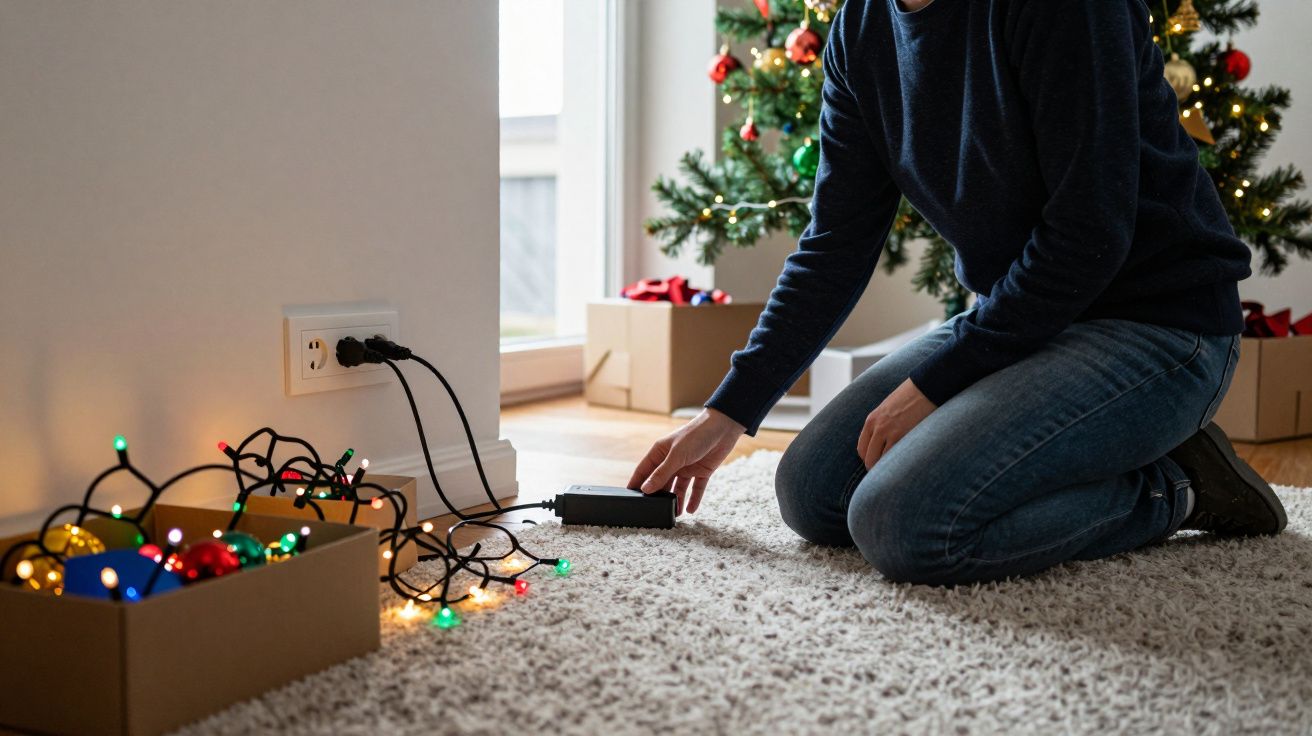
Boxes down from the loft, dust in the air, the familiar tangle of green flex and plastic stars on the living-room carpet. Someone puts the kettle on; someone else calls out, “Where’s that spare extension lead?” The double socket behind the tree is already busy with the TV and the Wi‑Fi router. A four‑way block appears, then a cube adaptor, then another plug for the light‑up reindeer that seemed like a sensible impulse buy in October.
Last year, a south London electrician named Amar was called to a terrace where the front room smelled faintly of melted plastic. The fairy lights were fine. The socket feeding them was not. The faceplate had browned at the edges; the back box was hot to the touch. The family had done what many of us do in December: added “just one more” set of lights to the same already‑tired outlet. No one noticed until the carpet started to feel warm.
When Amar finished replacing the scorched double socket, he showed the family a trick he says on repeat all winter:
“Stand up, look at each wall socket, and count the plugs. If you hit three, stop. If one of them heats anything, give it the socket to itself.”
He calls it the three‑plug rule. It isn’t in the Wiring Regulations as a line of text. It’s a simple household habit borrowed from people who spend their lives staring at burnt plastic so you don’t have to.
Why December is crash‑season for sockets
In an ordinary week, your living-room sockets probably jog along with the TV, a lamp, a soundbar, and a phone charger or two. December piles more on the same points: tree lights, window stars, smart speakers, electric candles, a plug‑in diffuser that smells like “Alpine Morning”. None of these feel big on their own. Together, they can push a tired socket over its comfort zone.
A standard UK socket is designed for up to 13 amps. That’s plenty for one kettle or one fan heater, and easily enough for a few strings of modern LED lights. The problem isn’t usually the lights. It’s everything else you quietly ask that one outlet to host at the same time, often through a cheap adaptor that’s seen ten winters.
Electricians will tell you the pattern they see: cube adaptors hanging out of the wall like Christmas baubles, extension leads daisy‑chained across skirting boards, multi‑way blocks jammed full under the tree where nobody can see if they’re getting hot. The failure point is rarely dramatic. A loose connection here, a cracked casing there, a bit of fluff in the plug, and the plastic begins to cook long before a fuse ever blows.
This is where the three‑plug rule earns its keep. Instead of trying to do the mental maths on watts and amps while balancing on one knee behind the sofa, you use a simple visual quota: three plugs per socket, with clear exceptions for the real power hogs.
The three‑plug rule, clearly explained
Think of every wall socket in your home as a tiny venue with a strict guest list. The three‑plug rule sets the bouncer’s policy:
If it makes heat, it drinks alone.
Kettles, toasters, portable heaters, tumble dryers, irons, hairdryers, air fryers - anything that glows, toasts or blows hot air gets its own wall socket, no extension leads, no sharing. These can draw close to the full 13‑amp limit on their own.For everything else, three is the ceiling.
Once the heat‑makers are on their own, count the remaining plugs feeding from any one double socket - directly or via an extension lead. Lights, TV, router, chargers, speakers. If you reach three, stop. Want to add more decorations? Use a different wall socket on a different part of the circuit.No daisy chains. Ever.
One extension lead per wall socket, that’s it. Don’t plug a multi‑way adaptor into another multi‑way adaptor, or an extension into an extension “just for Christmas”. You’re piling several sets of contacts and bits of cheap plastic between the supply and your tree.
Here’s a common December set‑up, before and after the rule:
Before:
Double socket behind the tree:- Left: four‑way extension with TV, soundbar, router, and tree lights.
- Right: cube adaptor with phone charger, window lights, heated throw.
- Left: four‑way extension with TV, soundbar, router, and tree lights.
After the three‑plug rule:
- TV and soundbar stay on one wall socket (two plugs, both lowish draw).
- Router moves to a different socket or a surge‑protected extension in another corner.
- Tree lights and window lights share a single four‑way extension, with one outlet left empty (two decorative loads, both LED).
- Heated throw either gets its own socket or is unplugged when lights go on.
- TV and soundbar stay on one wall socket (two plugs, both lowish draw).
It looks fussy written down. In the room, it’s five minutes of rearranging and two fewer things on the busiest outlet.
One electrician in Leeds sums it up like this:
“If you need more than three everyday bits on one socket, you don’t need a bigger adaptor - you need a different socket.”
Simple checks before any plug goes in
Counting plugs is half the story. The other half is making sure what you’re plugging in deserves your trust.
Start with the hardware you’re leaning on the most: extension leads and multi‑way adaptors.
Check the rating.
Flip the extension over and look for its maximum load. In the UK it should say 10A or 13A and carry a BS number (like BS 1363) and ideally the BSI Kitemark. If it only has vague symbols and no clear rating, retire it.Feel the cable.
A proper 13‑amp extension has a chunky, roundish cable. Thin, flat flex on a “bargain” block is a red flag; it’s not built for kettles or heaters, and barely for a loaded Christmas corner.Inspect the plugs and sockets.
Hairline cracks, scorch marks, wobbling pins, or tape repairs are all signs to bin it. “Fixed with tape” is how many post‑Christmas fire reports start.
Then look at your lights themselves:
LED over old filament.
Modern LED Christmas lights sip power compared with older incandescent sets. If you’ve still got vintage strings that run hot to the touch, consider upgrading. The energy saving is real; the safety margin is bigger.Indoor vs outdoor.
Only use outdoor‑rated lights and extension leads outside. Look for IP ratings and clear “for outdoor use” labelling. Running an ordinary indoor block under a back door to feed the reindeer on the lawn is how moisture finds its way into plugs.RCD protection.
If your consumer unit (fuse box) is older or your outdoor socket isn’t clearly RCD‑protected, use a plug‑in RCD adaptor for any outside lights. It cuts the power faster if there’s a fault to earth.
We’ve all had that moment halfway through decorating when you realise the only available socket is behind a bookcase and you’re tempted to stretch one more lead. Be honest: nobody is crawling back there in their Christmas jumper to unplug it at night. That’s why you do the tidy set‑up once, on purpose.
A tiny “socket walk” that buys a calmer December
The three‑plug rule works best when you turn it into a ritual: a five‑minute socket walk on the day the decorations come out.
Pick your Christmas “power points”.
Decide which sockets will feed the main displays - the tree, the window, any outdoor lights. Avoid ones already hosting a heat‑maker or heavy appliance.Do a fast count.
At each chosen socket, count all the everyday plugs (TV, router, lamps, chargers) already there. If you’re close to three, move something before adding lights. Chargers and gadgets are easiest to relocate.Lay the cables where you can see them.
Don’t bury multi‑way blocks behind piles of presents or under thick rugs. If something starts to smell or hum, you want a clear view and easy reach.Do a warm‑hand check on first switch‑on.
After the lights have been on for half an hour, feel the plugs, extension blocks and socket faceplates with the back of your hand. Warm is normal; hot, soft or buzzing is a stop sign. Unplug and rethink.
Communities quietly save themselves work when they normalise this. A landlord who puts a short note about plug counts in the stairwell. A WhatsApp message in the family group: “Tree going on this weekend - do the three‑plug check?” These aren’t dramatic safety campaigns. They’re small nudges at exactly the week of the year sockets get pushed hardest.
“Christmas lights don’t scare us,” says one Midlands electrician. “What scares us is the five other things already on that socket that nobody remembers are there.”
| Principle | Detail | Why it helps you |
|---|---|---|
| One heat‑maker per socket | Kettles, heaters and irons plug directly into the wall, no sharing | Cuts out the biggest overload risk in one move |
| Three‑plug rule for the rest | Max three everyday plugs from any one double socket | Simple visual check instead of mental maths |
| No daisy chains | One extension lead or adaptor per socket, never plugged into another | Removes the dodgiest connections from the system |
FAQ:
- Does three plugs mean I’m always safe, whatever they are?
No. The three‑plug rule is a simple household guideline, not an engineering formula. High‑power appliances that heat should still be alone on a socket. Use the rule for the mix of low‑power items - lights, chargers, TV - and keep anything that toasts, boils or blows hot air separate.- Can I fill all four outlets on a 4‑way extension if they’re just lights?
If they’re modern LED sets and the extension is properly rated at 10–13A, the electrical load is usually fine. The three‑plug rule simply encourages leaving some slack - one way spare, fewer joints working hard - especially on older wiring.- Are those cube adaptors safe for Christmas?
Many electricians dislike them. They put mechanical strain on the wall socket and often tempt people to overfill one point. If you must use one, keep to three plugs and avoid any heat‑making appliances. A short, good‑quality extension lead is usually safer.- Should I switch the lights off at the wall at night?
Yes. Turn off at the socket before bed or when you leave the house. It reduces fire risk and saves energy. Smart plugs are fine if they’re from reputable brands and not stacked into adaptors.- My house is new - do I still need to worry?
Newer wiring and RCDs give you better protection, but they can’t fix an overloaded adaptor or a damaged extension lead. The three‑plug rule and a quick visual check still apply, whether your sockets are brand‑new or older than your decorations.





Comments (0)
No comments yet. Be the first to comment!
Leave a Comment