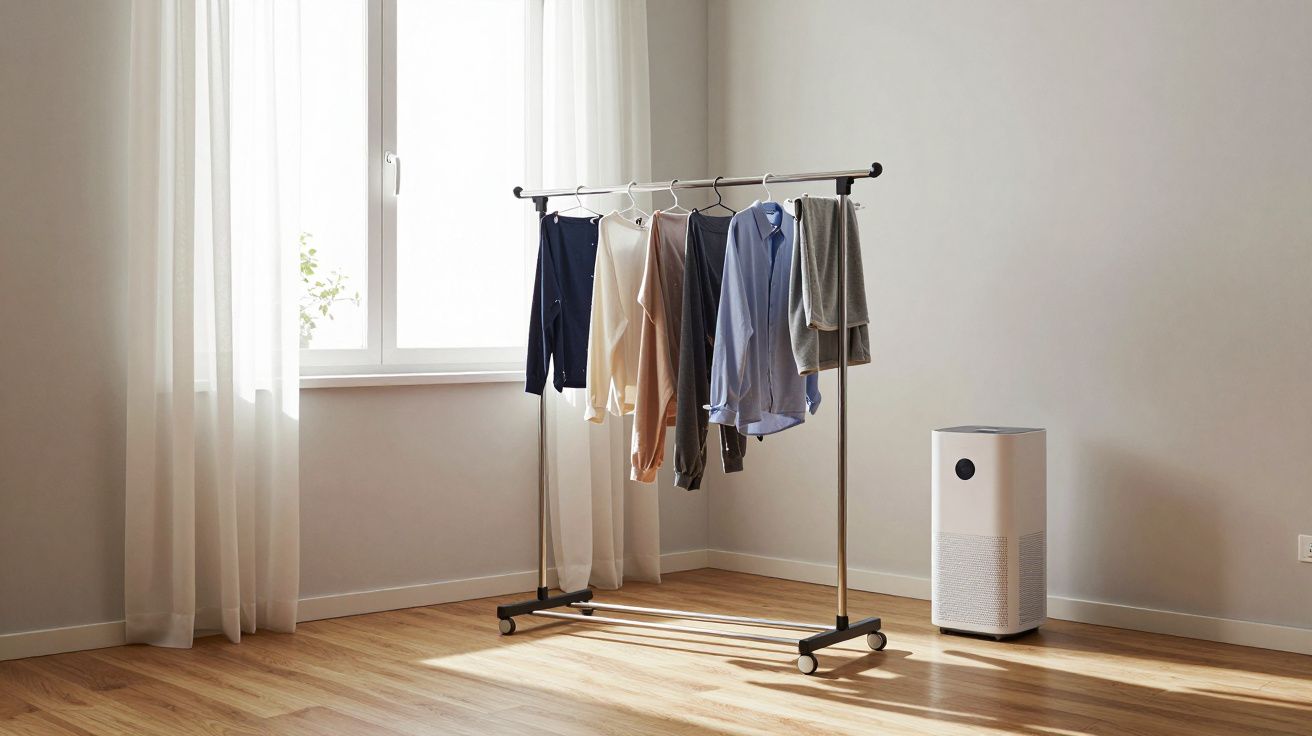
The air looks clear. The radiator hums, the clothes horse is wedged between sofa and window, and damp sleeves sway gently over the carpet. Nothing drips. It feels like you’ve found a clever way to dodge the tumble dryer.
An hour later the windows mist at the corners. By evening, the bedroom smells faintly “wet”, even though everything looks dry. That single load of washing has quietly leaked around a litre of water into your indoor air.
Most homes repeat this ritual several times a week from October to April. The habit feels harmless, even thrifty. Yet the extra moisture has to go somewhere, and if it doesn’t leave the building, it settles into paint, plaster, grout and wardrobes instead.
The hidden cost of a clothes airer in the living room
Wet laundry is basically a mobile reservoir. A typical 4–5kg wash, even after a good spin, can still hold 1.5–2 litres of water trapped in fibres. As it dries, that water doesn’t vanish. It evaporates into the room.
In a small flat, that evaporation can push humidity up by 10–30 percentage points for several hours. You might not see it straight away, but the building does. Warm, moist air hunts for the coldest surfaces: window panes, outside walls, corners behind furniture.
There, it cools, turns back into liquid, and starts feeding mould spores that were already waiting. Once those dark specks appear on silicone sealant or the bedroom ceiling, they’re surprisingly hard to evict for good.
The problem isn’t drying clothes indoors once in a while. It’s doing it most days in poorly ventilated rooms.
If someone in the household has asthma, allergies or a weak immune system, this background damp matters more than the energy you think you’re saving by avoiding the dryer.
How much water are we really talking about?
Laundry maths is surprisingly simple. Fabric comes out of the machine still holding around half its dry weight in water after a decent spin. That’s why clothes feel heavy when you lift them from the drum.
For a rough sense of scale:
| Scenario | Approx. water released into the room | What you notice |
|---|---|---|
| One small load on an airer | ~1 litre | Slight window fog, “wet” smell by evening |
| One full family load | 1.5–2 litres | Condensation on panes and cooler walls |
| Two loads in a day | Up to 3 litres | Persistent damp patches, slow‑drying towels |
A litre doesn’t sound much until you imagine pouring a full milk carton into the air. In a compact flat, that’s a heavy hit for the building fabric to absorb, especially on cold days when windows stay shut.
Higher indoor humidity also means your heating works harder. Damp air feels cooler against the skin and transfers heat into cold walls more quickly, so you end up nudging the thermostat up without quite knowing why.
Why extra moisture quickly turns into damp and mould
Buildings like a fairly narrow comfort band: around 40–60% relative humidity. Dip far below that and air feels dry. Sit far above and you’re in condensation country.
When laundry pushes humidity up, three things tend to follow:
- Water beads or hazes on windows, especially at the edges.
- Cooler corners behind wardrobes or sofas stay slightly clammy.
- Textiles such as curtains and carpets never feel fully crisp.
This is exactly the environment mould loves. It doesn’t need a flood, just regular moist air and a food source like paint, wallpaper paste or dust. Once established, it spreads quietly into wardrobes, onto the back of furniture and into silicone around baths and windows.
A single evening of wet windows isn’t a crisis. Weeks of them can turn into flaky paint, musty rooms and stubborn black spots.
Those black spots aren’t only a cosmetic issue. Mould releases spores that irritate airways, particularly in children and older adults. NHS advice repeatedly links damp housing to respiratory problems and allergies.
The simple workaround: corral the moisture, then get it out
You don’t have to buy a condenser dryer or stop drying indoors completely. The main shift is strategic: treat laundry as a moisture event you contain and then remove, rather than something that “just happens” in the middle of the home.
A simple, low‑effort routine looks like this:
- Pick one “drying room” – often a spare room, hallway or bathroom – and keep the door closed while clothes dry.
- Give the moisture an exit: open a window a crack or run an extractor fan or dehumidifier in that room.
- Place the airer centrally, away from cold outside walls and big pieces of furniture, so air can move all around it.
- Dry in batches: aim for one load at a time, not a forest of clothes stacked over each other.
- Vent afterwards: once clothes feel dry, keep the window ajar or fan running for another 20–30 minutes to flush lingering moisture.
The trick is small but powerful: localise the humidity spike, then drive it outside or into a water tank instead of into your plaster.
If you already own a dehumidifier, this is its moment. Park it next to the airer, door closed, and empty the tank when it fills. Many people are shocked at how much water they pour away after a single load.
If you can’t open a window: low‑tech tweaks that still help
Not every flat allows you to fling a window open on a winter night. You may live above a busy road, worry about security, or have a bathroom fan that sounds like a jet engine. Even then, you can shrink the damp risk.
Some practical tweaks:
- Spin harder at the machine: if your washer allows a higher spin speed, use it for towels and heavy fabrics. Every extra minute of spin is moisture your walls never see.
- Use a fan, even a cheap one: a small desk fan gently aimed across (not directly at) the airer speeds evaporation and helps move moist air towards any vent or open doorway.
- Keep clothes off radiators: they trap heat and stop rooms warming properly, encouraging condensation elsewhere. Use an airer beside, not on, the radiator.
- Try a heated airer with a cover: they dry faster at lower room humidity. Pairing one with a dehumidifier is far cheaper to run than many tumble dryers.
- Use the bathroom smartly: if you have an extractor, dry smaller loads in there with the fan running and door closed, just as you would after a hot shower.
None of these changes look dramatic day to day. Over a winter, though, they can be the difference between a fresh‑smelling flat and a recurring mould rash in the corners.
Everyday mistakes that quietly create damp
Even careful households fall into habits that push indoor humidity higher than they realise. A few common ones crop up again and again in housing surveys:
- Permanent clothes on radiators: convenient, but they turn every room into a mini steam room with no escape route.
- Airers squeezed into unventilated bedrooms: especially risky if you sleep there with the door shut, adding your own overnight moisture to the mix.
- Pushing airers right against cold outside walls: encourages damp patches to bloom exactly where you can’t see them until paint starts to bubble.
- Covering the entire airer with sheets or duvet covers: slows airflow so moisture hangs in the room for much longer.
- Drying multiple loads back‑to‑back on wet days: humidity never has time to drop between batches.
Damp is often less about one big mistake and more about a cluster of small, daily habits adding up.
Noticing and adjusting just one of those habits can make a visible difference within a week: clearer windows in the morning, fewer musty corners, towels that actually dry between showers.
Why this small shift matters for health, bills and your home
Cutting indoor humidity from laundry is about more than avoiding ugly black spots. It supports all the other things you’re probably already trying to juggle.
Drier air lets heating work more efficiently, so rooms feel comfortable at slightly lower thermostat settings. Walls and windows stay in better condition, which means fewer repainting jobs, less flaking plaster and less chance of rotten timber in older frames.
For anyone with asthma or allergies, fewer mould spores in the air often means quieter nights and less coughing. Even if no one has a formal diagnosis, people commonly report that a less “fuggy” home simply feels nicer to wake up in.
You don’t need to stop hanging washing indoors. You just need to stop letting the water stay indoors with it.
Treat every load as a litre or two that must either be spun out, captured in a tank, or nudged out of a window. Once that mental switch flips, the simple workaround – one drying room, one exit route for the moisture – becomes an easy habit rather than an extra chore.
FAQ:
- Is it really that bad to dry clothes in the bedroom? It depends how often you do it and how well the room ventilates. Occasional drying with a window open is usually fine; nightly drying with the door shut and no vent is a fast route to condensation, especially in winter.
- Will a dehumidifier cost more to run than a tumble dryer? In many UK homes, a modern dehumidifier plus airer is cheaper than a traditional vented dryer, especially if you already run heating. It also helps protect the whole property from damp, not just the laundry.
- How do I know if humidity is too high? Steamed‑up windows, peeling paint and a musty smell are clues. A simple digital hygrometer costs under £10 and gives you a number; aim to stay mostly between 40–60% relative humidity.
- Does opening a window in winter just waste heat? A short, sharp vent – 10–15 minutes with a window on latch while the door stays shut – removes moisture more efficiently than you lose heat. Long‑term, drier air actually makes heating work better than constantly warming a damp room.





Comments (0)
No comments yet. Be the first to comment!
Leave a Comment