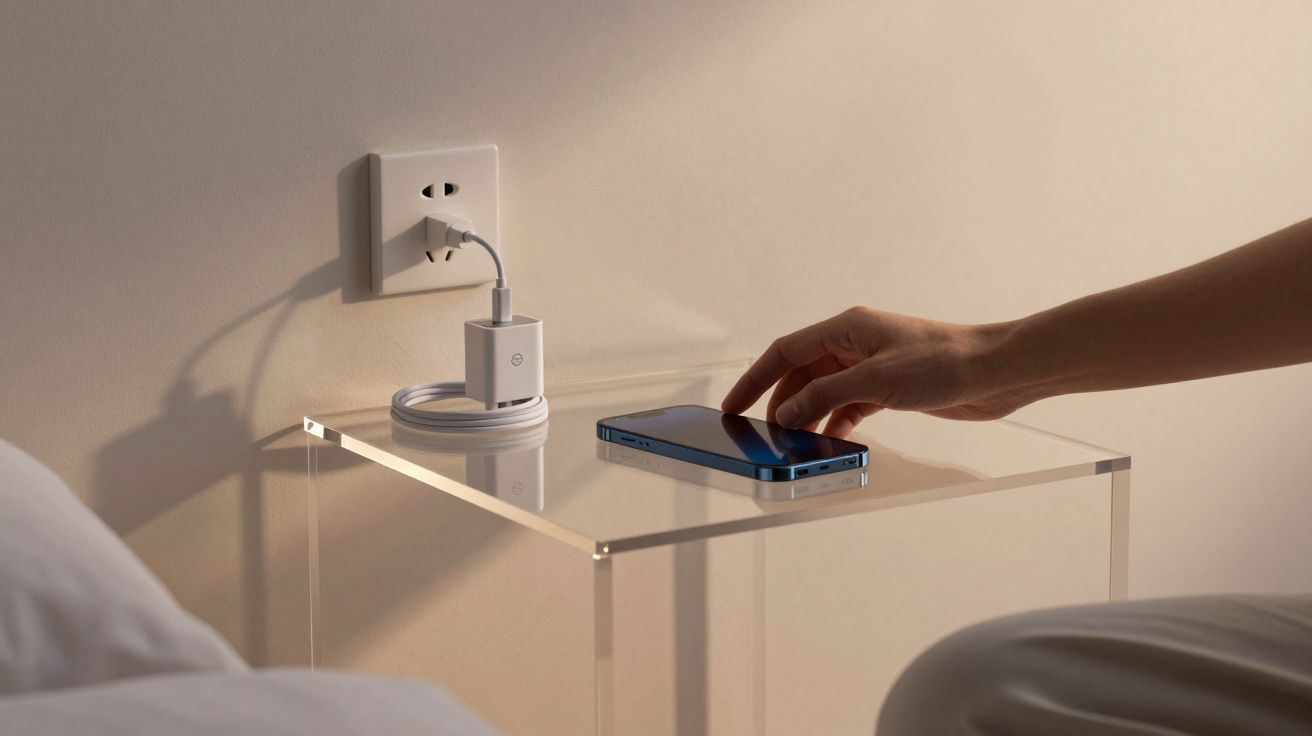
It starts the same way in millions of bedrooms. The lights are low, the room finally feels quiet, and you’re half‑propped on pillows scrolling “one last thing”. The battery bar slips into red, the cable appears almost by muscle memory, and the phone ends up charging right beside your pillow or somewhere in the folds of the duvet.
You know, somewhere “safe enough” until morning.
Firefighters see the same scene, but in reverse. Blackened mattress, melted cable, plastic fused into what used to be a bedside table. The pattern is so common that many brigades now repeat one line again and again: stop charging phones in bed. It sounds dramatic, almost fussy, until you look at what actually happens when a hot battery meets soft bedding at 3 a.m.
Your bed is for sleeping, not for charging. And there’s a much safer way to keep your phone close without turning your duvet into kindling.
Why charging on the bed is more dangerous than it looks
On the surface, it feels harmless. Phones are small, modern, smart. The charger is “only” a few watts. You’ve done it a hundred times and nothing caught fire. That familiarity is exactly why so many people underestimate the risk.
Lithium‑ion batteries hate two things: heat and pressure. Charging makes them warm by design. Put that warm device on a soft surface that wraps around it – mattress, duvet, pillow, teddy – and you trap the heat with nowhere to go. If there’s a fault in the cable, plug or battery, that trapped warmth can tip into overheating and, in the worst cases, a runaway reaction that ignites surrounding fabric.
It doesn’t have to start with an obvious bang. Many bedroom fires begin with a tiny hotspot where a cable is frayed, a cheap plug is arcing, or a phone is wedged under a pillow. The fabric chars, then smoulders, then flames. All while you’re deeply asleep, breathing in the very smoke that fills the room first.
Add a couple of other “normal” habits and the odds quietly shift further against you:
- Using very cheap or counterfeit chargers that don’t cut off safely if something goes wrong.
- Plugging multiple devices into one overloaded extension lead by the bed.
- Charging a phone that’s already damaged, swollen or has been dropped hard.
- Tucking the phone under the pillow so the light doesn’t bother you.
Each of those is manageable in a living room with hard floors and people awake. On a soft bed, in a small, closed bedroom at night, they become a different problem entirely.
What firefighters actually find after a bedroom fire
Ask any crew about “mobile phone fires” and you’ll hear the same sigh. The photos look almost identical, no matter the postcode.
There’s the scorched circle on the mattress where the phone was lying. A black line of melted cable leading back to a cheap adaptor or a crushed plug behind the bed. Soot staining the ceiling above where heat pooled first. Any soft toy or cushion nearby is usually unrecognisable. If the fire’s been caught early, it’s a near miss. If not, the whole room can be gutted in minutes.
Firefighters describe arriving at homes where:
- The alarm was raised by a neighbour because the occupants slept through the early stages.
- A teenager’s phone had been charging under a pillow all night.
- An extension lead behind the headboard was tangled with chargers, fairy lights and a fan.
- Smoke alarms had no battery or were in the hallway only, with bedroom doors left open.
One watch manager put it bluntly:
“We almost never see phones bursting into flames on a bare kitchen worktop. The serious ones are in bedrooms – on beds, on piles of clothes, or hidden under pillows where the heat can’t escape.”
The risk isn’t just fire. Dense toxic smoke from burning foam, plastics and synthetics can fill a bedroom in minutes. In a small space, it’s the smoke that knocks you out long before the flames reach you.
A safer bedside charging routine (the way brigades wish you would do it)
You don’t have to ditch your phone or sleep with it in another postcode. You just need to move the risky part – charging – off the bed and into a safer setup.
Think of it as your bedtime charging routine:
Pick a hard, clear surface
Use a bedside table, chest of drawers or shelf. The key is: hard, flat, and not stacked with laundry, papers or books. Keep the charger away from curtains and soft furnishings.Keep the bed itself a “no‑charge zone”
No phones, tablets, laptops or e‑cigs charging on the mattress, under pillows or on top of the duvet. If the cable won’t reach a hard surface, you don’t need a closer plug – you need a longer, good‑quality cable.Use proper, certified chargers
Stick to the charger that came with the device, or one from a reputable brand that’s properly certified for UK mains (look for the correct markings and a solid, fused UK plug). Avoid market‑stall bargains and unknown brands online.Don’t bury the charger or lead
Let the plug, adaptor and cable breathe. Don’t run the cable under rugs, cushions or the mattress. If you feel warmth building up, unplug and let everything cool.Charge earlier when you can
Top up in the evening while you’re still awake, in a living room or kitchen, then unplug before bed. Many modern phones can easily last a day on a single charge if you start near 80–100%.
For an extra layer of safety, fire brigades also recommend closing bedroom doors at night and making sure you’ve got working smoke alarms, ideally with one near bedrooms. A closed door can hold back smoke and heat long enough to wake you and get out.
Your 5‑step night‑time checklist
Try this simple list tonight. It takes under two minutes.
- Phone off the bed, onto a hard surface.
- Charger plugged directly into a wall socket, not an overloaded multi‑plug nest.
- Nothing covering the phone or charger – clear space around them.
- Bedroom door pulled to; landing / hallway smoke alarm tested regularly.
- Anything that shouldn’t stay on all night (candles, straighteners, heaters) turned off and unplugged.
Do that most nights and you’ve just removed several of the most common bedroom fire triggers in one go.
Small tech tweaks that make it easier
The safer routine sticks better if it’s convenient. A few quiet changes can mean you’re not relying on willpower at 11.45 p.m.
Modern phones already have features designed to avoid sitting at 100% charge for hours, which also happens to reduce heat:
- Optimised or adaptive charging (iPhone, Pixel, Samsung and others) slows the final part of the charge and times it to your alarm. Switch it on once in Settings.
- Charging limits on some Android phones cap the charge at around 80–85% for daily use. That creates less stress and less heat while still giving you a full day.
Pair these with some basic hardware choices:
- Use a longer, good‑quality cable so the phone can comfortably reach a table instead of the bed.
- Choose an extension lead with surge protection and an on/off switch, and avoid daisy‑chaining multiple adaptors together.
- If you like wireless charging, pick a solid, stable stand or pad on a hard surface, keep it dust‑free, and don’t stack books or fabrics over it.
If the phone or charger ever smells odd, feels very hot, shows signs of swelling, or the cable’s outer sheath is damaged, unplug it immediately and replace it. A “nearly fine” charger is not fine in a bedroom full of fabric.
Quick swaps that cut the risk
| Risky habit | Why it’s a problem | Safer swap |
|---|---|---|
| Phone charging on the bed or under a pillow | Traps heat, can ignite bedding if something faults | Phone on a hard bedside table, clear around it |
| Cheap, unbranded charger from a market or random website | Poor protection against faults and overheating | Manufacturer’s charger or reputable, certified brand |
| Extension lead hidden behind the bed, crammed with plugs | Overheats, hard to see damage, near lots of fabric | Single good‑quality extension you can see and reach easily |
FAQ:
- Is it ever safe to charge my phone overnight? Modern phones can safely manage overnight charging if you use a proper charger, keep the phone on a hard surface with space around it, and avoid covering it. Fire brigades mainly worry about what happens when faults meet soft bedding and sleeping people, not a lone phone on a bare table.
- How far from the bed should my phone be? As a rule, far enough that it isn’t touching the bed, pillows, duvet or curtains – and not able to slip onto them if it vibrates. A sturdy bedside table or a shelf by the bed is usually fine.
- Is wireless charging safer than a cable on the bed? Not if it’s still on the bed. Wireless pads and stands generate heat too, and they can also get buried in bedding. Used on a hard, clear surface with a proper plug, they’re generally safe.
- Can I sleep with a power bank in bed instead of plugging into the wall? A power bank still has a lithium‑ion battery that can overheat or get damaged. Keep it off the bed, don’t charge it under pillows, and avoid very cheap, high‑capacity banks from unknown brands.
- Are these fires really that common, or is this just scare‑mongering? While the absolute numbers are small compared with all fires, UK fire brigades repeatedly report incidents – and near misses – involving phones and chargers on beds, sofas and under pillows. The changes needed to avoid that risk are tiny, so it’s an easy win for safety.





Comments (0)
No comments yet. Be the first to comment!
Leave a Comment