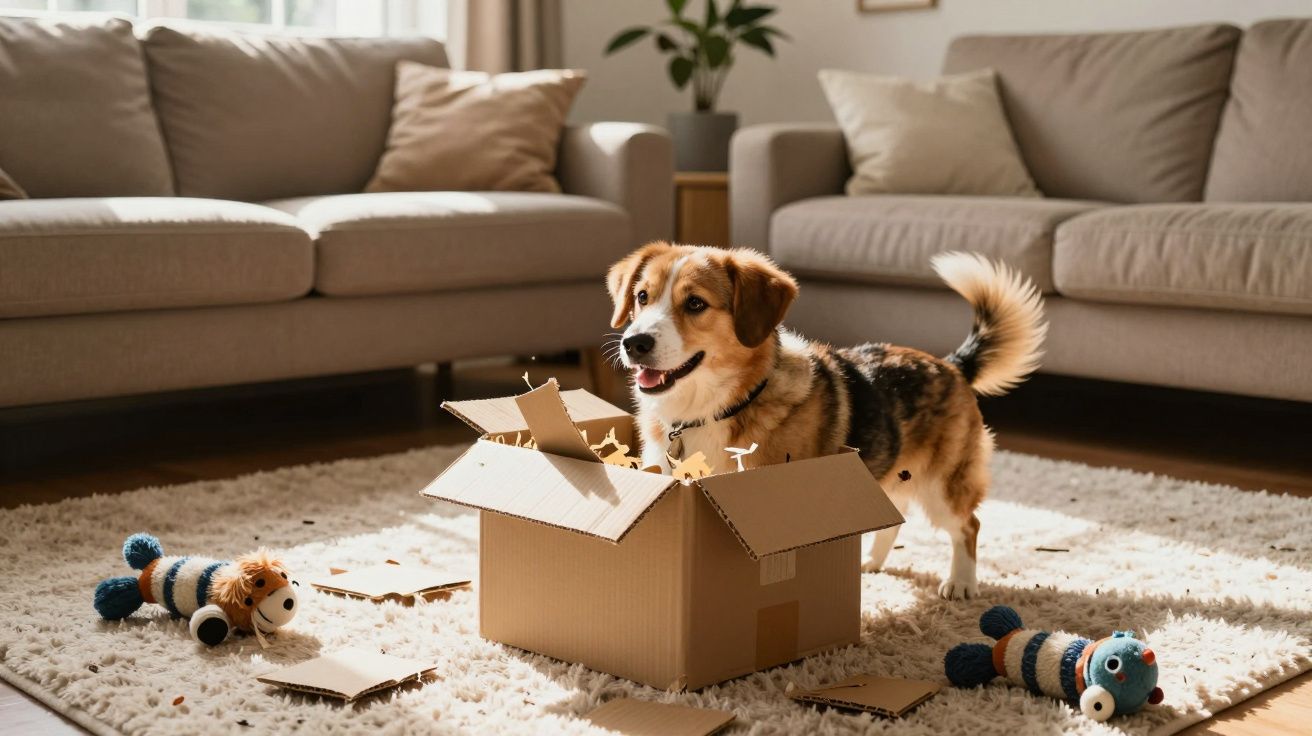
The box arrived with the usual fanfare: doorbell, footsteps, that soft thud on the mat. Inside was a carefully chosen enrichment toy – recycled rubber, pastel colours, a promise of “hours of mental stimulation” on the label. I sliced it open like it was a birthday. My dog sniffed it once, sneezed, and walked away.
Two minutes later he was back, not for the toy, but for the cardboard. The same boring delivery box I’d just pushed to one side. He pinned it with both paws, ripped a corner off with tremendous satisfaction, and settled into a focused, sighing shred. The £20 puzzle lay untouched in the middle of the floor, as decorative as a coffee-table book.
It’s tempting to think they’re being ungrateful or “naughty”, like toddlers ignoring the wooden train set to play with the packaging. But when I started talking to behaviourists about it, a different picture appeared. The cardboard wasn’t a snub to my shopping choices. It was information: about what my dog needed that day, and how close to the edge his stress levels were running.
We’ve all had that moment when you look at the confetti of ripped boxes and think, “Why do I bother buying toys?” Underneath the mess is a quiet story about control, coping strategies, and the small ways dogs let pressure out before it becomes a problem. The box, it turns out, is a barometer.
What cardboard gives your dog that fancy toys often don’t
At first glance, cardboard is the most boring object in the room. No squeak, no flashing light, no peanut-butter reservoir. But to a dog, a used delivery box is basically a sensory novel.
It smells of the courier’s van, the warehouse, the contents that were inside, and every hand that’s touched it. The fibres tear and crunch; the resistance changes as teeth sink in. It bends, it collapses, it fights back just enough. All of that feeds into the same ancient circuits that powered tearing fur and skin from prey, only now the “prey” is a recycled carton from your broadband upgrade.
Most shop-bought toys are built to survive, not surrender. They bounce back, squeak forever, and refuse to come apart. Great for our wallets. Less satisfying for a brain wired for the sequence of hunting: seek, stalk, chase, grab, dissect, eat, sleep. Cardboard lets them complete more of that sequence without harming anything living.
“Destruction isn’t always disobedience,” one canine behaviourist told me. “For many dogs, it’s decompression. Cardboard is safe, rippable, and doesn’t squeal or fight back. That makes it a perfect outlet when they’re wound up but trying to cope.”
Let’s be honest: no one really sets out to offer cardboard as enrichment. It just appears with life admin. But when you see what your dog chooses when you’re not performing “good owner” with the new toy, you get a clearer view of what genuinely helps them settle.
Stress, choice, and why the box often wins
Modern dogs live in a strange gap: bred for big jobs, asked to live small lives. Guarding, herding, retrieving, scent work – all shrunk down into two walks a day and a scattering of squeaky shapes on the rug. Most cope. Many carry a thin layer of tension we barely notice.
We’ve all had that dog who seems “fine” until the fireworks start, or the neighbour’s dog barks, or the broadband engineer stays a bit too long. Then the pacing, panting, or sudden clinginess kicks in. The stress doesn’t appear from nowhere; it accumulates. Shredding a box can be how your dog leaks some of it out in an acceptable way.
Cardboard has three advantages when your dog is mentally busy or a little frayed:
- It offers destruction with low stakes. They can finally win against something without anyone shouting.
- It gives choice and control. They decide when to start, how hard to rip, when to walk away.
- It’s self-directed. No human rules, no “sit”, “leave”, “drop” on repeat. Just dog and material.
When the expensive toy is ignored, it’s not always a product review. It’s often a signal: “Today I need to chew through something real, not solve a plastic puzzle under your supervision.”
Reading the mess: is your dog relaxed or overwhelmed?
A ripped box on its own doesn’t tell you much. The way your dog shreds, and what happens before and after, is where the clues sit. Two identical piles of cardboard can mean very different things.
Behaviourists suggest watching the whole scene like a silent film: body, face, breathing, rhythm. A dog who is simply enjoying themselves looks different from one trying to hold it together.
Cardboard fun vs cardboard coping
| What you see | Likely meaning | Your next step |
|---|---|---|
| Loose body, wiggly tail, soft eyes, pausing to sniff or carry bits around | Healthy play and exploration | Smile, supervise, recycle the remains |
| Fast, frantic ripping, stiff posture, hard eyes, ignoring you completely | Possible stress release or overload | Soften the environment, shorten demands, note what happened earlier |
| Regular shredding after specific events: postman, visitors, noisy school run | Patterned reaction to stress trigger | Adjust routine around those moments, add calm decompression time |
| Growling if you approach, swallowing chunks, can’t be interrupted | Red flag for resource guarding or high anxiety | Step back, swap for high-value treats, talk to a vet/behaviourist |
A few questions to ask yourself afterwards:
- Did they choose the box when the house was calm, or straight after something exciting or scary?
- Can you call them away easily, or do they lock on like they’re defending it?
- Do they settle for a proper rest afterwards, or go straight back to pacing, whining or scanning windows?
If the shredding is loose, goofy and short-lived, it’s probably just joy. If it’s intense, repetitive, and clustered around particular stressors, your dog may be using cardboard as a pressure valve – which is useful information for you, not a behaviour to punish.
When ignoring toys is a quiet cry for a different kind of play
That untouched enrichment toy can sting. It’s money, effort, and a small badge of “responsible owner” sitting there gathering dust. But boredom with new toys isn’t always a sign your dog is spoiled. Often it means the toy doesn’t match the job their nervous system is trying to do.
Some patterns behaviourists see again and again:
- Dogs who sniff half-heartedly at puzzles but burn through boxes after visitors leave.
- Dogs who refuse play fetch in busy parks yet joyfully shred loo-roll tubes at home.
- Dogs who ignore “brain games” when they’ve had a busy day, but love them on quiet afternoons.
The toy asks for focus, patience, sometimes even human guidance. The box simply says: “Do what you need.” For wired, tired or socially drained dogs, the second offer can feel safer.
“If a dog regularly picks destruction over interaction, I look at their week,” one vet behaviourist explained. “Too much pressure, too little choice, too many rules and not enough outlets often show up as so-called ‘naughty’ shredding.”
Instead of seeing the ignored toy as failure, use it as a prompt:
- Was today heavier on training, visitors, or noise than usual?
- Have walks been faster and more on-lead lately?
- Has anything changed in the house: new baby, workmen, decorating, illness?
Toys that require thinking are brilliant when a dog has capacity. Cardboard is brilliant when they don’t. Both have a place. The trick is matching the right thing to the right day.
How to turn box carnage into healthy decompression
You don’t have to choose between a toy graveyard and bare floors. With a few tweaks, you can let your dog indulge their inner shredder in a way that supports their stress levels instead of escalating them.
Think of it less as “spoiling” and more as hygiene: a mental shower after a mucky day.
- Designate “yes” cardboard. Keep a small stash of safe boxes and tubes (no staples, tape, string or glossy ink) in one spot. Offer from there, never straight off the counter or recycling pile, so the rules feel clearer.
- Pair it with sniffing, not just ripping. Scatter a handful of kibble or low-crumb treats inside and fold the flaps loosely. Let them nose, paw, then tear. This slows the pace and taps into foraging as well as destruction.
- Watch the clock. Many dogs get what they need from 5–10 minutes of intense shredding. If they start eating more than they destroy, gently swap for a chew or short scatter feed in the garden.
- Add a “that’ll do” cue. Teach a calm end to the game with a cue, a treat swap, and a different activity (lick mat, settle on bed). Over time, you’ll be able to lift the remaining box bits without a showdown.
We’ve all rolled our eyes at the chaos of wet cardboard footprints through the hallway. A small mat under the “shred station” and a cheap hand brush can turn it from war zone to five-minute tidy. Small rituals change how annoying a behaviour feels – and whether you let your dog keep the outlet that’s quietly keeping them sane.
When box-shredding is a clue to get extra help
Most box carnage is harmless, if untidy. But sometimes it points at something bigger: chronic stress, separation issues, pain, or unmet needs that a bit of cardboard can’t fix on its own.
Take a closer look – and consider speaking to your vet or a qualified behaviourist – if:
- The behaviour appears suddenly in an adult dog with no obvious trigger.
- They shred obsessively when alone but rarely when you’re home.
- They swallow large pieces, gag, or have tummy upsets afterwards.
- They guard cardboard fiercely, freezing or snapping when you approach.
- It’s joined by other signs: changes in eating, sleep, toileting, clinginess, or withdrawal.
Pain is an under-discussed part of this. A dog who can’t comfortably chase, tug or wrestle may default to solo, stationary destruction. Joint issues, dental pain or gut discomfort can all shift how they play. Any behaviour change deserves a medical check before it’s labelled “just stress”.
Think of the box as a symptom, not a diagnosis. It tells you something is going on; it doesn’t tell you what. Your job is to notice, not to panic.
Small shifts that make life softer for your dog
You don’t need a house full of enrichment gear to help your dog’s stress levels slide down a notch. Often it’s about adjusting the texture of the day rather than cramming in more activities.
A few small changes behaviourists routinely recommend:
- Slow the walks, lengthen the sniffs. Ten minutes of free sniffing on a quiet verge does more for nervous systems than a brisk loop of “come on” marching.
- Protect rest. Give them at least one chunk of undisturbed sleep during the day, away from front doors, windows and TVs.
- Loosen the schedule after stressful events. Visitors, vet trips, building work – these are “cardboard days”. Lower expectations, offer safe shredding or a stuffed kong, and let them decompress.
- Rotate, don’t pile. A tiny selection of toys out at once, swapped every few days, keeps interest higher and pressure lower than a constant flood of “new”.
“Dogs don’t need constant entertainment,” as one trainer put it. “They need permission to be dogs, plus a few outlets that match what their body is asking for that day.”
If the delivery box is getting more five-star reviews from your dog than the chew in your online basket, listen. They’re telling you, in the only language they have, how they manage the world you’ve put them in.
FAQ:
- Is it safe to let my dog shred cardboard? Plain, tape-free cardboard is usually fine in moderation, as long as your dog doesn’t swallow large amounts. Remove staples, labels, string and plastic first, supervise the session, and stop if they start eating more than tearing.
- Why does my dog only shred things when I’m out? That can be a sign of separation-related distress, boredom, or both. Film a short absence, talk to your vet to rule out medical issues, and consider a behaviourist to help build a gradual, kinder alone-time plan.
- Should I stop buying toys if my dog prefers boxes? Not necessarily. Rotate a few sturdy toys for calmer days and use cardboard for higher-stress times. Different outlets do different jobs; having both gives your dog more choice.
- How can I tell if shredding is making my dog more wound up? If they seem more agitated afterwards – pacing, whining, unable to rest – or their ripping gets faster and more frantic the longer it goes on, end the game gently and offer calmer activities like licking, slow sniffing, or a cosy rest spot.
- Can training stop destructive behaviour completely? Training can redirect and manage it, but the goal isn’t to erase the urge to chew and tear. It’s to give that urge safe, predictable outlets and reduce the stress that drives it, so your dog can relax more easily in the rest of their life.

Comments (0)
No comments yet. Be the first to comment!
Leave a Comment