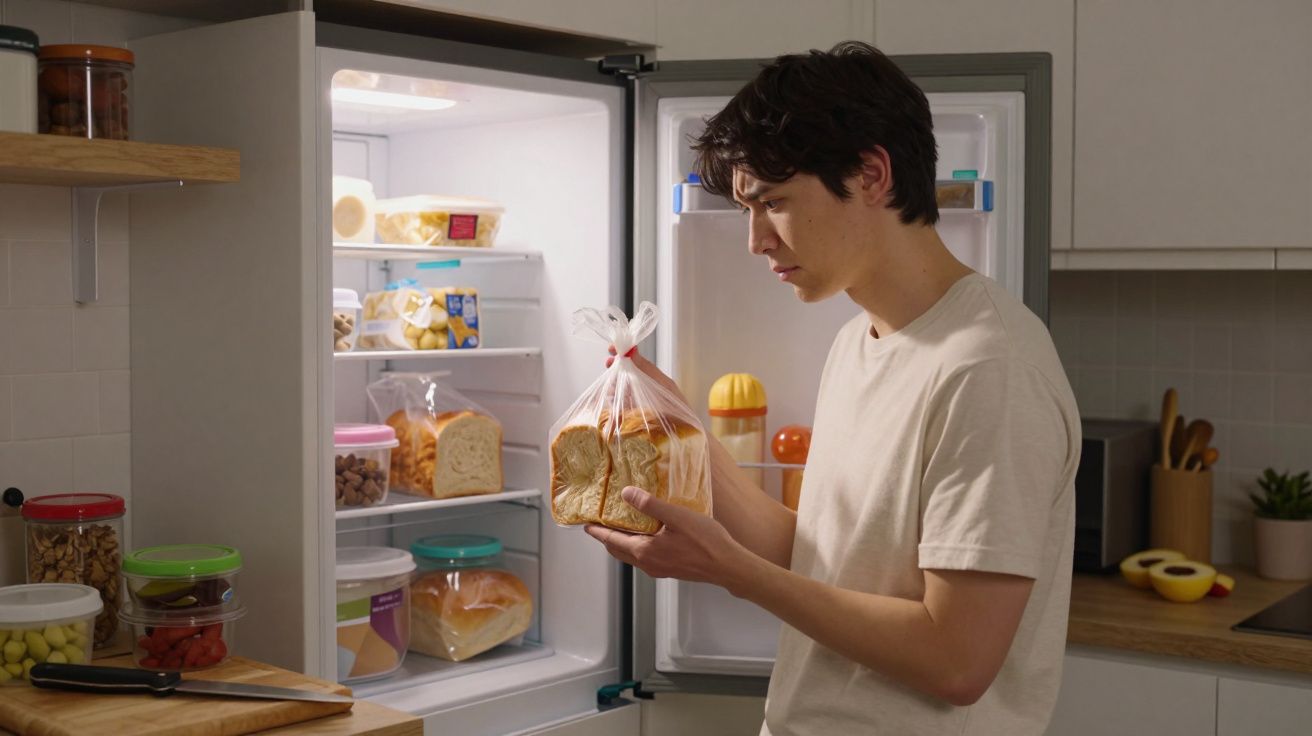
Saturday evening, you open the freezer hunting for an easy dinner. There’s half a beautiful sourdough in there from last weekend, wrapped “well enough” in the bag it came in. You picture thick slices, soft crumb, maybe some cheese melted on top. Then you actually touch it.
The crust feels like stone, the cut side is frosted white, and the inside looks oddly dry and crumbly, as if it has aged a month in seven days. You sigh, chip off a few slices anyway, and wonder – not for the first time – why the chicken breasts next to it look perfectly fine after three weeks, yet your bread seems to have spent a hard winter on a mountain.
Somewhere between “I’ll just chuck it in the freezer” and “Why has this turned into cardboard?” lies the real story: freezer burn, bread chemistry, and one very simple packaging trick that professional bakers quietly rely on.
Why bread “burns” in the freezer faster than meat
Freezer burn sounds dramatic, but it isn’t your freezer setting fire to anything. It’s a slow dehydration and oxidation process. Water in the food migrates to the coldest, driest part of the freezer, turns into ice crystals on the surface, and leaves what’s inside parched.
Bread is especially vulnerable because of its structure. All those air pockets that make it light and fluffy also give moisture an easy escape route. In a cold, constantly circulating airstream, water doesn’t just freeze and wait patiently. It sublimates: it goes from ice inside the bread straight into vapour, then re‑freezes on the outside as frost.
Meat, by contrast, is dense and compact. There are far fewer open pathways for water to run to the surface, and it’s often tightly vacuum‑packed or wrapped at the factory. The same process of moisture loss happens, but much more slowly and in a more protected environment.
With bread, especially sliced loaves and cut ends, there’s more exposed surface area and more open crumb. So the very qualities that make fresh bread lovely are exactly what make it dry out brutally fast in a badly packed freezer.
What freezer burn really does to bread (and why it feels “stale”)
The first sign is cosmetic: icy crystals, pale patches, maybe a slightly greyish tint on the crust. The real damage is inside. As moisture escapes, the crumb firms up and loses its suppleness. When you defrost it, it feels drier, crumblier and oddly chewy at the same time.
On top of that, bread is already going through its own ageing process from the moment it cools after baking. Starches slowly recrystallise – a process called retrogradation – making the texture firmer. Freezing slows this down but doesn’t stop it completely. If you freeze bread when it’s already a bit tired, you’re freezing in that staleness and then adding freezer burn on top.
That’s why yesterday’s baguette thrown into the freezer bare in its paper bag often comes out tasting like something rescued from the back of a cupboard. The cold hasn’t “saved” it; it has just paused it mid‑decline while quietly siphoning off what little moisture it had left.
Why your meat seems to survive for ages
The chicken that looks fine after a month isn’t magically immune. It just started out with a few advantages.
- Meat holds more water per gram than most bread, and that water is locked in by muscle fibres and fat.
- Factory packaging is usually thick, tight and low in air – closer to vacuum conditions – which slows down dehydration and oxidation dramatically.
- We tend to freeze meat as single solid pieces, not pre‑sliced with lots of exposed edges.
Bread, especially if it’s already sliced, is basically the opposite: relatively low moisture, high surface area, porous structure, and casual, loose packaging at home. So the same length of time in the same freezer produces very different results.
If you packed your bread as well as your butcher packs meat, it would hold up far better too. Which is where the double‑bagging trick comes in.
The double‑bagging trick bakers use
Professional bakers know that air is the enemy in the freezer. Not just for off‑flavours, but for texture. Their quiet solution is simple: a tight inner wrap plus a looser outer bag.
Here’s how to copy it at home:
Start with cool, fresh bread
Never freeze bread that is still warm; steam inside the bag will turn into ice and speed up freezer burn. Aim to freeze the same day it’s baked or bought, at its best.Slice before freezing (but keep pieces snug)
Slice the loaf or divide rolls so you can take out only what you need. Push the pieces back together into a “re‑formed” loaf so there are fewer exposed faces.Inner wrap: press something directly against the crumb
Use cling film, a thin freezer bag or even reusable silicone wrap. Press it gently but firmly against the whole surface of the bread – including cut ends – squeezing out as much air as possible. The goal is contact, not a balloon of cold air around it.Outer bag: insulation and extra barrier
Slip the wrapped bread into a second, thicker freezer bag. This outer layer doesn’t have to be vacuum‑tight; it’s there to add insulation and reduce temperature swings every time you open the freezer. Squeeze out most of the air and seal.Label and tuck it away from the door
Date it, then store it deeper inside the freezer, not in the door where temperatures fluctuate most. Less fluctuation = fewer cycles of moisture migration and ice crystal growth.
Done well, this double‑layer approach lets many loaves stay soft and usable for several weeks instead of just a few days before they take on that “freezer” taste.
Little habits that make a big difference
Once you understand that your freezer is basically a very dry wind tunnel, not a magic pause button, a few small changes become obvious.
Avoid paper for long‑term storage
Paper bags are great on the counter but terrible in the freezer. They breathe, which means they leak moisture. If you must use the bakery bag, treat it as your outer layer, not the only one.Freeze in realistic portions
Half loaves, bundles of 2–4 slices, or individual rolls wrapped together. Chunky portions defrost better than one giant frozen brick you keep hacking at.Don’t refreeze repeatedly
Every freeze–thaw cycle accelerates moisture loss and staling. If you think you’ll use it in stages, divide and wrap portions separately from the start.Reheat, don’t just defrost
A short burst in a hot oven (around 180–200°C for 5–10 minutes, depending on size) or a quick toast can revive the crumb far better than leaving bread to thaw at room temperature alone. Heat helps reverse some of the starch crystallisation and makes it taste fresher.Keep the freezer reasonably full
A fuller freezer holds a steadier temperature, which means fewer swings and less damage to delicate foods like bread.
At a glance: what helps bread survive the freezer
| Habit | What it does | Why it matters |
|---|---|---|
| Tight inner wrap | Reduces contact with dry freezer air | Slows dehydration and freezer burn |
| Second outer bag | Adds insulation, buffers temperature swings | Keeps texture softer for longer |
| Freezing while fresh | Catches bread before staling advances | Better texture when you defrost |
| Slicing then re‑assembling | Convenient portions, fewer exposed edges | Less surface area = less drying |
Between convenience and quality: choosing your own line
The point of freezing bread is to make life easier, not to create another kitchen perfection project. No one is carefully double‑wrapping every crust on a manic Tuesday night.
Think in terms of defaults. If you know that tossing a half‑eaten baguette into the freezer naked in its paper bag will almost certainly ruin it, you can decide more clearly: either you’ll eat it tomorrow, or you’ll take 60 extra seconds to wrap it properly and actually enjoy it next week.
Some days you’ll still just shove it in and hope for the best. Other days you’ll remember the rock‑hard sourdough you binned last month and reach for the second bag. Over time, those tiny choices are what separate “the freezer ruins bread” from “the freezer means we always have decent toast”.
FAQ:
- How long can bread last in the freezer if it’s double‑bagged?
Well‑wrapped bread usually keeps good eating quality for 3–4 weeks. Beyond that it may still be safe, but the texture and flavour start to fade.- Is a single thick freezer bag ever enough?
For short periods (up to a week or so), a good‑quality freezer bag with the air pressed out can be fine. For longer storage, an inner wrap in contact with the bread plus a second bag works noticeably better.- Can I freeze fresh bakery bread in the paper bag it came in?
Not on its own. Paper lets moisture escape and invites freezer burn. If you like, slip the paper bag inside a plastic one, squeezing out air, but don’t rely on paper as the only layer.- Does freezing bread change its nutritional value?
Not in any meaningful way for home storage times. The main changes are texture and flavour, not nutrients.- What’s the best way to defrost a whole loaf?
Take it from the freezer, keep it in its wrapping while it thaws at room temperature to stop moisture escaping, then refresh it in a hot oven for 5–10 minutes to restore the crust and soften the crumb.



Comments (0)
No comments yet. Be the first to comment!
Leave a Comment