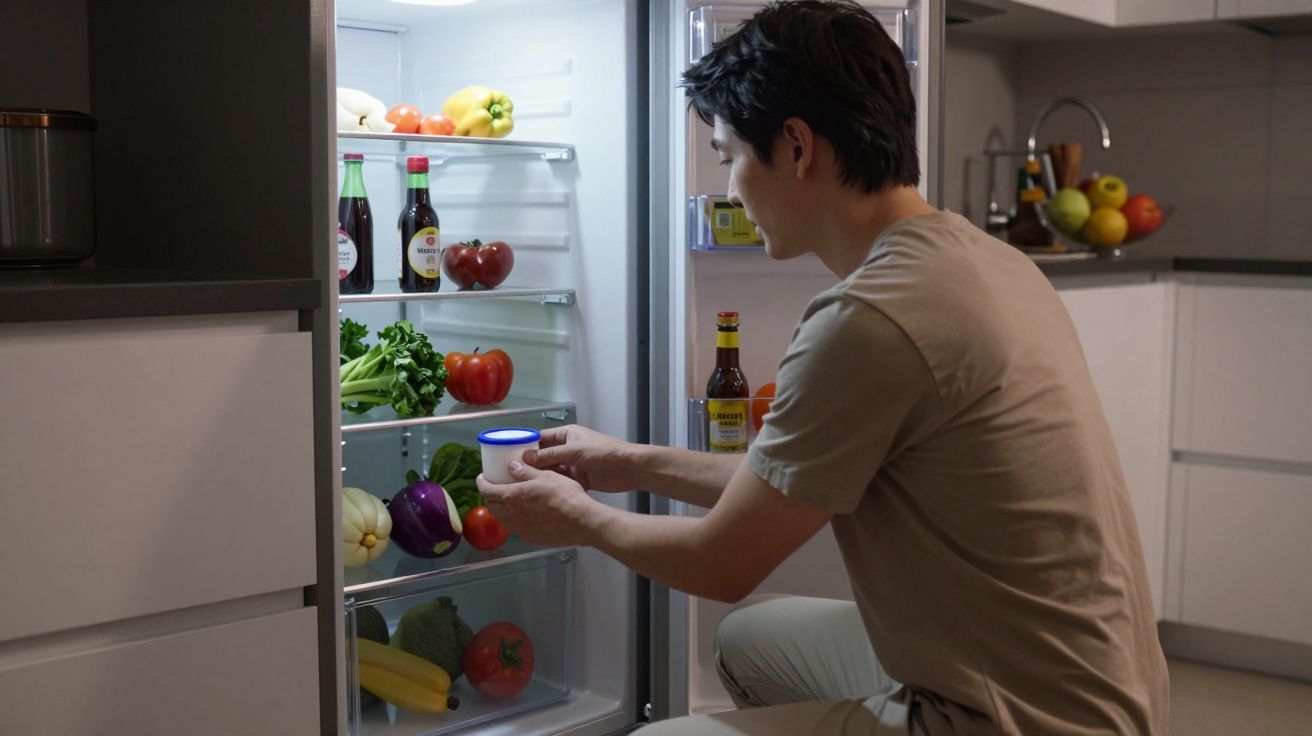
You take everything out, wipe each shelf until it squeaks, maybe even run a lemon around for good measure. The fridge looks immaculate, you shut the door with a little glow of satisfaction… and by the next morning, there it is again. That faint, sour whiff that hits you the moment the door opens. Not rotten, not fresh. Just… fridge.
I had that same baffling smell in a rental flat until a chef friend came over for dinner. He pulled open the fridge, sniffed once, and laughed. “You’ve cleaned the wrong bits,” he said, already pulling the drawers out. Ten minutes later the smell had gone, and he slid a tiny, unlabelled container onto the bottom shelf like it was a secret ingredient.
It wasn’t a scented product. No fancy filter. Just a plain little tub of powder I already had in the cupboard. Once you know how it works, you’ll never look at a “clean” fridge the same way again.
Why your fridge still smells after a deep clean
We tend to scrub what we can see: shelves, drawers, door balconies, the interior walls. Those surfaces matter, but they are not where most of the odour lives.
Smell in a fridge is rarely one big spill. It is layers. Tiny protein and fat residues, juice from vegetables, drips from meat packaging, yeast from jars, all drying in thin films you barely notice. They creep into seams, sit under the salad drawers and run into channels you never think to wipe.
Cold air slows bacteria, but it doesn’t freeze smells. Odour molecules cling to plastic, rubber and dried-on grime. Clean the obvious areas and the air smells better for a day or two, until the stuff you missed slowly re-perfumes the space. Soyons honnêtes : personne ne démonte vraiment son frigo chaque semaine.
Add one more twist: your nose adapts. You stop noticing a background smell you live with every day. Guests, on the other hand, notice it instantly.
The hidden culprits you probably missed
If a basic wipe-down hasn’t solved the smell, it’s almost always coming from one of these five spots.
1. The door seals and folds
Those soft rubber gaskets trap crumbs, juice and condensation. Mould loves the damp folds.
- Mix warm water with a splash of washing-up liquid and a little white vinegar.
- Wrap the cloth around a blunt butter knife or an old toothbrush and run it along every crease.
- Dry well afterwards so moisture doesn’t sit in the folds.
2. The drain hole and channel
Most fridges have a little drain at the back of the main compartment. Condensation and tiny spills run down into it.
Over time, that channel grows a slimy biofilm that smells far worse than it looks.
- Turn the fridge off at the socket.
- Use a cotton bud or pipe cleaner dipped in hot, soapy water to clean the hole and the channel leading to it.
- Rinse with a small syringe or squeezy bottle of hot water, then dry what you can reach.
3. The drip tray you never knew existed
At the bottom back of most fridges is a shallow plastic tray that sits over the warm compressor. Water from the drain collects there and gently evaporates.
If anything organic has made its way into that tray, you have a low, warm petri dish of smell.
- Pull the fridge away from the wall.
- Look for a removable tray near the bottom rear and slide it out.
- Wash it with hot, soapy water, add a splash of vinegar, rinse and dry fully before replacing.
4. Undersides, rails and runners
Spills often run under glass shelves, into metal rails or along drawer runners.
Remove each shelf and drawer completely if you can. Wipe:
- The underside of the shelf.
- The lip around the edge where glass meets plastic.
- The runners and the grooves the drawers slide into.
5. The plastic itself
Very strong smells (fish, blue cheese, garlic, curry) can slowly migrate into cheap plastic and gaskets. Once the source is gone, a faint echo remains.
You can’t un-make the plastic, but you can stop those odour molecules floating back into the air – and that’s where the tiny container comes in.
The small container trick chefs use on the bottom shelf
Commercial kitchens cannot afford fridges that smell questionable. So chefs do two things: they clean the right places, and they quietly run a passive odour trap inside the fridge all the time.
That “secret” tub on the bottom shelf is almost always:
- Bicarbonate of soda (baking soda),
or - Activated charcoal granules,
or a mix of the two.
They are not perfumes. They are silent sponges for smell.
Bicarbonate of soda helps neutralise acidic odours and some basic ones. Activated charcoal has a huge internal surface area – think of it as microscopic pores – that physically adsorb (not absorb) smell molecules from the air.
How to set it up
You do not need anything fancy. You do need the container to be:
- Small and shallow.
- Open to the air.
- Stable so it won’t tip.
Basic version (bicarbonate only):
- Take a clean ramekin, jam jar lid or very small, shallow container.
- Pour in 2–3 tablespoons of bicarbonate of soda.
- Place it on the bottom shelf or in the bottom door balcony, away from obvious spills.
- Replace the powder every 4–6 weeks, or sooner if you’ve had a major odour event.
Stronger version (bicarb + charcoal):
- Mix 1–2 tablespoons of bicarbonate of soda with 1–2 tablespoons of activated charcoal granules.
- Use a small, open container. If you’re worried about spills, line it with a paper filter.
- Tuck it on the bottom shelf near the back, where air circulates but it won’t be knocked.
Chefs favour the bottom shelf because heavier, cooler air sits lower. Odour molecules pass over the powder repeatedly as the fridge cycles, and the container keeps working quietly in the background.
“You don’t want a fridge that smells of lemons,” one pastry chef told me. “You want a fridge that smells of nothing at all. Charcoal does that better than any spray.”
What about coffee grounds and sliced lemons?
They can help temporarily, and they smell pleasant, but they are really masking odours more than removing them. Used coffee grounds also mould quickly in a cold, damp space.
As a short-term rescue after a power cut or a forgotten chicken, they’re fine. For everyday, the dry, unscented powders win.
A 20‑minute reset routine that actually works
Once you’ve done one deeper clean (including the hidden bits), this is the simple rhythm that keeps smells from building up again.
- Unplug first if you’ll be working near electrics or the drain.
- Remove food from one section at a time so nothing sits out long.
- Wipe shelves and walls with:
- Warm water,
- A tiny squeeze of washing-up liquid,
- A splash of white vinegar.
- Clean:
- Door seals,
- Drain hole,
- Drawer runners, every second or third reset rather than weekly.
- Dry surfaces with a clean tea towel or microfibre cloth.
- Put your tiny container of bicarb/charcoal on the bottom shelf.
- Return food, checking dates and wiping sticky jars as you go.
- Close the door and let the fridge settle for an hour.
The next time you open it, breathe in. Nothing is the result you’re after.
Common trip‑ups
- Using strongly scented sprays: they mix with food smells and create a new, stranger odour.
- Leaving uncovered leftovers: exposed surfaces dry and smell faster.
- Overfilling the fridge: air cannot circulate, cold spots and warm pockets form, and small spills stay wet and smelly.
Keeping smells away without turning cleaning into a second job
The goal is not a showroom fridge. It is a working fridge that never gets truly whiffy.
Focus on three low‑effort habits:
Contain strong smells well
- Use lidded glass or good‑quality plastic for onions, cheese, fish, curries.
- Wrap pungent cheeses in baking paper, then in a box.
Let the fridge do its job
- Keep it at 3–5°C.
- Do not stuff it so full that air vents are blocked.
Adopt a tiny weekly ritual
- Choose one day.
- Toss anything clearly past its best.
- Wipe one shelf and the door seals with a damp cloth.
- Stir or top up your bicarb/charcoal container once a month.
Over time, even older plastics hold onto far less smell because there is less new odour to replace what the powders remove.
Typical culprits and quick fixes
| Smell source | Clue you’ll notice | Fastest useful step |
|---|---|---|
| Drip tray / drain slime | Whiff even after interior looks clean | Clean drain + wash drip tray |
| Door seals mould | Dark specks in folds | Scrub with soapy vinegar water |
| Exposed strong foods | Smell spikes after opening packets | Repack in lidded containers |
FAQ:
- Is bicarbonate of soda the same as baking powder?
No. Baking powder contains bicarbonate plus acids and starch. For odour control you want plain bicarbonate of soda (sometimes labelled baking soda), not raising mix.- How often should I change the powder or charcoal?
Every 4–6 weeks in a typical household fridge, or sooner after a strong odour incident. If you notice smells returning, that’s your cue.- Can I just sprinkle bicarb directly on shelves?
It’s better not to. It can get damp, cake on and be hard to clean. Keep it in a small open container so it’s effective but contained.- Is activated charcoal safe to keep near food?
Yes, as long as it is food‑grade and kept in a secure open tub. Do not let it spill into food, as it can affect the taste and colour of delicate items.- What if my fridge still smells after all this?
Check for a hidden spill (behind the back panel, under a liner), inspect the drip tray carefully, and make sure the temperature is cold enough. If there’s a persistent, odd odour and the motor runs hot or loudly, call a technician: failing components can overheat and produce unfamiliar smells.


Comments (0)
No comments yet. Be the first to comment!
Leave a Comment