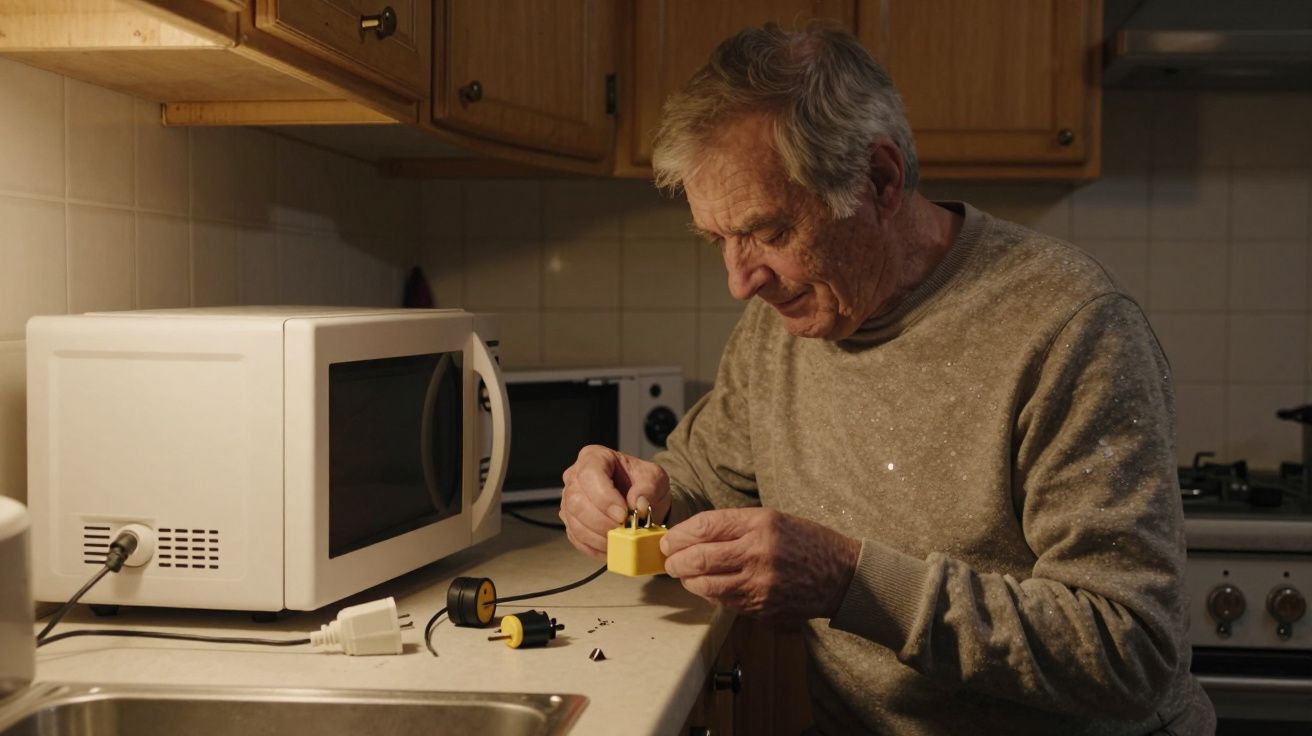
The first sign is usually not drama, just inconvenience. You tap the microwave door, hit “Start”, walk away to grab cutlery – and the kitchen goes dead with a crisp click from the cupboard under the stairs.
The display fades, the fridge stops humming, and you do that automatic walk to the fuse box, half‑annoyed, half‑worried you’ve just broken something expensive. Flick the switch back on, reheat the plate, hope it was a blip.
For one reader in his 50s, it wasn’t. His microwave tripped the fuse box three evenings in a row. He called an electrician, bracing for new wiring or a dead appliance. The electrician looked once, unplugged a cheap, yellowing adaptor, changed a tiny fuse, and said: “There’s your problem.” Parts cost: under a fiver. Call‑out: a lot more.
You don’t have to wait for that bill to find out if your problem is similar.
What’s really happening when the microwave “kills” the power
When people say the microwave “blows the fuse”, they usually mean one of two things:
- A breaker or RCD in the consumer unit (fuse box) has tripped.
- The 13A fuse in the plug has blown and the microwave is now dead.
Both are safety reactions, not random failures. Microwaves draw a lot of current, especially the split second they start. If something in the chain – plug, adaptor, socket, wiring, or the microwave itself – is weak or faulty, that surge is often what finally exposes it.
The good news: very often, the wiring in the walls is fine. The weak link is something cheap and replaceable that sits between the socket and the appliance.
The quiet rule big appliances don’t forgive
Microwaves, kettles and toasters all have the same simple rule: they want a solid, good‑quality connection to a proper wall socket.
What they do not like:
- Wobbly “cube” adaptors.
- Long, thin, bargain‑bin extension leads.
- Overloaded four‑gangs with half the kitchen plugged in.
Those little blocks are convenient, but they run hot under heavy load. Over time, contacts loosen, plastic discolours, and resistance builds. That extra resistance turns into heat, and heat turns into nuisance trips – or worse.
Electricians see it constantly: the “faulty” appliance is fine when plugged straight into a sound socket. The failing bit is the £3 adaptor that’s been quietly cooking itself for years.
The three common reasons your microwave trips the fuse box
You don’t need to be an engineer to understand the usual suspects. They mostly boil down to overload, damage, or internal fault.
1. Too much on one circuit
Typical pattern: microwave trips the breaker only when something else is on – the kettle, toaster, air fryer or tumble dryer.
What’s going on:
- Your microwave might draw 1,200–2,000W.
- Add a 3,000W kettle and a toaster on the same ring, and you’re nudging the breaker’s limit.
- The “Start” surge is the last straw and the breaker trips to protect the wiring.
Clue: if you stagger the use of other appliances and the trip disappears, you’re probably looking at simple overload, not a dangerous fault.
2. Tired plug, adaptor or socket
Here you’ll often see or smell evidence:
- Brown scorch marks around a socket or adaptor.
- A plug that feels hot to the touch after use.
- A crackling or buzzing noise when the microwave runs.
Loose contacts create tiny arcs of electricity and heat. The current spike when the microwave starts can make a worn connection spark just enough to nudge an RCD or breaker.
This is where the £5 fix usually lives: in a cheap adaptor, a tired extension lead, or a damaged plug top.
3. A fault inside the microwave itself
Sometimes the microwave really is on its way out:
- It trips the breaker every single time, even on its own, in a different socket.
- You see sparks inside, smell burning, or hear sharp crackling.
- It trips the RCD the instant you press “Start”, not a few seconds later.
Internal faults can include:
- Moisture or food residue causing arcing.
- A failing door switch or interlock.
- A breakdown in insulation inside the high‑voltage section.
Once you’ve ruled out plugs, adaptors and sockets, this is when to stop experimenting and either have it professionally checked or replace it.
The £5 fix many electricians try before anything else
Before anyone starts talking about rewiring or condemning the appliance, a good electrician will quietly eliminate the cheapest, weakest components in the chain.
In most kitchens, that means:
- Removing any multi‑way adaptors or old extension leads and plugging the microwave directly into the wall.
- Fitting a new, good‑quality plug and 13A fuse if the existing plug looks tired, scorched or loose.
- Swapping out a worn double socket front if the contacts are clearly heat‑damaged.
The parts for that are typically under £5:
- A branded 13A plug: ~£2–£3.
- A pack of 13A plug fuses: ~£1–£2.
- A basic replacement socket front: often under a fiver.
The labour and the call‑out are what cost – not the hardware.
At home, without opening anything up, you can safely copy the first half of that thought process: get rid of the weak links you can see and replace them with one solid connection.
If your microwave is on a cheap adaptor or overloaded extension, the first £5 you should spend is on a decent trailing socket or, better still, using a dedicated wall socket.
How to troubleshoot safely before calling an electrician
You don’t need tools for these checks, just patience and the ability to leave the consumer unit alone.
Unplug everything.
Turn the affected breaker back on with the microwave unplugged. If it still trips immediately, stop there and call a professional – the issue may be in the wiring, not the appliance.Inspect the plug and lead.
Look for nicks in the cable, bent pins, cracked plastic or heat discolouration. If the plug is damaged and not moulded on, have the plug replaced with a good‑quality 13A one and a fresh fuse.Bin the cheap adaptor.
If your microwave is plugged into:- a cube adaptor,
- a very old or flimsy extension, or
- a 4‑way strip already full of other big appliances,
take it out of the equation. Plug the microwave directly into a wall socket, on its own.
- a cube adaptor,
Try a different socket on another circuit.
If you can, use a socket on a completely different breaker (for example, a socket in another room via a heavy‑duty extension just for a quick test).- If it runs fine there: the original circuit may be overloaded or the original socket is tired.
- If it still trips: it’s likely the microwave itself.
- If it runs fine there: the original circuit may be overloaded or the original socket is tired.
Note exactly when it trips.
- Immediately, as you press “Start”: often a fault or an earth leakage issue.
- After 5–10 seconds, only with other appliances on: more likely overload.
- Immediately, as you press “Start”: often a fault or an earth leakage issue.
If at any point you see scorch marks, melted plastic, or smell burning, stop using the microwave or that socket at once and get it checked.
Quick reference: symptoms and likely culprits
| Symptom | Likely cause | First thing to try |
|---|---|---|
| Trips only when kettle/toaster also on | Circuit overload | Use microwave alone on that circuit |
| Trips even on its own adaptor/extension | Weak adaptor or plug | Plug directly into wall, replace lead |
| Socket/plug is hot or discoloured | Loose or damaged contacts | Stop using, replace plug/adaptor, call electrician if socket is affected |
| Trips instantly on “Start” in any socket | Internal microwave fault or earth leak | Stop using, repair or replace |
| Plug fuse keeps blowing but house breaker is fine | Undersized or tired plug fuse | Fit a fresh 13A fuse of correct rating |
When not to DIY
There’s a clear line between sensible checks and risky tinkering.
Call an electrician – and stop using the microwave – if:
- The consumer unit trips even with the microwave unplugged.
- The socket front is cracked, melted or smells burnt.
- You hear buzzing or see arcing at the socket when you plug in.
- The microwave trips an RCD instantly in more than one property or circuit.
- You’re not confident working with plugs, fuses or basic electrics.
Replacing a £5 adaptor or plug is fair game for many people. Opening a consumer unit, taking a socket off the wall or poking inside a microwave is not.
How to avoid repeat trips in future
Once you’ve solved today’s blackout, a few small habits will stop it returning.
- Give the microwave its own socket wherever possible. Avoid running it through daisy‑chained adaptors.
- Keep the inside clean and dry. Spilled sauce, foil, or a chipped plate can all encourage internal arcing.
- Spread out heavy loads. Don’t run kettle, toaster and microwave together on the same pair of sockets if you can help it.
- Buy decent accessories. A branded 13A extension rated for high loads is cheaper than a call‑out, and a lot safer than a wobbly cube.
The fuse box tripping is your house doing you a favour, not trying to ruin your dinner. If you start with the small, cheap links in the chain – the things an electrician quietly swaps for a few pounds – you’ll often fix the problem long before anyone needs to touch the wiring in your walls.
FAQ:
- Is it safe to keep resetting the breaker every time it trips?
No. A one‑off trip can be a fluke, but repeated tripping is the system telling you something’s wrong. Find and fix the cause rather than treating the breaker like a stubborn switch.- Can I replace the plug on a moulded‑plug microwave lead?
Not safely, no. If the moulded plug is damaged, the usual advice is to have the whole lead replaced by a professional or to replace the appliance.- Does a surge‑protected extension help with microwave trips?
Surge protection won’t fix an overload or a bad connection. A good, heavy‑duty extension can be safer than a flimsy one, but the best option is still a direct plug into a sound wall socket.- My microwave works fine but the lights dim when it starts – is that normal?
A slight dip in brightness on the same circuit can be normal with high‑load appliances. If lights flicker badly, or other devices reset, have an electrician check for loose connections or borderline wiring.- Is it worth repairing a microwave that keeps tripping the RCD?
If it’s fairly new or expensive, a repair might make sense. For older budget models, the cost of diagnosis and parts often approaches the price of a new, safer unit. A qualified engineer can advise once they’ve tested it.





Comments (0)
No comments yet. Be the first to comment!
Leave a Comment